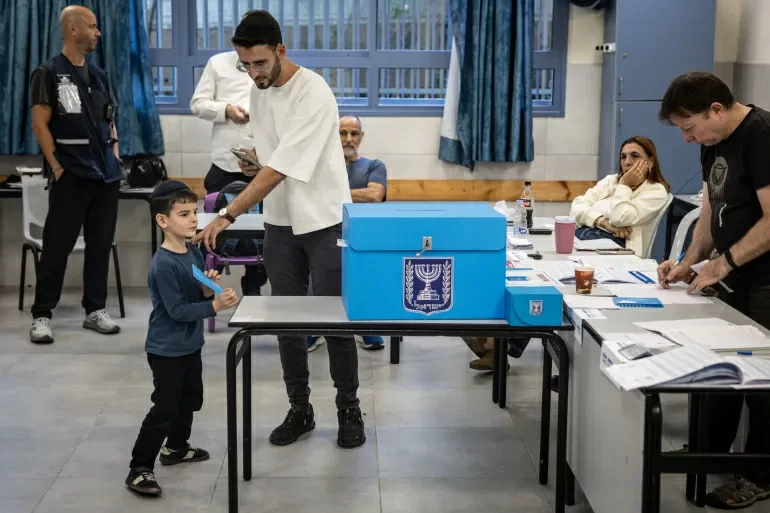
On October 27, 2026, Israeli voters headed to polling stations across the country, including a widely documented scene in Bnei Brak near Tel Aviv where a father guided his son to cast a ballot, as captured in Getty Images footage. Initial exit polls from Israel’s top three major broadcasters — Kan 11, Channel 12, and Channel 13 — indicate no outright decisive winner has emerged in the national parliamentary race for seats in the 120-member Knesset.
Preliminary projections show the centrist-left opposition coalition led by former Israel Defense Forces chief of staff Gadi Eisenkot is poised to secure 52 to 53 seats, while incumbent Prime Minister Benjamin Netanyahu’s long-ruling right-wing governing bloc is estimated to take 50 seats. The collective slate of Arab-majority political parties is projected to win 17 to 18 seats, a strong showing that positions the faction as a critical kingmaker in the coming coalition building process. To form a functional governing majority, a coalition must command a minimum of 61 seats in the Knesset, a threshold neither of the two dominant blocs can reach on their own with current projected numbers.
Notably, Netanyahu’s Likud party remains the single largest individual political party in the projections, with 24 to 25 seats, outperforming Eisenkot’s Yashar party which is estimated to win 21 to 23 seats. This marks a surprising reversal of pre-election public opinion surveys, which had consistently placed Eisenkot’s party narrowly ahead of Likud in the weeks leading up to polling day.
Eisenkot framed the early exit poll data as a clear public rejection of Netanyahu’s leadership, stating the results reflected widespread loss of confidence in the prime minister and his administration. For his part, Israel’s Foreign Minister pushed back against premature celebration from opposition ranks, warning that final vote counts could shift the balance of power significantly. Officials emphasize that exit polls are statistical estimates, not official verified results, and final seat allocations may still shift as all physical ballots are processed.
Voter turnout reached a historic high for recent Israeli elections, with 74.3% of the nation’s more than 7 million eligible voters having cast their ballots by 8 p.m. local time, according to data from the Israeli Central Elections Commission. This marks a notable rise from the 70.63% turnout recorded in the country’s 2022 general election. The elections commission also rejected a last-minute petition from Likud to extend polling hours, with all voting stations closing promptly at 10 p.m. local time as scheduled.
The strong performance of Arab political parties introduces a new layer of complexity to coalition negotiations, as their combined 17 to 18 projected seats would theoretically be enough to push Eisenkot’s opposition bloc over the 61-seat majority threshold. However, long-standing political reluctance from both major Jewish-led political blocs to enter formal governing partnerships with Arab party factions means this path is far from guaranteed. Smaller, unaligned political parties that do not fall firmly within either of the two main blocs will also hold disproportionate sway over the final shape of the next government.
If neither Eisenkot nor Netanyahu can cobble together a viable 61-seat coalition in the coming weeks, Israel could face the prospect of yet another round of snap national elections, reviving the era of prolonged political deadlock the country experienced between 2019 and 2022, when five separate national votes were held over a three-and-a-half year period without a stable long-term government being formed.
This 2026 election marks the first national Israeli ballot held in the aftermath of the October 7, 2023 Hamas attack and the subsequent Israeli military campaign in Gaza, which has dominated public discourse, deepened social divisions across Israeli society, and become the central defining issue of the electoral campaign. The vote has been framed by analysts as a national referendum on Netanyahu’s handling of the security crisis, his wartime leadership, and the long-term trajectory of Israeli policy amid ongoing regional conflicts. Official final election results are scheduled to be formally released by the Central Elections Commission on November 4, after which President Isaac Herzog will formally task the party leader most likely to form a stable coalition with the mandate to begin formal government building negotiations.