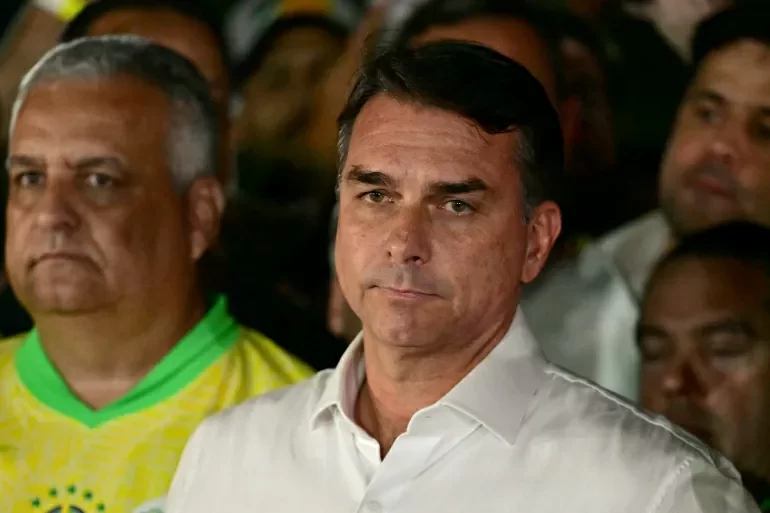
On October 27, local Brazilian time, the ruling Liberal Party (PL) — the political organization aligned with defeated right-wing senatorial presidential hopeful Flávio Bolsonaro — formally acknowledged the official election result that confirmed incumbent president Luiz Inácio Lula da Silva’s re-election victory in the October 25 second-round runoff. The landmark announcement, delivered by PL national chair Valdemar Costa Neto on Monday, marked a sharp departure from the party’s earlier stance that mirrored Flávio Bolsonaro’s initial refusal to concede his electoral loss, though party leaders emphasized they still demand a full, transparent review of lingering procedural concerns raised during the post-vote period. Final official tallies from Brazil’s independent electoral authority show Lula secured roughly 64.26 million valid ballots, accounting for 51.79% of all counted votes, while Flávio Bolsonaro earned approximately 59.83 million votes, making up 48.21% of the total, creating a decisive 4.4 million vote margin for the incumbent. Prior to the PL’s formal recognition, Flávio Bolsonaro’s campaign team had threatened sweeping legal action to invalidate the entire election result, later adjusting their demands to push for the annulment of Lula’s win over unsubstantiated claims that the incumbent had abused state political and economic power to sway voters. The core procedural grievance raised by Bolsonaro’s camp centers on a two-hour extension of polling station closing times across the country on election day, a measure authorized by Brazil’s Supreme Federal Court that pushed standard closing hours from 17:00 local time to 19:00. Bolsonaro’s legal team argued the last-minute rule change disadvantaged his conservative base, pointing to severe flooding across southern Brazilian states that created travel barriers for his supporters, and additionally noting that the judge who approved the extension, Cristiano Zanin, had previously served as Lula’s personal defense attorney before being appointed to the Supreme Court by the sitting president in 2023. What the campaign omitted, however, is that both the Bolsonaro and Lula teams had formally submitted requests for the polling hour extension, albeit for different justifications: Lula’s campaign pushed for extra time to ensure low-income urban voters facing public transit restrictions could cast their ballots, while Bolsonaro’s team sought the extension explicitly to accommodate voters stranded by the southern regional floods. Independent analysis from Pedro Burgos, a leading political science professor at Brazil’s renowned Insper higher education institute, further undermines the unsubstantiated fraud claims: Burgos calculated that only around 35,000 extra votes were cast during the two extended polling hours, representing less than 0.03% of the total national vote share, a number far too small to close Lula’s 4.4 million-vote lead. The post-election dispute drew international attention when former U.S. President Donald Trump told reporters on Monday that he believed the Brazilian election appeared to be “another rigged electoral process,” offering no tangible evidence to back up his assertion, while simultaneously claiming he had not taken sides in the Brazilian electoral contest. Though Trump’s comments provided rhetorical support for Bolsonaro’s unsubstantiated challenges, the former U.S. president did not announce any concrete policy or diplomatic measures to intervene on behalf of the defeated right-wing candidate. Brazilian Vice President Geraldo Alckmin swiftly dismissed Trump’s remarks as entirely baseless and unfounded. Parallel to the electoral dispute, Flávio Bolsonaro faces separate mounting legal pressure: Brazil’s Federal Police ordered the senator to surrender his passports this week, a measure linked to an ongoing Supreme Federal Court-ordered criminal investigation into alleged corruption and money laundering tied to the financing of a documentary titled *Dark Horse*, a biographical film centered on his father, former far-right president Jair Bolsonaro. Flávio Bolsonaro has publicly stated he will comply with the passport seizure order, has no intention of fleeing the country, and plans to mount a vigorous legal defense against the allegations, which have not resulted in any formal conviction to date. He has also announced his intention to lead the national conservative opposition bloc moving forward, as he seeks to preserve his political career in the wake of his presidential election defeat. The initial refusal by Flávio Bolsonaro to concede the election result has drawn widespread comparisons to the turbulent 2022 Brazilian presidential election, when his father Jair Bolsonaro refused to accept his loss to Lula for months, inciting a violent insurrection attempt by his supporters to block the peaceful transfer of executive power. The former president was later sentenced to 27 years in federal prison for his central role in the 2022 anti-democratic plot, and is additionally barred from holding any public elected office for an 8-year period. The Bolsonaro family has repeatedly denounced all legal proceedings against the former president as politically motivated persecution.