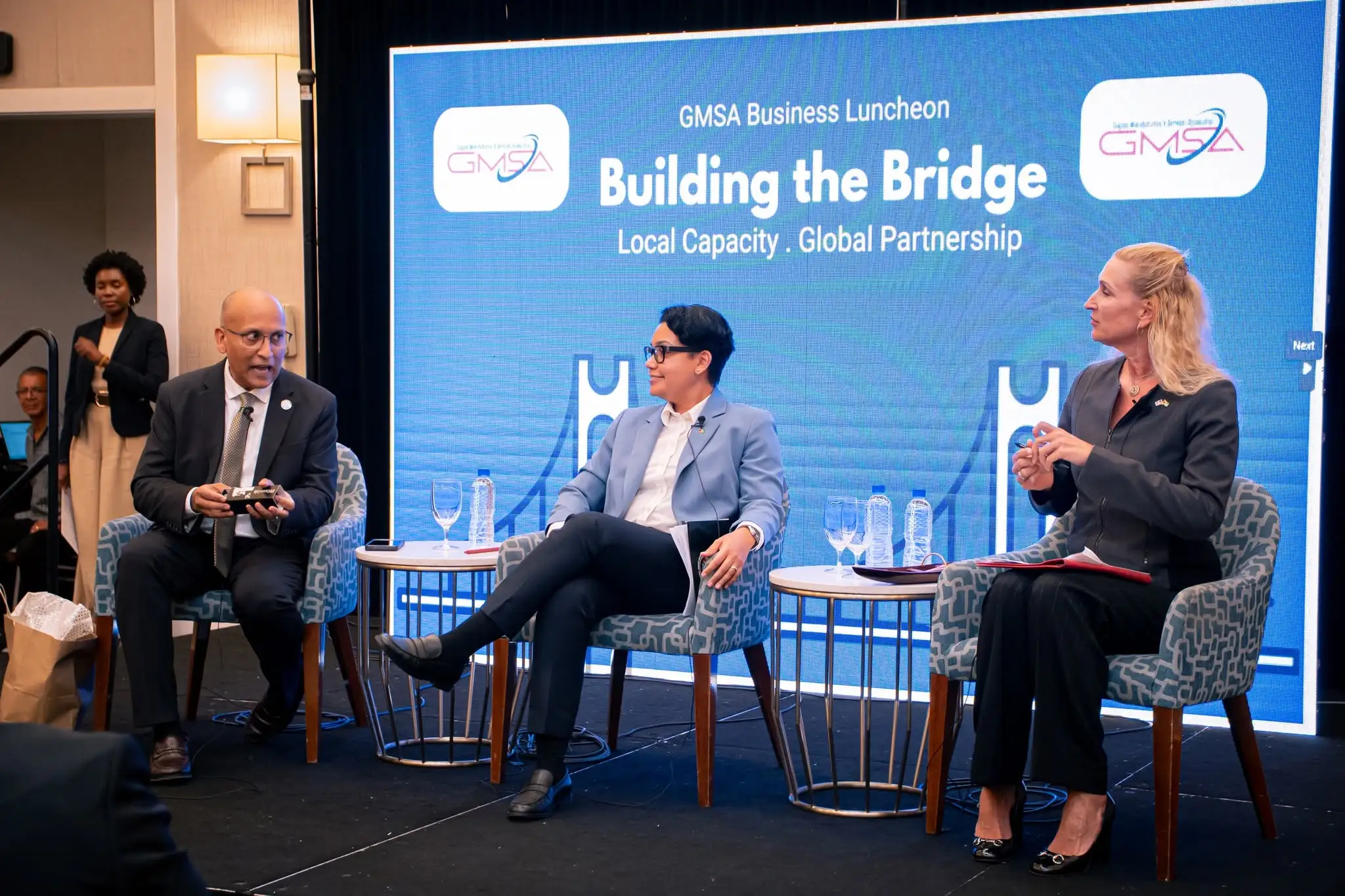
Against the backdrop of Guyana’s rapidly expanding economy, fueled by a booming oil sector and growing interest from international investors, top government officials and U.S. diplomatic representatives gathered at a recent Guyana Manufacturing and Services Association (GMSA) business luncheon themed “Building The Bridge- Local Capacity, Global Partnership” to chart a path for mutually beneficial cross-border commercial collaboration.
U.S. Ambassador to Guyana Nicole Theriot opened her address by noting that her embassy has been flooded with inquiries from American firms eager to enter the Guyanese market, drawn by the country’s promising investment landscape that has already attracted major U.S. commitments in oil and gas, food franchises, branded hospitality, and offshore shorebase operations. However, Theriot emphasized that significant gaps remain for local enterprises to position themselves as reliable, scalable partners for U.S. buyers and investors. She outlined persistent pain points cited repeatedly by U.S. companies exploring Guyana: limited access to local partners capable of delivering goods and services at consistent, large-scale volumes, underdeveloped logistics networks, soaring energy costs, a burdensome and unpredictable tax framework, and shortages of accessible land and skilled labor.
Theriot framed targeted, collaborative progress on these fronts as the foundation for long-term, transformative economic growth in Guyana, noting that targeted foreign capital inflows could unlock stronger domestic firms, upskill local workforces, introduce cutting-edge operational technologies, and drive widespread adoption of internationally recognized production standards. She also highlighted that three key U.S. federal agencies — the U.S. International Development Finance Corporation, the U.S. Trade and Development Agency, and the U.S. Department of Commerce — offer dedicated support programs for Guyanese enterprises looking to establish formal commercial ties with U.S. counterparts. Theriot added that U.S. firms prioritize three core benchmarks when vetting local partners: the ability to produce goods to exact, consistent specifications, unwavering quality control and safety protocols, and the operational flexibility to scale output to meet rising demand. She expressed optimism that Guyana’s recently introduced tax incentives and business support schemes for domestic firms would help clear existing frictions, and reaffirmed her commitment to working with local stakeholders to resolve remaining market access barriers through structured global partnerships.
For her part, Guyana’s Minister of Industry and Commerce Susan Rodrigues delivered a direct call to local business owners to reframe third-party certification and compliance not as a costly administrative burden, but as a high-return strategic investment, urging them to leverage resources offered by the Guyana National Bureau of Standards (GNBS) to align their operations with global benchmarks. Rodrigues clarified that meeting only local Guyanese standards is insufficient to gain entry to overseas markets across the Caribbean, North America, Europe and other key trade blocs, all of which enforce their own strict import requirements for quality, safety and consistency. She laid out the full set of criteria for export readiness: consistent production quality, reliable supply chain capacity, deep familiarity with target market regulatory rules, competitive pricing, and a proven track record of fulfilling large orders on schedule. The minister also pledged full government support to domestic enterprises navigating the process of meeting international export specifications, encouraging them to prioritize global quality benchmarks from the earliest stages of product development rather than only working to meet local domestic requirements as an initial goal.
US pinpoints hurdles to partnerships with Guyanese businesses