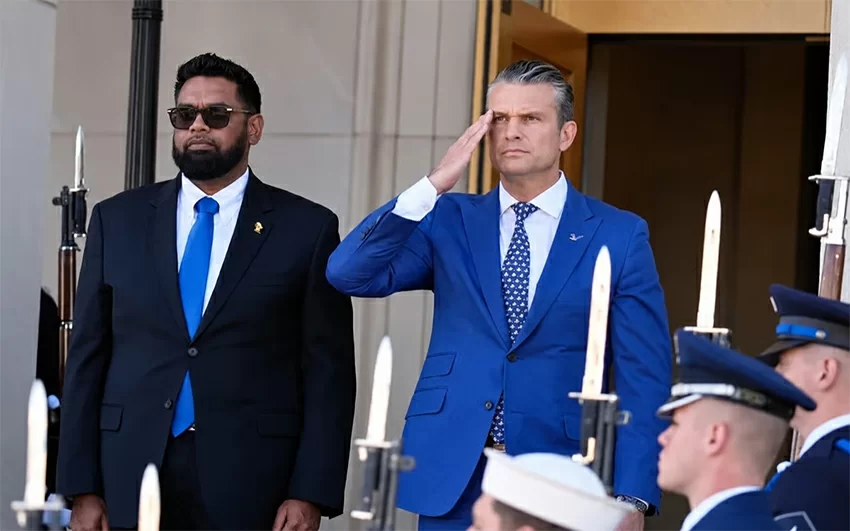
On October 21, a landmark new defense cooperation agreement was signed at the Pentagon in Washington D.C., bringing the United States and Guyana into a deeper, more structured security partnership. The document, a joint declaration establishing a comprehensive defense partnership, was signed by Guyanese President Irfaan Ali and U.S. Secretary of Defense Pete Hegseth, marking a formal expansion of decades of existing security collaboration between the two nations.
Under the terms of the new agreement, the United States has committed to long-term support for Guyana’s military development, including the provision of specialized military expertise, tailored training for the Guyana Defence Force across multiple operational domains, and joint military exercises. A key priority of the partnership is upgrading Guyana’s airspace monitoring capabilities, enabling the South American nation to more effectively detect, deter, and respond to both internal and external security threats along its borders. The agreement also expands joint efforts to crack down on transnational drug trafficking and criminal networks labeled as narcoterrorist by both governments, aligning with existing regional initiatives including the Americas Counter Cartel Coalition and the Shield of the Americas program focused on disrupting cross-border criminal activity.
Speaking after the signing, Hegseth praised Guyana’s growing leadership role in Caribbean security, noting that under Ali’s administration, the country has made significant contributions to collaborative security efforts across the Caribbean region. He emphasized that the deeper partnership is designed to address shared security challenges, ranging from drug trafficking to the growing influence of extra-regional military actors. For his part, Ali welcomed the agreement, framing security and stability as non-negotiable foundations for long-term, sustainable economic development in Guyana and the broader region. Ali added that the Caribbean must be free of drug trafficking, terrorism, and outside actors that undermine regional stability, calling the new agreement a critical step toward a more robust bilateral partnership and confirming Guyana’s readiness for deeper collaboration with Washington.
The expansion of U.S.-Guyana defense ties comes against the backdrop of a decades-long unresolved territorial dispute between Guyana and neighboring Venezuela over the resource-rich Essequibo region. Venezuela claims full sovereignty over the 159,000-square-kilometer area, which is currently administered by Guyana. Guyana bases its claim on an 1899 international arbitration ruling that established the bilateral border, and the dispute is currently pending before the International Court of Justice (ICJ) in The Hague, which is tasked with ruling on the validity of the 1899 border agreement. The ICJ has previously ordered Venezuela not to take any action that would alter the status quo of the region, including changes to governance or control, while the case remains ongoing. While the new defense agreement explicitly reaffirms U.S. support for Guyana’s sovereignty and territorial integrity, it does not mention any specific U.S. military deployment directed at Venezuela.
For the Guyanese government, the agreement represents a major milestone in the ongoing modernization of the country’s national defense forces. Beyond security cooperation, Guyana’s broader bilateral relationship with the U.S. already encompasses deep collaboration in energy development, trade, and foreign direct investment. However, key details of the new defense partnership remain undisclosed as of the signing. The full text of the joint declaration has not been made public, and no information has been released on funding amounts, implementation timelines, the number of U.S. military personnel that will be involved, or plans for a permanent U.S. military base in Guyana. In the coming months, both sides will work to translate the broad commitments of the declaration into concrete action, including scheduled training programs, joint exercises, and upgrades to border and airspace monitoring infrastructure.
Analysts note that the new partnership advances both nations’ strategic goals: for Guyana, it strengthens security backing amid its ongoing border dispute and supports economic development by stabilizing the regional security environment, while for the U.S., it fits into a broader strategy of deepening security and economic ties with partners across the Caribbean and South America to counter transnational crime and extra-regional influence.