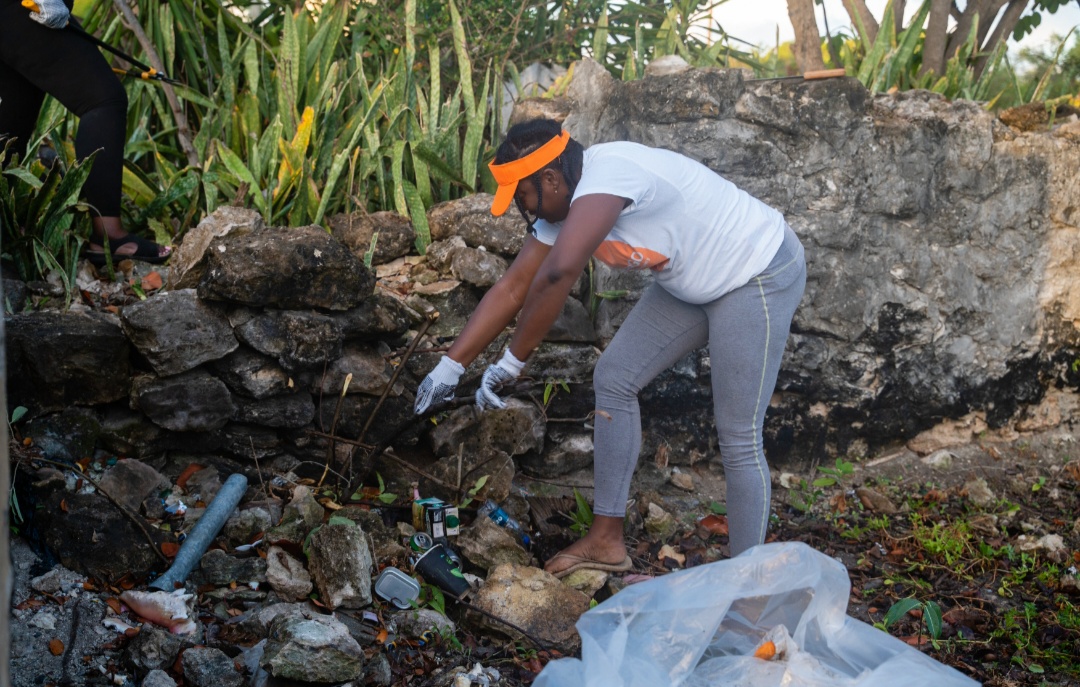
A Barbuda-based community environmental group barbudanGO is scaling up its long-running Action for Habitat conservation and restoration project, with fresh backing from the Caribbean Natural Resources Institute (CANARI) as part of a major global climate adaptation scheme. The expanded work falls under the Generating Ambition for Locally Led Adaptation (GA-LLA) programme, a five-year €15 million global initiative running from 2023 to 2028. Funded by the Government of the Netherlands and steered by the International Institute for Environment and Development (IIED) alongside a cross-sector global consortium, GA-LLA is designed to amplify community-driven climate action and build more inclusive, equitable local responses to escalating climate hazards. In the Caribbean region, CANARI serves as the official regional lead, coordinating with civil society partners to boost grassroots climate resilience, advance inclusive governance frameworks, and remove barriers that have long restricted local communities’ access to dedicated climate finance streams, with barbudanGO leading on-the-ground delivery in Antigua and Barbuda. The newly formalised partnership agreement between barbudanGO and CANARI spans 2025 to 2028, allocating up to US$68,530 to deliver the full suite of Action for Habitat activities under the GA-LLA umbrella. The expansion follows a recent formal consultation between barbudanGO representatives and the Barbuda Council, where the governing body granted full official approval for the organisation to continue targeted conservation and habitat restoration work across its designated island sites.
The Action for Habitat initiative was first conceptualised back in 2022, under the leadership of Barbuda’s Director of Environment Pethrolyna Isaac, after a series of cross-sector consultations that brought together stakeholders from the tourism, land management, agriculture, and commercial fisheries sectors. barbudanGO submitted a formal project proposal to the Barbuda Council in May 2022, securing full operational approval three months later in August 2022. The project launched shortly after with US$50,000 in seed funding from the Global Environment Facility Small Grants Programme, supplemented by an additional US$51,164.61 in co-financing and in-kind community contributions. In 2023, the Barbuda Council formalised its support via a signed memorandum of understanding, committing labour crews, construction materials, and heavy-duty machinery valued at over US$25,000 to support on-site works. During its initial implementation phase, the initiative delivered a wide range of on-the-ground outcomes: targeted site clean-ups, the formal demarcation of protected conservation zones, ongoing land bird population monitoring, targeted support for native plant species recovery, and the reconstruction of traditional free-standing dry-stone fences using locally sourced volcanic rock. barbudanGO also built a robust network of technical partners specialising in community-led conservation, low-cost irrigation systems, mangrove propagation, native nursery management, and long-term biodiversity monitoring frameworks.
Under the new GA-LLA supported phase, barbudanGO will build directly on this existing community foundation using an ecosystem-based adaptation model, which leverages the protection and restoration of natural ecosystems to reduce the island’s vulnerability to climate shocks. The expanded workplan includes comprehensive ecological baseline assessments, widespread community consultation sessions, large-scale habitat restoration drives, the development of public native plant educational gardens, mass mangrove outplanting, the rehabilitation of historical stone structures, traditional freshwater ponds and community wells, upgrades to public nature trails and educational signage, structured community and volunteer training programmes, and continuous long-term monitoring of restoration progress and biodiversity recovery outcomes. The programme also includes targeted activities to strengthen the institutional capacity of local community groups and Barbuda’s governing bodies to independently lead future climate adaptation projects, including organisational skills development workshops, cross-community knowledge sharing events, regional peer-to-peer learning exchanges, and the full documentation of the Action for Habitat model as a public case study for other small island communities across the Caribbean.
Healthy, intact natural ecosystems form the backbone of Barbuda’s climate resilience. Widespread mangrove die-off and ecosystem degradation in the aftermath of Hurricane Irma in 2017 severely undermined the island’s natural coastal flood defences, displaced critical terrestrial and marine biodiversity, and disrupted the livelihoods of hundreds of Barbuda residents who rely on coastal ecosystems for fishing and tourism. The restoration and long-term protection of these vulnerable habitats is therefore a core priority to reduce the island’s exposure to future climate-related risks including storm surges, coastal erosion, and saltwater intrusion into freshwater aquifers. For barbudanGO, this next phase of Action for Habitat embodies the organisation’s longstanding commitment to centring community voice in conservation, integrating ecological restoration, intergenerational local ecological knowledge, traditional land stewardship practices, formal skills building, and permanent long-term habitat protection. The organisation’s core goal under the GA-LLA programme is to tangibly reduce Barbuda’s climate vulnerability by restoring extensive areas of degraded mangrove ecosystems, safeguarding critical terrestrial and coastal habitats, and equipping local institutions and community groups to lead sustainable, community-designed climate adaptation initiatives for decades to come.