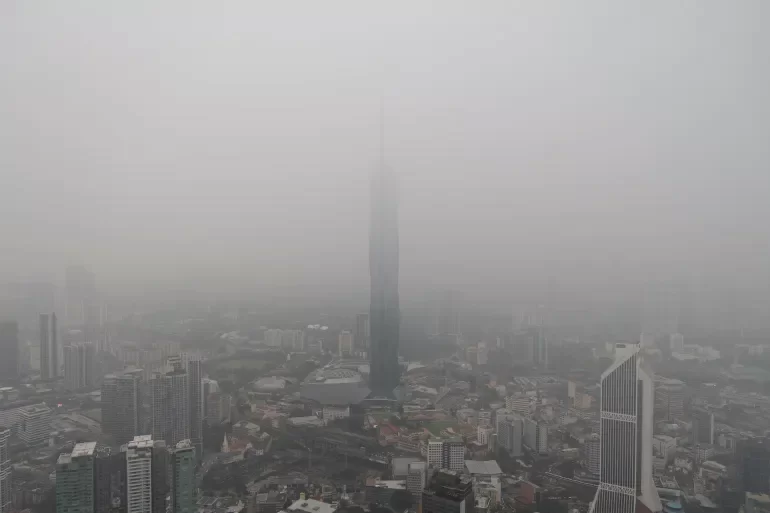
Southeast Asia is grappling with one of its worst transboundary haze crises in more than a decade, fueled by rampant peat and forest fires across Indonesia that have choked major urban centers in neighboring Singapore and Malaysia, triggering mounting calls to hold responsible companies legally accountable for the cross-border pollution. The unfolding disaster has also put long-standing regional cooperation frameworks under the Association of Southeast Asian Nations (ASEAN) to the test, revealing critical gaps in enforcement that have undermined decades of agreed-upon anti-haze commitments.
The current blazes have been amplified by prolonged drought conditions amplified by the El Niño weather phenomenon, creating tinder-dry conditions across Indonesia’s major forested regions in Sumatra and Kalimantan. As toxic smoke drifts across national borders, it has severely degraded air quality across a wide swathe of the region, triggering widespread public health concerns, disrupting daily life, and obscuring iconic city skylines from Kuala Lumpur to Singapore’s central business district.
Singapore has emerged as the first government to ramp up concrete legal action against linked entities, ramping up pressure under its 2014 Transboundary Haze Pollution Act. On October 19, the country’s National Environment Agency (NEA) announced it would impose mandatory preventive measures on three additional Indonesian companies linked to fires burning within their concession areas. Authorities confirmed there is evidence that smoke from these properties has reached Singapore’s territory. This brings the total number of Indonesian firms targeted by Singaporean regulators to 10, following an initial notification of seven companies earlier in the crisis.
Under the required measures, the companies must deploy dedicated firefighting teams to extinguish existing blazes on their land, stop any slash-and-burn clearing activities, and submit formal prevention plans to stop new fires from breaking out. Companies found guilty of violating the law face fines of up to S$100,000 per day, capped at a total of S$2 million, and non-compliance with preventive orders carries additional legal penalties. Importantly, Singaporean authorities emphasize the notifications do not equal a finding of guilt, and successful prosecution requires robust evidence connecting the companies directly to the blazes and resulting pollution. To date, Singapore has never secured a conviction under the 2014 law, with investigations into companies linked to the devastating 2015 haze crisis still ongoing in some cases.
Indonesia’s national government has also pledged to crack down on fire starters, with President Prabowo Subianto ordering the country’s national police, public prosecutor’s office, and ministry of forestry to launch full investigations into suspected corporate and individual involvement in starting the blazes. As of the latest updates, Indonesian authorities have named 223 individuals and 9 companies as suspects across 273 open fire-related police cases, covering a total burned area of more than 5,150 hectares. As with Singapore’s process, suspect status does not equal a finding of guilt, with ongoing investigations working to determine who is responsible for starting the blazes and whether any criminal violations have occurred. President Prabowo has previously stated that companies proven responsible for the fires will face revocation of their operating concessions, noting the government has zero tolerance for intentional arson and other activities that threaten the country’s forest and land reserves.
At the same time, Indonesia has deployed a massive emergency response to contain the ongoing blazes: more than 69,000 firefighters and support personnel have been mobilized, supported by roughly 50 aircraft conducting water bombing and cloud seeding operations to trigger rain. While official data shows a decline in the number of active hotspots and total emissions in the week leading up to October 21, authorities warn the situation remains volatile, with existing hotspots at risk of reigniting and new fires easily breaking out under continued dry conditions.
The crisis has once again drawn attention to the critical weaknesses of ASEAN’s existing regional framework to address transboundary haze. All 11 ASEAN member states signed the Agreement on Transboundary Haze Pollution back in 2002, a legally binding pact that requires member states to work collaboratively to tackle haze causes and mitigate impacts. However, the agreement lacks any independent judicial body with the authority to directly penalize non-compliant nations or companies, and all disputes over interpretation and implementation must be resolved through diplomatic negotiation. As a result, enforcement remains almost entirely dependent on national legislation and the willingness of individual governments to cooperate, with ASEAN’s long-standing principle of non-interference in internal affairs further limiting action.
Environmental groups and legal experts have repeatedly called for the regional framework to be strengthened with independent monitoring, clearer compliance protocols, and formal mechanisms to hold corporate actors accountable. They note that while diplomatic dialogue and emergency response measures are necessary, they are insufficient to address the root of the problem, which is tied to powerful economic interests driving deforestation, land clearing, and the widespread use of fire to clear land for agricultural development.
One of the biggest practical barriers to successful prosecution is the challenge of proving a specific company is responsible for a blaze that caused haze pollution in a neighboring country. While satellite imagery, meteorological data, and concession maps can help trace the origin of fires, criminal convictions require additional evidence linking specific companies or individuals to the ignition of the blaze, and confirming the fire started within the company’s concession area. Companies often argue that fires started outside their concessions and spread onto their land, creating further evidentiary complexity. This makes close cooperation with Indonesian authorities critical, as foreign investigators need access to on-the-ground evidence and local data to build a viable legal case. While Singapore’s law also allows civil claims from individuals and businesses harmed by the haze, legal action can also trigger diplomatic tensions: in 2016, a dispute erupted between Singapore and Indonesia after Singapore attempted to summon an Indonesian corporate executive for questioning related to a previous haze event.
Despite the recent drop in active hotspots, the broader regional situation remains concerning. ASEAN’s specialized meteorological center still reports high numbers of active hotspots across parts of Sumatra and Kalimantan, and transboundary smoke continues to be detected in parts of Malaysia and Singapore. Long-term weather forecasts predict continued precipitation deficits across much of the region, with a projected strengthening of El Niño expected to worsen drought conditions and keep the risk of new fires elevated. While forecasters predict increased rainfall by the end of October that could bring some relief, there is no guarantee the haze will dissipate quickly.
Beyond environmental damage, the haze poses severe public health risks: toxic fine particulate matter in the smoke triggers and worsens respiratory conditions, with children, the elderly, and people with pre-existing health conditions facing the greatest risk.
Experts are now calling for a broader systemic approach that holds not only the companies that start fires accountable, but also the corporations that profit from deforested land and the financial institutions that fund these high-risk activities. Proposed reforms include stricter supply chain checks for palm oil and other agricultural commodities, expanded sustainability certification schemes, and meaningful penalties for companies that violate environmental regulations. Consumers can also drive change by avoiding products from companies with proven links to irresponsible fire-driven land clearing.
The 2024 haze crisis has laid bare a long-standing structural flaw in regional anti-haze efforts: while Southeast Asian nations have had formal agreements in place to tackle transboundary haze for more than 20 years, actual enforcement still lags far behind the scale of the ongoing problem.