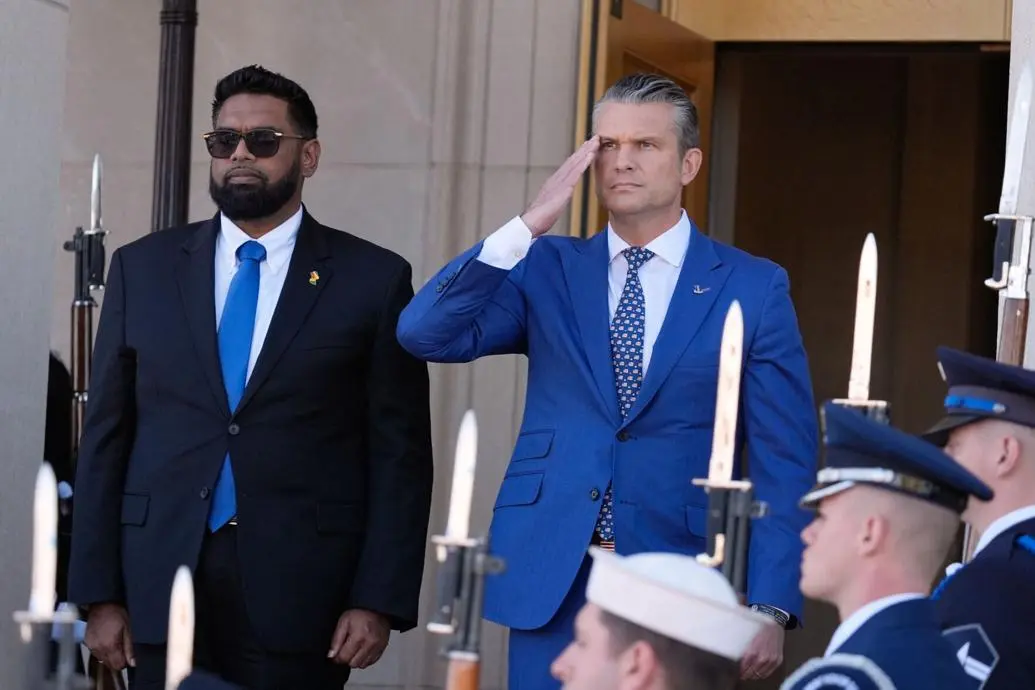
On Wednesday, October 21, 2026, a historic diplomatic milestone took place at the United States Pentagon, where U.S. Secretary of War Pete Hegseth and Guyanese President Mohamed Irfaan Ali formalized a groundbreaking enhanced defense cooperation pact between the two nations.
In remarks released by the U.S. Department of War, Hegseth praised Ali’s regional leadership among Caribbean partner nations, emphasizing that Guyana’s proactive engagement has laid critical groundwork for expanded security collaboration across the Western Hemisphere. “Your leadership across the region with key Caribbean partners has been indispensable,” Hegseth stated. “Countries look to you. You’ve taken the lead, you’ve stepped out, laying the foundation for what we’re doing in the hemisphere.”
Hegseth outlined the core shared threats that the new partnership aims to address, highlighting the growing risks of narco-terrorism and expanding military influence from non-hemispheric powers. He framed the cooperation as an extension of the corollary to the Monroe Doctrine articulated by former U.S. President Donald J. Trump, noting that both nations are committed to collectively pushing back against these external and transnational threats. “We’ve only just begun on that project, and your investment has inspired confidence for us,” Hegseth added. “I hope you’ve seen that our investment has inspired confidence in you, in security forces, in our militaries and in the landmark joint declaration today to further elevate our defense cooperation on our all-domain partnership.”
Under the terms of the new agreement, the United States will ramp up joint training initiatives with Guyanese security forces, focusing heavily on multidomain operational tactics and aerial interdiction operations targeting illicit trafficking. The pact also addresses economic and industrial security ties: Hegseth confirmed that a pending memorandum of understanding focused on critical minerals between the two nations is a key component of collective security efforts, designed to strengthen the shared defense industrial base that supports both countries’ security goals.
For his part, President Ali aligned closely with the U.S. framing of regional security priorities, noting that long-term sustainable prosperity for the Caribbean and Western Hemisphere depends on eliminating space for transnational criminal and extremist activity. “The things that are critical for stability in the region, sustainable [for] long-term prosperity and stability, are the very things you’re pursuing — a region that’s free from narco-trafficking, free from international actors that are bad for the region, free from terrorism and free from any thinking from any group or cell anywhere in the world that this is a region where they can find a home,” Ali said.
The Guyanese leader framed the agreement as a pivotal step forward in bilateral relations, declaring that the current moment demands bold, collaborative action. “This is the era of action; this is the era of leadership; this is the era of domination and commitment, and we’re very happy to be part of this partnership,” Ali said. “We look forward to working with you in a stronger way.”
The signing marks a deepening of security ties between the United States and Guyana, a key partner in a Caribbean region that has become an increasingly focal point for great power competition and transnational security challenges in recent years.