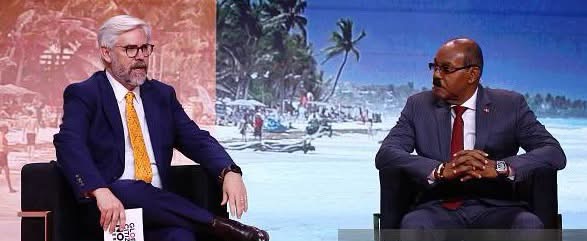
During an official working visit to Australia, Prime Minister Gaston Browne of Antigua and Barbuda has launched a series of high-level bilateral engagements focused on advancing clean energy transition, building strategic global partnerships, and finalizing preparations for the 2026 Commonwealth Heads of Government Meeting (CHOGM) set to be hosted on his home soil.
The trip opened with formal talks with top Western Australian state officials, including Premier Roger Cook and Energy and Decarbonisation Minister Amber-Jade Sanderson. Delegates from both sides centered discussions on Western Australia’s well-documented track record in scaling renewable energy capacity, enhancing national energy security, and cultivating competitive clean industrial sectors. For Browne, the meeting served as a platform to unveil his flagship regional policy proposal: the Organisation of Eastern Caribbean States (OECS) Renewable Islands Initiative. This ambitious framework aims to revolutionize energy systems across 11 Eastern Caribbean island nations through deepened regional coordination and targeted large-scale investment in low-carbon renewable technologies.
Browne emphasized that the initiative is rooted in the region’s urgent need to cut its heavy reliance on costly imported fossil fuels, bring down energy prices for households and businesses, and build greater economic resilience against global commodity price volatility. The two sides also mapped out potential areas for ongoing collaborative work ahead of two landmark upcoming global events: the 2026 CHOGM in Antigua and Barbuda, and the 31st UN Climate Change Conference (COP31).
Beyond government-level talks, Browne held scheduled meetings with influential Australian industry and philanthropic leaders, including Fortescue Chairman Dr. Andrew Forrest, who also founded the Minderoo Foundation, and Fortescue Metals Chief Executive Dino Otranto. Browne used the engagement to underscore the critical gap in targeted international support for Small Island Developing States (SIDS) across both the Caribbean and Pacific, which face disproportionate climate vulnerability despite contributing the least to global emissions. He outlined the full scope of the OECS Renewable Islands Initiative and opened discussions on potential contributions from Fortescue and the Minderoo Foundation, ranging from specialized technical expertise to climate finance and other forms of strategic partnership as the project moves forward.
Browne also updated stakeholders on Antigua and Barbuda’s ongoing work to build a national sustainable electric mobility ecosystem, a program already underway through an existing partnership with UK-based green energy firm Octopus Energy. A separate upcoming bilateral meeting with Octopus Energy Generation Chief Executive Zoisa North-Bond is planned to review progress on the partnership, specifically arrangements for a fleet of electric vehicles (EVs) that will power official transportation during the 2026 CHOGM. Notably, the first batch of EVs has already arrived in the country, marking a tangible early milestone in the government’s push to integrate zero-emission transportation technologies into public sector operations.
Following the CHOGM event, Browne plans to integrate the EV fleet into a long-term national electric mobility strategy, and upcoming talks will address core practical considerations: expanding public and private EV charging infrastructure, establishing long-term maintenance protocols, defining operational frameworks, optimizing vehicle deployment across the country, and securing sustainable financing for future expansion. The prime minister is set to stress that the EV initiative is not designed as a one-off showcase for the international summit, but as a lasting infrastructure legacy that will advance Antigua and Barbuda’s national climate commitments and long-term development goals. He will also explore additional support for the next phase of the program from Fortescue, Minderoo, and other interested global partners.
As part of preparations for CHOGM 2026, the Antigua and Barbuda government is developing a dedicated “Invest Antigua and Barbuda” investment forum to be held alongside the summit, designed to attract global attention to the country’s untapped investment opportunities across high-priority sectors. Browne will formally invite participation from international business leaders and organizations working in renewable energy, sustainable infrastructure, and other key growth areas, emphasizing that the country is seeking equitable partnerships that deliver tangible local benefits, generate new jobs for Antiguans and Barbudans, and strengthen the country’s long-term economic competitiveness.
The prime minister’s bilateral schedule also included a meeting with former Samoan Prime Minister Fiame Naomi Mataʻafa, who previously served as the Commonwealth’s Chair-in-Office when Samoa hosted the 2024 CHOGM. The meeting allowed the two leaders to exchange perspectives on shared development challenges facing SIDS in both the Caribbean and Pacific regions. Browne sought Mataʻafa’s insights and lessons learned from Samoa’s experience hosting a large-scale international summit, input that will directly inform Antigua and Barbuda’s preparations for 2026. The pair also discussed ways the Commonwealth can deliver more tangible, meaningful benefits to member state citizens, particularly for vulnerable low-income communities and youth populations across small island nations.
Browne’s series of engagements in Australia form a core component of Antigua and Barbuda’s broader national development strategy, which prioritizes building targeted international partnerships to advance shared national and regional progress. The talks underscore the country’s commitment to moving beyond symbolic climate declarations to deliver on-the-ground practical cooperation in renewable energy deployment, sustainable investment, climate resilience, and inclusive long-term economic growth. Throughout his tenure, Browne has consistently argued that small island developing states must pursue intentional strategic global partnerships to overcome unique structural challenges, including limited natural resource endowments, persistently high energy costs, and heightened exposure to global economic and climate shocks.