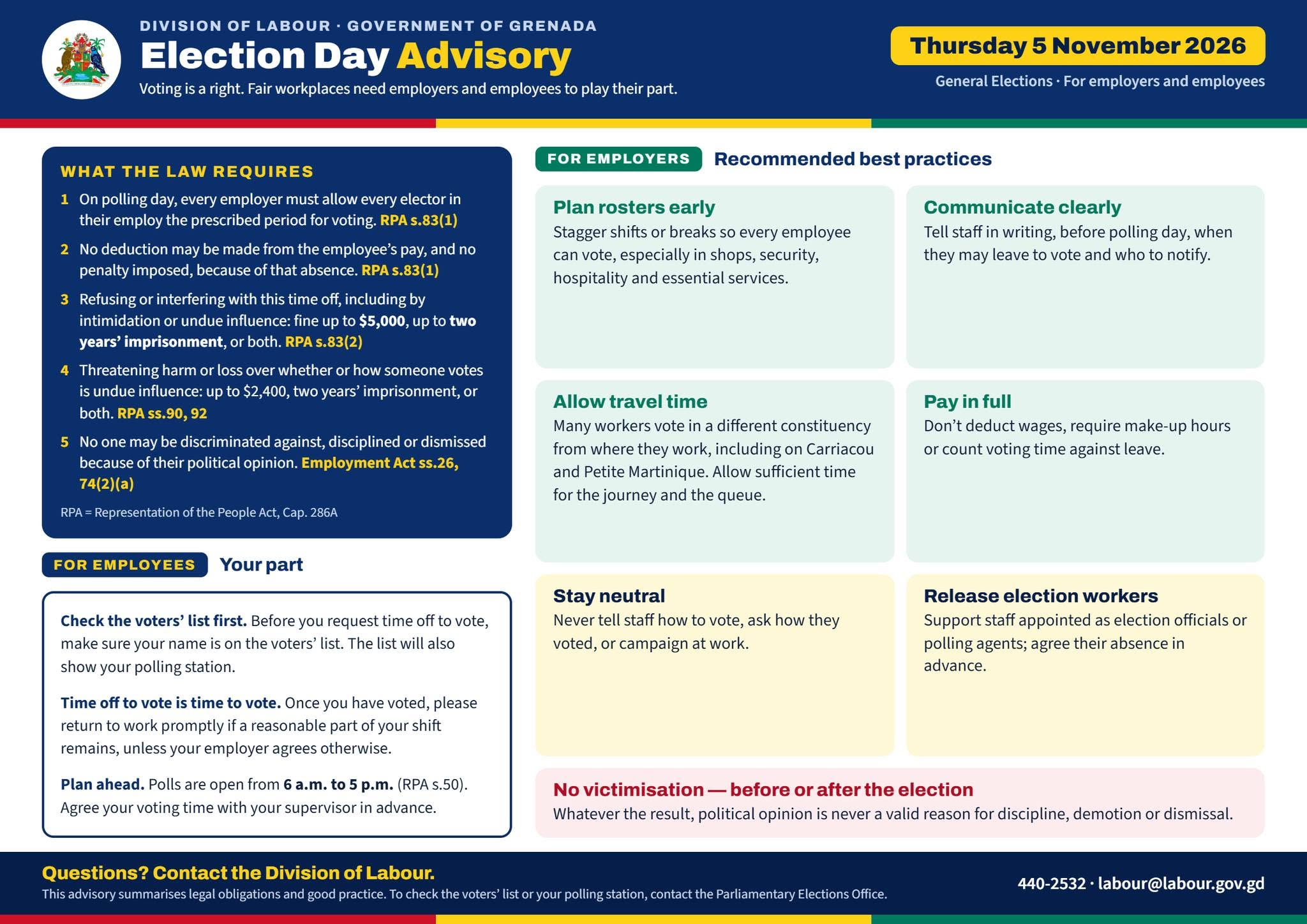
As Grenada prepares for its 2026 General Election on Thursday, November 5, government authorities have released a comprehensive advisory outlining legal obligations for employers and key responsibilities for employees, designed to guarantee all registered electors can exercise their democratic right to vote without penalty or interference.
Under the Representation of the People Act, Chapter 286A, the law mandates that every employer must grant all voting-eligible employees a protected period of absence to cast their ballot on polling day. Section 83(1) of the Act explicitly prohibits employers from deducting wages or imposing any disciplinary penalties on workers for taking this legally required time off.
Employers who violate this regulation by refusing access to voting time, or who intimidate workers or exert undue influence over their employees’ participation, face severe legal consequences: penalties can include fines of up to $5,000, imprisonment for up to two years, or both, as outlined in Section 83(2). Additional protections are enshrined in law for voters: anyone who threatens harm or loss based on a person’s decision or choice of vote can be found guilty of undue influence, carrying penalties of up to $2,400 in fines, two years imprisonment, or both per Sections 90 and 92 of the Act. The Employment Act further reinforces these protections, stating that no worker may be discriminated against, disciplined, or dismissed based on their political opinion, per Sections 26 and 74(2)(a).
Alongside these legal requirements, the advisory outlines a series of recommended best practices for employers to follow ahead of polling day, to ensure a smooth voting process for all staff. The advisory particularly highlights the importance of advance planning, especially for workplaces in retail, security, hospitality, and essential public services that remain operational on election day. Employers are encouraged to adjust work rosters early, stagger work shifts and scheduled breaks to accommodate every employee’s voting schedule, and account for the reality that many workers, particularly those living and working across Carriacou and Petite Martinique, must travel between their workplace and their assigned polling station in a different constituency. Sufficient time should be granted to account for travel and potential waiting lines at polling locations.
Clear communication is another key recommendation: employers are advised to confirm in writing with staff ahead of polling day what procedures workers should follow to request time off, when they may leave the workplace to vote, and who they are required to notify. The advisory also stresses that employers must pay workers in full for their voting time, and should not require makeup hours for the time taken off nor count voting absence against any existing paid leave allocations. To maintain a fair democratic process, employers are also encouraged to stay strictly neutral in the election: they are urged not to direct staff how to vote, ask employees about their voting choices, or conduct any political campaigning within the workplace.
Additionally, employers are encouraged to accommodate staff who have been appointed as election officials or polling agents, and to confirm arrangements for their absence well ahead of time. Most importantly, the advisory reminds all employers that political opinion can never be a valid justification for disciplinary action, demotion, or dismissal, regardless of the election outcome, and that victimization of workers for their political beliefs before or after the vote is illegal.
For their part, employees also have responsibilities to ensure the process runs smoothly. The advisory recommends that workers confirm their registration and check their assigned polling station on the official voters’ list before requesting time off to vote, to avoid any last-minute confusion or complications. Workers are reminded that time off granted for voting is intended solely for that purpose, and that they should return to work promptly after casting their ballot if a significant portion of their shift remains, unless their employer has agreed to a different arrangement. Polling stations will be open from 6 a.m. to 5 p.m. on November 5, and employees are encouraged to coordinate their planned voting time with their supervisor well ahead of polling day to avoid workplace disruptions.
This advisory, a joint publication from the Parliamentary Elections Office and the Division of Labour, summarizes core legal obligations and good practices for the 2026 general election. Members of the public can check the voters’ list or confirm their polling station details by contacting the Parliamentary Elections Office directly. Any questions about workplace rules and voting can be directed to the Division of Labour via phone at +1 (473) 440-2532 or email at [email protected].