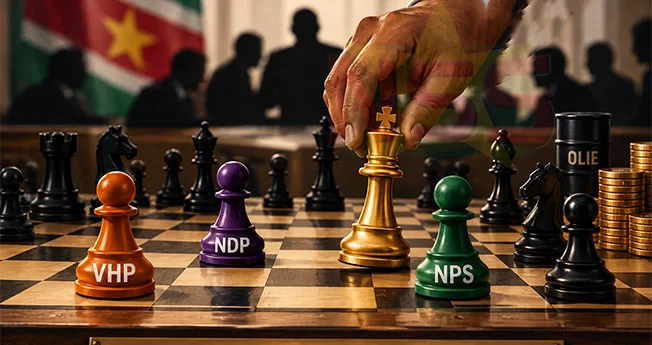
Leadership contests are already beginning to take shape across Suriname’s major political parties, even as some official elections for top posts remain years away. What looks on the surface like routine internal party elections is actually a high-stakes battle for control of party infrastructure and, ultimately, access to the massive upcoming oil and gas revenues that will reshape the country’s political economy over the next decade.
At the ruling VHP (Verenigde Hindoestaanse Partij), a leadership election is scheduled for May 2027. Two high-profile candidates have already thrown their hats into the ring: former minister Armand Achaibersing and current deputy chair Asis Gajadien. Political observers expect open campaigning, public endorsements from allies, and targeted pushback from opponents to ramp up over the coming months as the contest gains momentum.
Over at the main opposition NDP (Nationale Democratische Partij), while official leadership elections are not expected until 2029, jockeying to succeed current chair Jennifer Simons is already underway. Two prominent contenders have emerged: deputy chair Faizal Abdoelgafoer, who currently holds an influential position in the president’s cabinet, and former vice president Ashwin Adhin, who made his presidential ambitions clear ahead of the May 2025 general election.
The third major party, NPS (Nationale Partij Suriname), is also facing questions about its long-term leadership. Incumbent chair Gregory Rusland has stated he is willing to stay on in the role if the party membership supports that decision.
Across all three parties, what ultimately determines the outcome of these leadership contests is not just public popularity or policy platforms, but control over internal party structures. Parties routinely frame their internal elections as open, democratic processes, where branch and local constituency votes elect delegates who then select the national party leadership. But ordinary rank-and-file members almost never get to vote directly for their party chair. Their influence is filtered through layers of intermediaries, meaning that the actual power to pick leaders rests with whoever controls those intermediate structures.
This system raises a host of critical questions that go far beyond procedural fairness. Who sets the rules for who gets voting rights in internal elections? Who exercises influence over local party branches to ensure loyal supporters are installed in key positions that can shape the final outcome? How much room is there for independent candidates who are not part of the existing established power network to compete? A candidate that is wildly popular among thousands of ordinary members can still lose to a lesser-known contender who has spent years building alliances across the party’s internal structure. In that scenario, policy expertise, governing experience and broad popular support often lose out to carefully cultivated insider networks.
Indirect internal elections are not inherently undemocratic. But when the outgoing party leadership exercises outsized influence over the composition of the bodies that are tasked with electing their replacement, it creates a closed system where existing power blocs maintain their grip on authority. In this scenario, the election becomes little more than a formality to rubber-stamp an outcome that was determined long before any votes are counted.
The stakes of these contests extend far beyond who gets to hold the gavel at party meetings. Over the coming years, Suriname is set to earn billions in new revenue from its expanding offshore oil and gas sector, and the 2030 parliamentary election is already on the horizon. Whoever controls the party leadership gets to shape candidate lists for national office, approve key political appointments, negotiate coalition agreements, and ultimately determine who gets access to executive power. Control of the party does not just translate into influence over policy; it also determines who gets access to opportunities, public sector appointments, and a seat at the table when national resources are distributed.
After years of severe economic austerity and scarcity across Suriname, the promise of billions in new oil revenue has created intense incentive for political factions to consolidate control. Every candidate publicly claims they will put the national interest first, but rhetoric alone is not enough. The question that remains unanswered by most candidates is who exactly they intend to benefit if they win the leadership: ordinary Surinamese citizens who have sacrificed for years through economic crisis, loyal rank-and-file party members who have campaigned for the party through election cycles, or a small inner circle of political insiders who helped the candidate climb the ladder and now expect favors in return?
The leaders of VHP, NDP, and NPS owe far greater transparency to both their members and the general public about what their leadership would mean for the distribution of this new national wealth. A party that shuts out independent voices internally is unlikely to be open to public criticism or alternative policy perspectives once in power. If a faction consistently puts narrow party interests ahead of the broader national good, that dynamic is unlikely to change even when billions in new oil revenue flow into the national treasury.
The true test of a political party’s internal democracy is not whether votes are counted fairly on election night. It starts long before that, with how party structures are built, and how much meaningful influence ordinary rank-and-file members are given to shape the outcome. Control of those structures is what will determine who wins the party leadership. The big open question that remains is who will win after that: the people of Suriname, or the small circle of insiders surrounding the new party leader.