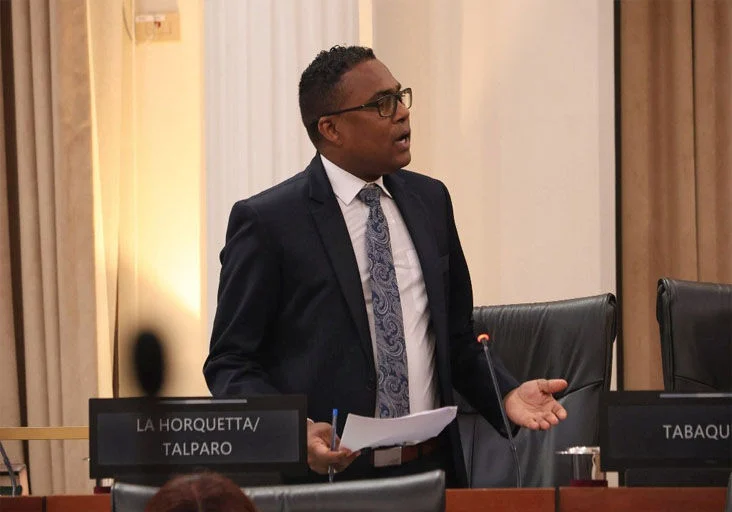
A simmering political firestorm has erupted in Trinidad and Tobago after Minister of Sport and Youth Affairs Phillip Watts made deeply controversial remarks targeting the appearance and sexual morality of opposition female parliamentarians during Saturday’s annual budget debate. The controversy unfolded as Watts, who also serves as the Member of Parliament for the La Horquetta/Talparo constituency, took the floor to defend the ruling administration’s management of national youth development programmes, while levelling accusations that the previous Opposition People’s National Movement (PNM) administration left multiple youth initiatives in a state of mismanagement and disarray.
As his prepared remarks drew to a close, Watts made an unprompted detour into comments about female lawmakers on the government side of the chamber. He praised ruling party women for their looks and what he framed as their strong “moral values,” before launching an insinuating attack on his opposition colleagues. “One of the things I most admire about this side, watch from the front bench, look at the back bench, come down on this side, look at the good-looking women on this side and you know why I feel very comfortable on this side, Mr Speaker, especially with the women, they have a lot of moral values,” Watts told the chamber.
The comment immediately drew a pushback from Opposition MP Kareem Marcelle, who raised a procedural objection under Standing Order 48.1, arguing that remarks about personal appearance had no place in a formal budget debate and were entirely irrelevant to the proceedings. However, Speaker of the House Jagdeo Singh ruled to allow Watts to continue, noting that parliamentarians had historically been granted broad latitude to speak during budget debates, and that the same flexibility extended to Watts as it had to other speakers earlier in the sitting. “I’ll just let you harken back to your own speech and harken back to the comments you made about the member who is delivering his speech now. You will realise that the member must be given some latitude just the way you got,” Singh explained in his ruling.
Undeterred by the objection, Watts doubled down on his remarks, framing the exchange as a competitive sporting contest, comparing himself to a cricket bowler who was throwing opposition lawmakers off their game with his aggressive rhetoric. He then made an explicit unsubstantiated claim: “I have never come across any of these ladies sleeping with their colleagues. I have never come across that on this side,” drawing desk-thumping support from some ruling party lawmakers.
By Sunday afternoon, the comments had spread widely across social media and triggered a sharp backlash from across the political spectrum, with both political opponents and women’s rights advocates condemning the remarks as misogynistic and inappropriate for parliamentary proceedings. The PNM’s National Women’s League (NWL) released an official statement condemning what it called “scurrilous attacks” on the party’s female parliamentarians and office holders. The organization directly blamed operatives from the ruling United National Congress (UNC) for orchestrating personal attacks against PNM women, and accused Prime Minister Kamla Persad-Bissessar of openly condoning Watts’ inappropriate conduct. The statement went further, also reviving prior criticism of Persad-Bissessar over past allegations of supporting child marriage and victim-blaming a 13-year-old survivor of potential sexual abuse. “The failure of this UNC government has been exposed by the PNM, and in desperation, the Prime Minister has resorted to the lowest, vilest gutter tactics,” the NWL statement said.
Anita Haynes, a former UNC Member of Parliament who has been a vocal advocate for respectful treatment of women in politics, also publicly criticized Watts in a social media post that included a clip of his parliamentary remarks. “The winner for now is the Member for La Horquetta/Talparo. In his eagerness to pledge his loyalty, he appears to have forgotten his responsibility to the people of Trinidad and Tobago,” Haynes wrote. She emphasized that Watts’ decision to dwell on the appearance and sexual morality of female colleagues came at a time when ordinary citizens across the country were already struggling with rampant cost of living increases, high unemployment, and widespread global economic uncertainty. “One would have hoped the budget offered more substantive material,” she added.
Haynes framed the remarks as a deliberate, targeted attack on all women in public life, arguing that a woman’s private personal life and physical appearance have no bearing on her professional competence or job performance as a lawmaker. “My stance on personal attacks against women in politics is well documented, including when intimate images of female politicians were circulated publicly. A woman’s private life does not determine her competence, nor is attractiveness a measure of performance. Such commentary has no place in a parliamentary debate,” she said. She also joined criticism of Speaker Singh, arguing that he missed a critical opportunity to rule the remarks out of order and uphold standards of appropriate conduct in parliament, adding that it was deeply troubling that women’s bodies and personal lives had become a source of public ridicule in the nation’s highest legislative body.
Alongside his controversial remarks about female colleagues, Watts used his budget debate address to respond to opposition questioning about the inclusion of new youth programming in the 2025 national budget, repeating his claim that the previous PNM administration left multiple youth projects in chaotic disarray when the UNC took office last year. He specifically called out the Civilian Conservation Corps (CCC) Programme, an initiative designed to support unemployed and underemployed young adults across the country, which he ultimately ordered closed after taking office. Watts told the chamber that when he assumed his post, he discovered 114 administrative staff had been hired on three-month renewable contracts, even though the programme had not accepted any new participant cohorts. “Chefs, drivers, directors, managers and they also had buildings all over Trinidad that they were renting. They did not bring in any cohort in January (2025)…They renewed the people’s contract till June and it is when I came in as a responsible minister and I realised what was going on, we had to put a stop to it. We cannot be paying 114 persons with no cohort. So who really shut down CCC?” he said.