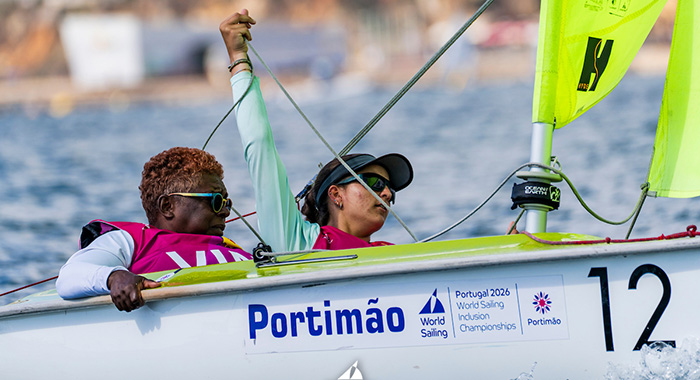
PORTIMÃO, PORTUGAL — A small Caribbean nation has etched its name into the history books of inclusive global sailing, after a visually impaired athlete from Saint Vincent and the Grenadines (SVG) made the country’s first ever appearance at the prestigious World Sailing Inclusion Championships this month. Competing alongside crewmate Scarlett Hadley, skipper Lorna Bacchus turned a historic debut into a milestone performance that has captured attention for its demonstration of resilience, teamwork and the transformative power of inclusive sport.
Organized by global sailing governing body World Sailing, the Inclusion Championships stands as the sport’s flagship international event for para and adaptive athletes. Built around the core principle of creating a level competitive playing field for athletes of all physical abilities, the week-long gathering blends high-stakes racing, targeted skill development and cross-athlete community building. Far more than a simple competition, the event exists to prove that sailing can be a fully accessible, empowering activity for people regardless of disability, highlighting how dedication and teamwork can outpace physical limitations.
Before the official racing got underway, Bacchus and Hadley earned a spot in the World Sailing Inclusion Development Programme, a specialized pre-regatta initiative designed to support first-time participants from emerging sailing nations. Over three days of intensive on-the-water training, the pair worked closely with elite coaches to master core race skills adapted to their needs: reading shifting coastal tides and wind patterns, honing precision starting techniques, and adjusting boat speed and sail trim on vessels they had never sailed before. The hands-on coaching not only built their technical skills but also strengthened the on-board communication that would prove critical during competition.
That preparation paid off across six days of grueling open-water racing, held along Portugal’s rocky Algarve coast. The Vincentian rookie team faced tough, unpredictable conditions: unusually light winds paired with strong, fast-moving tidal currents that pushed even experienced teams to their limits. Every leg of the race tested the pair’s tactical decision-making, mental resilience and ability to work as a cohesive unit. Over the course of the event, however, Bacchus and Hadley showed consistent, measurable improvement: their communication grew smoother, their boat handling sharper, and their on-course strategy more confident. They saved their strongest performance for the regatta’s closing contest, crossing the line in a top-10 position — a result that exceeded many pre-event expectations and hit the personal goal the pair set before the race: to get better every single day they competed.
In an interview after the final race, Bacchus, who navigates the course using audio cues and tactile references as a visually impaired athlete, reflected on the experience. “As a visually impaired sailor, this championship was both challenging and empowering,” she said. “Every race taught us something new, and I am so proud to get the chance to represent SVG on this world stage.”
Her crewmate Hadley echoed that sentiment, highlighting the welcoming community the pair found at the event. “The entire environment here was incredibly supportive,” Hadley said. “We didn’t just grow as sailors — we grew as teammates too. We hope our journey here inspires more people back home in SVG to get out on the water, no matter their ability.”
Jenny Trumble, president of the SVG Sailing Association, called the debut a turning point for the sport in the Caribbean nation. “Lorna and Scarlett’s participation marks a historic milestone for Vincentian sailing,” Trumble said. “Their resilience and steady progress perfectly embody our vision of making sailing inclusive for all and growing the sport here. We couldn’t be prouder to see Saint Vincent and the Grenadines represented on this global stage.”