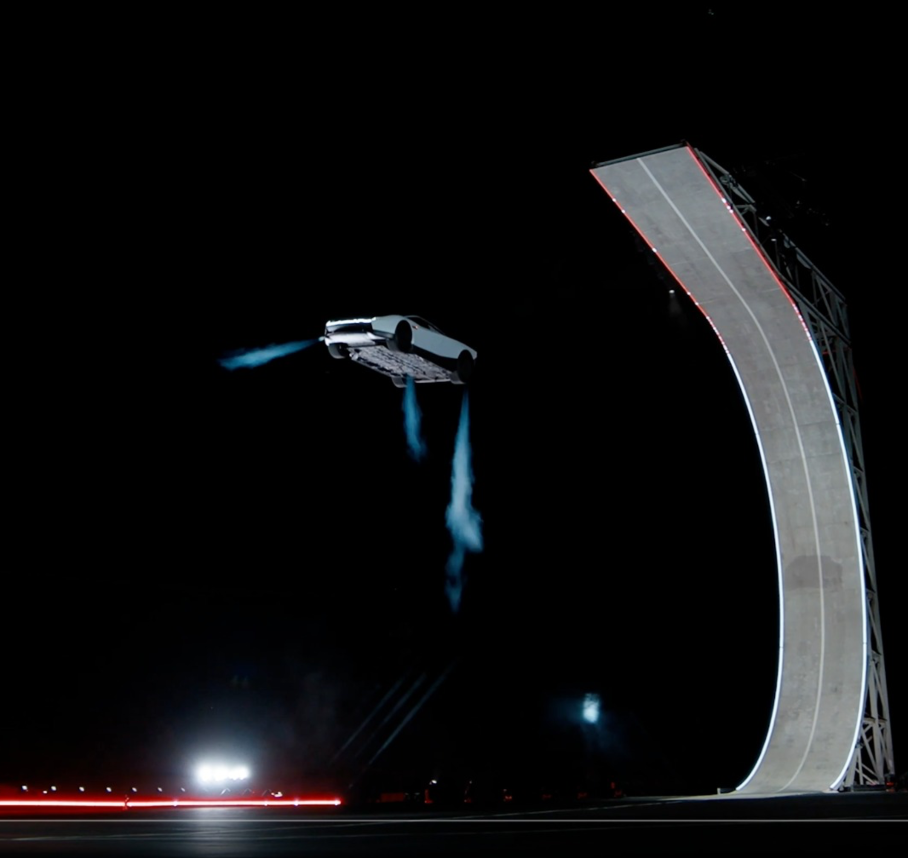
In a high-profile demonstration held Thursday at SpaceX’s private Texas test facility, Tesla CEO Elon Musk pulled back the curtain on the brand’s next-generation Roadster, a two-seat sports car that pushes the boundaries of automotive innovation by claiming to offer flight capabilities – a concept long confined to the pages of science fiction and animated entertainment.
During the carefully staged event, Musk showcased the vehicle’s extraordinary performance, noting it can accelerate from 0 to 60 mph in less than a second, a new record for production cars. The Roadster relies on a system of 10 high-pressure air nozzles and ultra high-pressure air tanks to generate thrust, enabling it to pull off dramatic stunts: during the demonstration, the car used downward suction to climb a steep ramp, hang upside down mid-ramp, spin off the edge, flip through the air, and land smoothly using its air jet system. No human driver was on board for the stunt, a safety precaution Musk explained was implemented to eliminate the risk of fatal injury in case of a malfunction. Acknowledging the uncertainty of the demonstration, Musk told the gathered crowd of Tesla enthusiasts, “Success is not guaranteed. I mean that. It’ll probably work, but if it doesn’t work, we’re at a safe distance.” Later in the event, the Roadster completed a second stunt, leaping over a line of parked Tesla production vehicles using its jets before accelerating to 60 mph in the advertised record time.
Musk framed the Roadster’s technology as the natural outcome of cross-industry collaboration between Tesla, which he called the world’s top car manufacturer, and SpaceX, the leading rocket development firm he also leads. Production of the revolutionary vehicle is currently scheduled to begin in 2028, though observers have noted that Musk has a long history of missing self-imposed production deadlines by multiple years.
Addressing the cheering crowd, Musk emphasized that the in-person demonstration was intended to prove the vehicle was real rather than generated by artificial intelligence. “We need an audience to prove that it’s not AI or SI. So you guys can tell people you saw it with your eyes, because what you see with your eyes, you will not believe,” he said.
Despite the successful staged stunts, major questions remain about whether the new Roadster will actually deliver on its promise of true flight. Thursday’s demonstration did not include any test of sustained, long-range flight, and leading aerospace and automotive experts have expressed significant skepticism about the feasibility of a street-legal flying car.
In recent years, the emerging electric vertical take-off and landing (eVTOL) industry has seen major technical progress, but major engineering barriers still stand in the way of developing a vehicle that can perform safely and effectively both on public roads and in the air. Roger Connor, curator for vertical flight at the Smithsonian’s National Air and Space Museum, explained the core design conflict ahead of Tesla’s event: “Aircraft are extremely sensitive to weight, whereas with ground vehicles you want them to have bumpers and crumple zones and all that. Inevitably, something that is a hybrid between the two is going to be a poor performing aircraft and a poor performing vehicle, and also quite expensive.” Connor also noted that Thursday’s demonstration only showed short, controlled hops, not sustained flight, adding, “We’re not talking about sustained flight. We are literally talking about hopping.” He also cast doubt on whether a street-legal vehicle like the Roadster would be able to fly in any location a driver might want.
Other players in the emerging flying car space also weighed in on Tesla’s reveal. California-based startup Alef Aeronautics, which is currently developing its own single-seat flying car, confirmed it has already managed to get its prototype airborne, but its 254-pound vehicle weighs a small fraction of the Tesla Roadster, and can only carry one passenger who must weigh less than the vehicle itself. Alef CEO Jim Dukhovny said he expected Tesla would be able to get its Roadster airborne for Thursday’s demonstration, but that does not mean it has achieved true functional flight. “It absolutely is 100% feasible,” Dukhovny said. “That being said, the hardest part on all eVTOLs, and for us, it’s a transition from rising vertical to moving forward. It needs to be extremely careful, making sure you do not lose lift, and making sure it’s very stable.”
For now, the world will have to wait to see if Tesla can overcome the massive engineering and regulatory hurdles to deliver a road-legal flying car that lives up to Musk’s bold claims.