When international conversations turn to remittance patterns in the Caribbean, the focus almost always falls on inbound funds: money earned by Caribbean migrants working abroad and sent back to support family members and local households. What is less frequently highlighted is the reverse flow – outward remittances sent by foreign migrant workers, expats, and foreign-born residents living and working within the Caribbean Community (CARICOM) who send a portion of their local earnings back to their home countries abroad. For the region’s small, trade-dependent open economies, both inbound and outbound remittance flows directly impact the total volume of foreign currency retained within national borders, a key metric for financial stability.
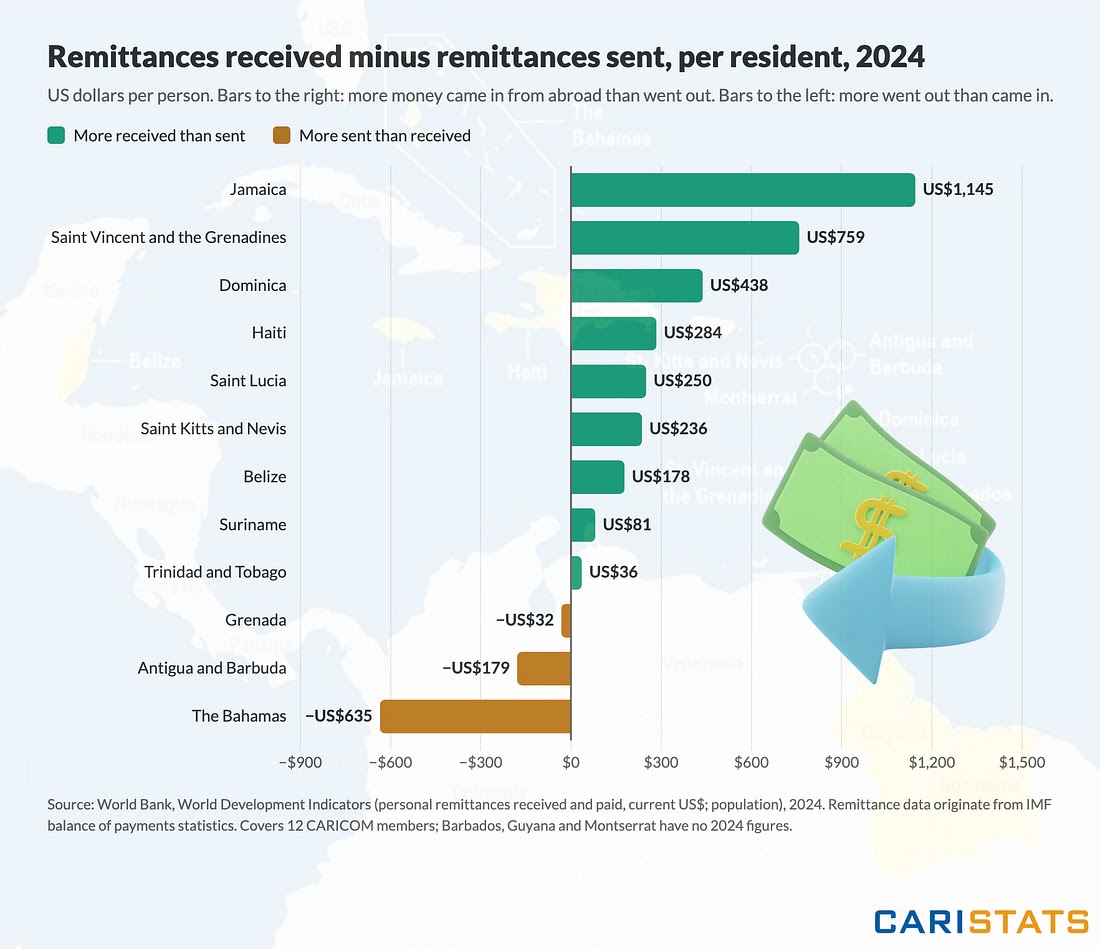
New 2024 data from the World Bank, which compiles remittance figures sourced from the International Monetary Fund’s balance of payments statistics, sheds new light on these dual flows across 12 reporting CARICOM member states. Of the 12 members with available 2024 data, nine recorded a net inflow of remittances, meaning more money entered national borders than left. Three member states bucked this trend, however, registering a net outflow of remittances in 2024.
The Bahamas recorded the largest net outflow by far: the country received just $66 million in inbound remittances in 2024, but sent $321 million in outbound remittances, resulting in a $255 million net loss of foreign currency via remittances. Antigua and Barbuda also recorded a net outflow, taking in $26 million in inbound remittances and sending $43 million out for a net deficit of $17 million. Grenada came closest to balance, with $48 million in inbound remittances and $52 million in outbound, resulting in a small $4 million net outflow. Combined, these three nations saw a total net remittance outflow of $276 million in 2024.
When adjusted for population size, the gap between inbound and outbound remittances becomes even more stark in net outflow countries. For The Bahamas, this works out to roughly $800 in outbound remittances per resident each year, compared to just $164 in inbound remittances per capita. Even among nations that recorded a net inbound surplus, per capita outbound flows can be significant: Saint Kitts and Nevis, which still ended 2024 with more remittance money coming in than going out, recorded roughly $590 in per capita outbound remittances.
For the three net outflow nations, the lost foreign currency from remittances is currently offset by existing revenue streams that bring in foreign exchange – most notably the region’s core tourism sector, as well as cross-border trade and foreign direct investment. It is important to note that three CARICOM members – Barbados, Guyana, and Montserrat – did not have complete 2024 remittance data available for the World Bank’s analysis.