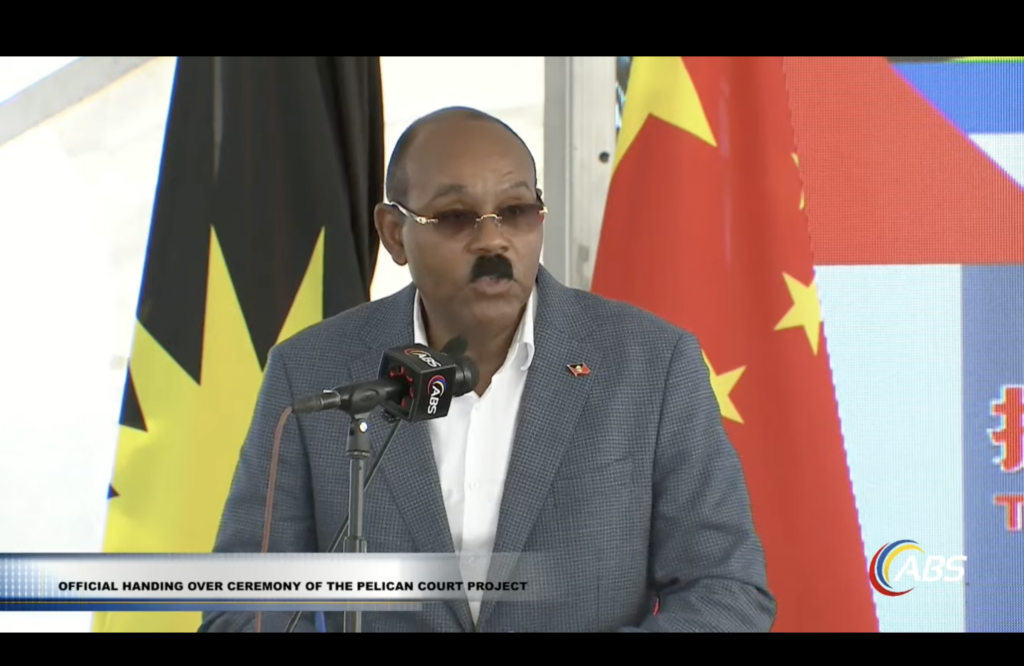
On Thursday, Antigua and Barbuda Prime Minister Gaston Browne delivered a bold and unwavering statement reaffirming his nation’s commitment to maintaining its close bilateral relationship with China, even in the face of unspecified geopolitical consequences. His remarks came during a formal handover ceremony for Pelican Court, a landmark affordable housing development fully funded by a Chinese grant, which Browne hailed as a tangible example of the long-standing partnership between the two countries.
Speaking to an assembled group of officials and community stakeholders at the event, Browne emphasized that China has stood as Antigua and Barbuda’s most critical development partner over the past 30 years, a track record of collaboration that has transformed the nation’s infrastructure landscape and lifted living standards for countless residents. He called on the country to actively defend this friendship in global multilateral forums and push forward with expanding bilateral cooperation, rejecting external pressure that seeks to undermine the relationship.
“Over the last three decades, no other nation has done more to advance our country’s development than the People’s Republic of China,” Browne stated bluntly. While the prime minister acknowledged that the bilateral relationship faces unspecified geopolitical threats, he declined to name any specific country, international organization, or punitive measure that has prompted the pressure. What he did make clear, however, is that the decades of Chinese support have been instrumental in building Antigua and Barbuda’s economic and social infrastructure at moments when the country needed it most.
Browne argued that without China’s consistent contributions, Antigua and Barbuda’s national progress would look drastically different today, and the overall quality of life enjoyed by its citizens would be far lower. This history of partnership, he said, demands that the country maintain its gratitude through action — even when holding that position carries potential consequences. “So let us continue to march on with China as our most important development partner,” he urged.
The Pelican Court project, which is valued at 50 million Eastern Caribbean dollars and delivered via a Chinese grant, consists of 150 fully completed two-bedroom residential units. It forms a core part of the wider redevelopment of the Booby Alley neighborhood in Antigua’s Point community, an area that has long struggled with substandard housing and vulnerability to climate impacts.
Browne framed Pelican Court as the most socially impactful Chinese-backed project completed in Antigua and Barbuda to date, noting that its creation directly addresses the housing needs of low-income and vulnerable residents. The project is built with climate-resilient construction standards, a design feature that reflects both China’s expertise in sustainable infrastructure and the Antiguan government’s commitment to improving living conditions for even the poorest members of society. Beyond the new buildings themselves, Browne emphasized that the entire redevelopment initiative centers on elevating the quality of life for the community that will call Pelican Court home.
In closing, the prime minister reaffirmed his administration’s pledge to continue deepening bilateral ties with China, holding up the newly completed housing development as clear proof that the partnership delivers tangible, life-changing benefits for the people of Antigua and Barbuda.