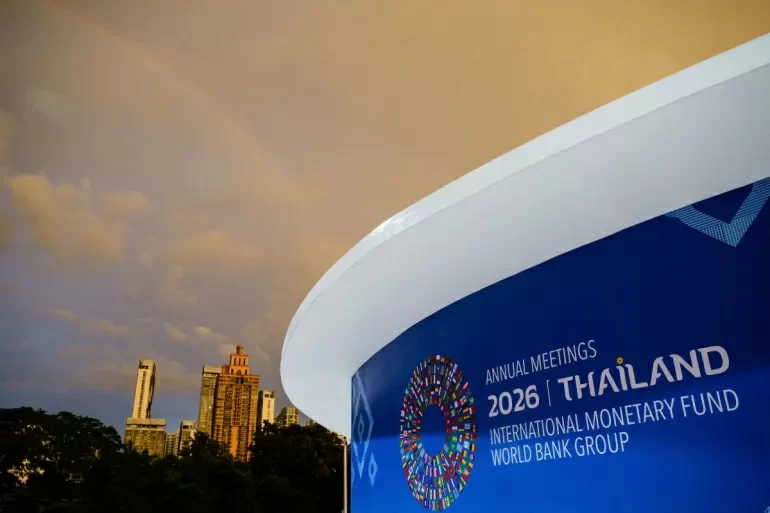
Top finance ministers and central bank governors from the G20 bloc convened in Bangkok, Thailand on Thursday for a high-stakes meeting centered on addressing the far-reaching economic fallout of the ongoing Middle East conflict between the United States, Israel and Iran. The gathering is being held as part of the annual joint meetings of the International Monetary Fund (IMF) and the World Bank, which run from October 12 to 18 in the Thai capital.
Persistent geopolitical tensions in the Middle East, combined with growing disruptions to maritime shipping through the Strait of Hormuz, have injected unprecedented uncertainty into global energy supply chains, inflation outlooks and long-term economic growth projections. The conflict has already suppressed economic activity across large swathes of the Middle East, and its ripple effects are being felt sharply in international energy markets. As a critical chokepoint that handles roughly a fifth of the world’s daily oil and natural gas trade, any sustained disruption to shipping through the Strait of Hormuz would drive up global transportation and energy costs, hitting businesses and household consumers across every continent.
Australian Treasurer Jim Chalmers has called ahead of the meeting for an immediate end to hostilities in the Middle East and a full restoration of unimpeded commercial shipping through the strategic waterway. He noted that the economic impacts of the conflict are already visible globally, manifesting in elevated fuel prices, stubbornly high inflation and increased interest rate pressures that are straining household and business budgets alike.
Beyond the Middle East conflict, rising levels of sovereign debt are set to be a second core agenda item for the gathering. Major economies around the world are currently grappling with historically high public debt loads, which have eroded their fiscal buffer to absorb future economic shocks. IMF Managing Director Kristalina Georgieva warned on Wednesday that the growing global debt burden poses a systemic threat to the stability of the world economy. She stressed that governments will face difficult fiscal tradeoffs to bring their budgets back into balance, with tax increases and public spending cuts likely unavoidable for many nations.
Energy-importing countries are facing particularly acute dual risks: sustained high oil and gas prices drive up import costs, fuel further inflation, erode household purchasing power, and add even more pressure to already strained government budgets.
Frictions in bilateral trade relations between the world’s two largest economies, the United States and China, will also feature heavily in the G20 discussions. Washington has long accused Beijing of distorting global competition through its industrial policies and state support for domestic producers, which it says have led to lopsided global trade imbalances.
U.S. Treasury Secretary Scott Bessent will not attend the Bangkok meeting in person, with U.S. officials citing conflicting domestic priorities. The U.S. delegation will instead be led by Deputy Secretaries Francis Brooke and Erin Browne. In a pre-submitted statement to the IMF, Bessent pushed for greater global focus on addressing persistent trade imbalances, and the impact of national policy and exchange rate practices on international competitive positions.
However, divergent national interests across the G20 membership have made a coordinated collective approach to these pressing challenges extremely difficult to achieve. During the last G20 finance leaders meeting, held in Asheville, North Carolina in late August and early September, participants failed to agree on a joint closing communiqué. Disagreements over trade policy, including Chinese objections to specific proposed language, blocked any consensus on a unified statement.
This week’s Bangkok meeting also serves a key preparatory role, setting the policy agenda for the upcoming G20 heads of state summit, scheduled to take place on December 14 and 15 in Miami, Florida.
The G20 bloc comprises 19 individual nations, plus the European Union and the African Union. Together, the group accounts for the vast majority of global economic output and international trade, and was established as a forum to coordinate on pressing global economic and financial issues and strengthen cross-border cooperation.