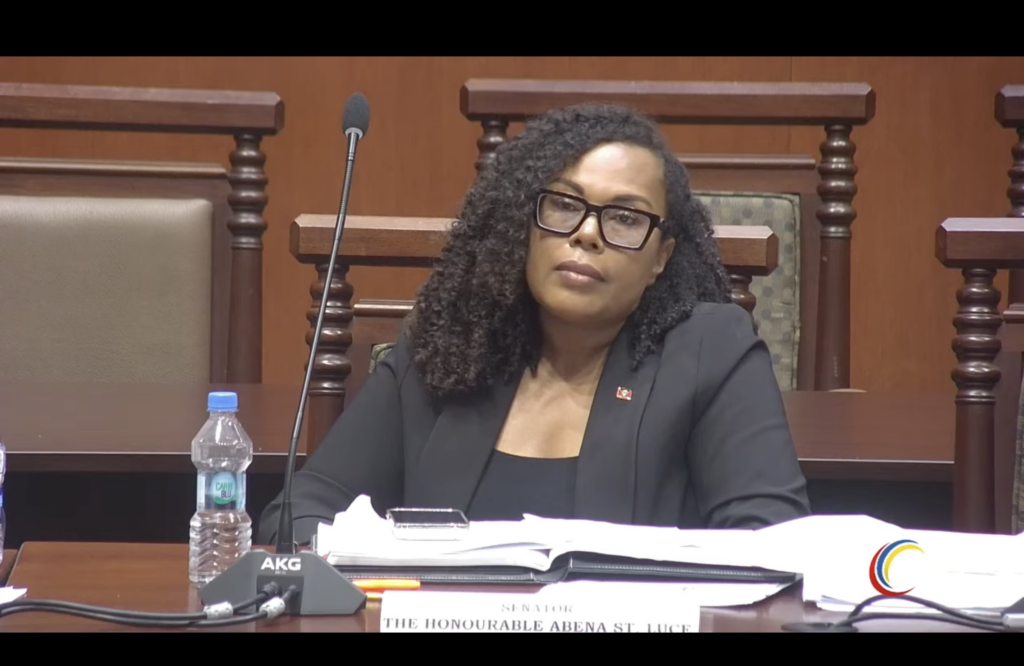
During a heated, emotionally charged Senate debate on the 2026 Sexual Offences Amendment Bill, government Senator Abena St. Luce has pulled back the curtain on a decades-long hidden crisis in Antigua and Barbuda, calling child sexual abuse an entrenched “dirty secret” that demands far more than harsher prison sentences to address. St. Luce’s impassioned remarks came on the heels of a vulnerable public disclosure from Independent Senator Jamilla Kirwan, who shared her own experience of childhood sexual abuse during the proceedings, proving that the harm does not discriminate by household type or social status.\n\nSt. Luce commended survivors like Kirwan who risk emotional distress to share their stories, emphasizing that shining a bright light on this once-taboo topic is the only first step toward protecting future generations of children. Recounting conversations from her own youth, she revealed that multiple friends – including children of active police officers – had confided in her about experiencing sexual abuse. She was careful to clarify that she did not accuse the police officers themselves of abusing their children, but used the example to dismantle the common myth that abuse only occurs in marginalized or unstable households. “Predators don’t look for neighborhood or family background details. They look for accessible children,” St. Luce explained. “Wherever there is a child, there is a potential victim.”\n\nWhile St. Luce offered her full backing to the proposed amendment bill, she stressed that its passage should not be framed as the end of the national fight against child sexual abuse. Instead, she outlined a four-pillar holistic strategy that combines punishment, prevention, survivor support, and long-term post-release supervision of convicted offenders. On the prevention front, she pushed back against the common focus on only teaching children to identify inappropriate touching and report abuse, arguing that adults must fundamentally change how they respond to warning signs in children’s behavior. She specifically called out the harmful culture of victim-blaming that labels young girls “fast” or promiscuous for their clothing or actions, noting that such behaviors are almost always cries for help from traumatized children rather than justifications for blame. “Children are never at fault for their own abuse,” she insisted, warning that public victim-blaming only silences other potential survivors who fear judgment if they come forward.\n\nSt. Luce also criticized the widespread culture of silence that has allowed abuse to flourish across Antigua and Barbuda for generations, noting that communities often bury their heads in the sand, clinging to the false belief that abuse could never happen in their own households. She pointed out that public scrutiny of lenient sentencing for child sexual offenders only intensified in recent years, after a broader public debate over lenient sentences for gun crime expanded to include penalties for sexual offenders.\n\nTo illustrate the urgency of sentencing reform, St. Luce shared two disturbing examples of what she called unacceptably short sentences for child abusers. The first involved a 56-year-old man who repeatedly sexually assaulted his 5-year-old great-niece, threatening to kill the child’s mother if she reported the abuse. The offender received just five years and three months in prison – a sentence that would see him released before his victim even reaches puberty, despite the fact that the maximum penalty for the crime is life imprisonment. She also cited a second case of a man in his 20s who served three years for abusing a 12-year-old girl, only to reoffend against another child immediately after release. St. Luce argued that lenient sentences, which are often reduced for first-time offenders who accept guilty pleas to avoid trial, send a dangerous message that child sexual abuse is a minor offense. A clean prior record, she noted, does not mean an offender has never abused a child – it only means they have never been caught or convicted before.\n\nSt. Luce welcomed key provisions of the 2026 amendment, particularly its establishment of a mandatory minimum sentencing floor that bars courts from issuing sentences less than 50% of the maximum penalty after all applicable adjustments. For example, a 30-year maximum sentence would result in a 15-year mandatory minimum, a change that St. Luce said gives survivors decades of safety to access care and rebuild their lives before they could potentially encounter their abuser in public again. She also praised the amendment’s increase in penalties for indecent assault – raising the maximum from five years to 20 years – noting that the change ends the culture of trivializing unwanted sexual touching as a harmless joke. Another key win highlighted by St. Luce is the bill’s gender-neutral approach to victims and offenders, which guarantees equal protection for boy survivors and holds female abusers accountable the same way male abusers are, ending the harmful normalization of sexualized interactions between adult women and underage boys, such as those sometimes seen during Carnival celebrations.\n\nJoining a growing cohort of senators calling for broader reform, St. Luce pushed for Antigua and Barbuda to raise the age of sexual consent from 16 to 18, arguing that the current threshold is inconsistent with the country’s recognition of 18 as the age of adulthood for voting and other legal responsibilities. Pointing to her own 16-year-old children, who remain focused on school and dependent on her support, she noted that in 2026, it is clear that 16-year-olds are still children incapable of giving informed sexual consent.\n\nBeyond changes to criminal law and sentencing, St. Luce called for sweeping improvements to survivor support, arguing that counseling for survivors must be made far more affordable and accessible across the country. She called for sliding-scale or fully free counseling services, and pushed to accelerate provisions in pending mental health legislation that expand access to trauma care, while urging the public to overcome the stigma surrounding seeking professional mental health support.\n\nSt. Luce also addressed a critical gap in the proposed reform: the new, harsher penalties will not apply retroactively to offenders already convicted and serving sentences under older laws. That means the country must put systems in place to monitor offenders who have already been released or will be released early under old sentencing rules. To address this gap, she publicly supported opening the national sex offender registry to the public, arguing that police cannot monitor every offender at all times, and community awareness is a critical layer of protection. She also called for permanent bans that bar convicted child sex offenders from working or gathering in spaces frequented by children, including schools, Carnival bands, and sports facilities, as well as other spaces with vulnerable groups such as nursing homes and hospitals. In a forward-thinking proposal, St. Luce suggested involving young people in developing digital monitoring tools for convicted offenders, a move that would empower youth to contribute to the systems designed to keep them safe. Finally, she called on all adults to embrace collective responsibility for child safety, noting that children often share their experiences with friends first, so all parents must be prepared to step in and help any child showing warning signs of abuse, not just their own children.\n\nClosing her remarks, St. Luce reaffirmed her full support for the 2026 Sexual Offences Amendment Bill, but reiterated that legislation alone cannot end the crisis. Meaningful change, she said, requires sustained investment in prevention, public education, survivor care, and ongoing post-release supervision – and a collective commitment from every adult in the country to prioritize child safety over silence and comfort.
St. Luce: Antigua and Barbuda must stop blaming sexually abused children