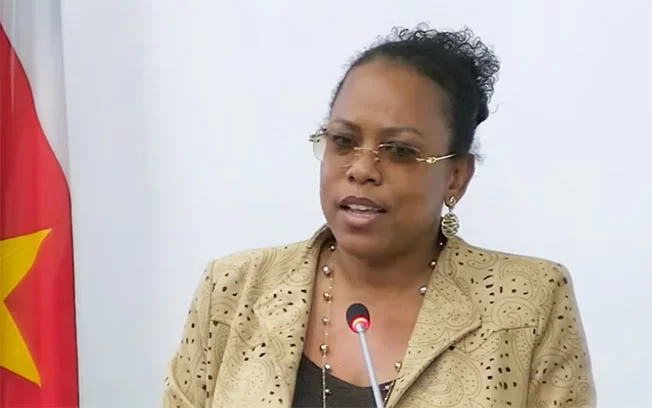
During parliamentary debate on proposed new tax collection legislation, National Assembly member Rossellie Cotino of the NDP party has outlined key gaps and proposed targeted amendments to create a fairer balance of rights between the tax authority and the taxpayers it serves.
Cotino, who serves on the committee of rapporteurs reviewing the bill, argues that the current draft focuses disproportionately on expanding the powers of the tax authority to recover outstanding taxes and associated costs, while failing to enshrine clear legal protections for taxpayers owed refunds for overpaid or wrongfully collected taxes. She emphasized that taxpayers need legal certainty that any improperly collected funds will be returned to them within clearly defined statutory timelines, and pressed the government to specify where in the national legal framework refund processes are formally regulated.
A core criticism from Cotino is that the proposed framework creates an imbalanced, one-sided system: it provides the state robust tools to collect taxes and pass collection costs onto taxpayers, but offers no clarity on how citizens and business owners can claim back funds they are owed, nor does it address whether taxpayers can recover the costs they incur when pursuing legitimate refunds.
Beyond refund protections, Cotino has raised questions over the bill’s provisions for collection interest. Under the current draft, the applicable interest rate is set solely by state decree, with no parameters outlined in the primary legislation. She has proposed codifying the foundational methodology for calculating this interest in the act itself, suggesting it could be benchmarked to the central bank rate or prevailing market rate for consistency and transparency. She also called on the government to clarify whether interest can be charged on unpaid collection costs, a point currently unaddressed in the draft.
Cotino also turned attention to the rules governing recoverable collection costs passed onto taxpayers, specifically highlighting Article 60 which regulates costs for publicizing planned asset sales to recover tax debt. She argued that allowing recovery of only actual incurred costs is insufficient; the legislation should explicitly require that all recoverable costs be reasonably necessary, protecting taxpayers from excessive, unnecessary charges. For example, she noted that advertising costs can vary drastically depending on whether notice is published on a government website or in a national print newspaper, with no current guardrails to prevent taxpayers from being billed for inflated, unnecessary advertising expenses.
To address the problem of outdated collection tariff schedules that require cumbersome legislative overhauls to update, Cotino put forward a concrete proposal for automatic annual indexation. Rather than fixing tariffs in legislation and updating them only through ad hoc state decrees, she recommends embedding an automatic annual adjustment tied to the consumer price index in the law. Adjustments would take effect each January 1, based on data from the General Bureau of Statistics (ABS), with revised tariffs formally published by December 1 of the preceding year to give taxpayers and businesses advance clarity. She noted that parliament previously required multiple time-consuming sessions to update an outdated tariff in the Funeral Act, and a statutory indexation rule would eliminate such cumbersome procedures entirely. She added that the model could also be adopted for tariff schedules in the Customs Act and other tax legislation to improve long-term efficiency.
Additional proposed changes relate to legal protections for taxpayers filing objections to collection measures. Cotino pointed out that Article 15 of the draft currently restricts the grounds for objection, and is missing an explicit allowance for objections when the amount claimed has been set too low, not just too high. She argued the amendment is necessary to account for a full range of scenarios that may arise in practice.
Cotino also proposed several technical legislative adjustments: splitting transitional and closing provisions into separate standalone articles, and framing reference to the responsible minister in general terms (i.e., the minister responsible for finance and tax matters) rather than using the current formal name of the Ministry of Finance and Planning. This change would avoid the need for future legislative amendments if the ministry’s name or institutional structure is modified.
Acknowledging that the government has already shown willingness to incorporate parliamentary proposals into the draft bill during the review process, Cotino expressed hope that her additional recommendations will also be integrated. She emphasized that tax authority reform should not only deliver more efficient tax collection, but also guarantee clear rights, reasonable costs and greater legal certainty for all taxpayers, both individual citizens and business owners.