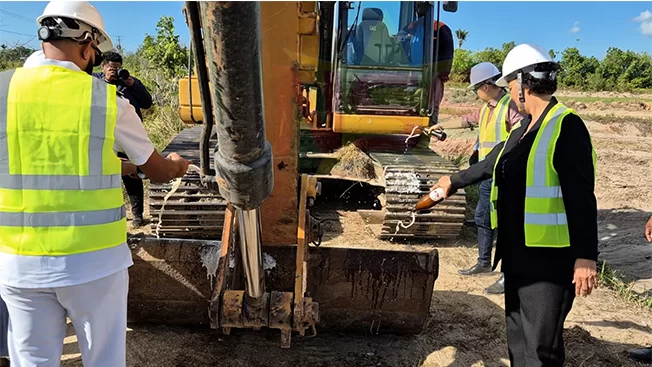
On Monday, officials from the government of Suriname and representatives of the Chinese Embassy marked the official groundbreaking of the China-Aid Low Income Housing Project in Reeberg, Wanica, putting to rest years of delays and budget uncertainties that threatened to shrink the scale of this landmark infrastructure initiative. First announced in 2017, the project is a full grant from the People’s Republic of China to Suriname, designed to expand access to affordable housing for low-income households in the South American nation. What was originally planned as a 350-unit development, however, faced years of setbacks on the Surinamese side that eroded the project’s budget and put its original scope at risk.
According to Stephan Tsang, Minister of Public Works and Spatial Planning (OWRO), repeated changes to the project’s proposed construction site between 2019 and 2025 drove unnecessary cost increases, even after design and approval processes wrapped up in August 2018. Each site adjustment required new environmental surveys, pre-construction preparation and permitting, which pushed up overall expenses. By 2022, the available budget could no longer cover the original 350 units, and by 2025, officials estimated only 248 units could be completed – a loss of 102 planned homes directly tied to Surinamese mismanagement.
“102 homes have been lost due to mismanagement on the Surinamese side. That is something to be ashamed of, and we must learn from this mistake,” Minister Tsang acknowledged during the groundbreaking ceremony. In an unexpected show of solidarity, China stepped in to cover the additional cost of restoring the project to its original 350-unit scope, a gesture that Surinamese officials have described as a powerful demonstration of the bilateral friendship between the two nations. The exact amount of additional funding China has committed to the project was not disclosed during Monday’s event.
Suriname’s President Jennifer Simons, who also attended the ceremony, thanked China for the generous grant, emphasizing that expanding access to affordable housing remains one of the most pressing policy challenges for her administration. “As a government, we are doing our best to provide homes for our people, but it is not an easy task, and we welcome all the support we can get,” President Simons said. She added that affordable housing is a foundational pillar for healthy family life, and the government is keenly aware of the urgent need across the country.
Simons also noted that three affordable housing projects are currently under construction across Suriname, and urged prospective homebuyers to monitor official announcements for updates on new housing opportunities and available financing options. Low-interest mortgage loans with rates of 3%, 5%, and 7% are currently available to help Surinamese households access homeownership, she added.
During the ceremony, both Chinese Embassy representatives and Surinamese government officials reaffirmed the deep, long-standing bilateral ties between the two countries. The housing project itself, Simons noted, stands as a tangible symbol of the cooperative partnership and enduring friendship between China and Suriname. Following the formal remarks, Minister Tsang carried out a symbolic groundbreaking ceremony, moving several cubic meters of sand with an excavator to mark the official start of construction. The project is expected to take two years to complete.