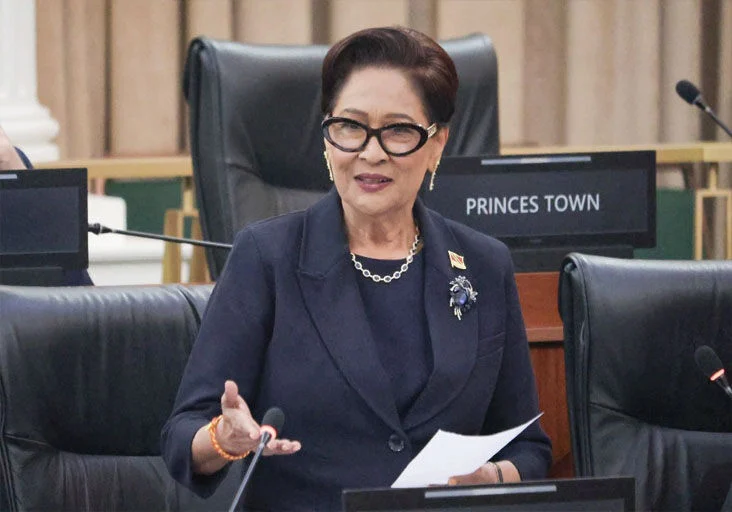
Hours ahead of Finance Minister Davendranath Tancoo’s scheduled presentation of the 2026/2027 national budget to Parliament, Prime Minister Kamla Persad-Bissessar has announced a major policy shift in the allocation of state resources, targeting misuse of public funds and reorienting spending toward productive, law-abiding citizens.
In a public statement shared across her official social media channels one day prior to the budget address, Persad-Bissessar framed the change as a long-overdue rebalancing of national priorities. The government will move away from systems that have enabled systemic misuse of public assistance, wasteful spending, and incentives for laziness, and redirect state revenue toward supporting productive economic activity and residents who contribute honestly to national progress, she explained.
“The Government will rebalance society in favour of the law-abiding, hard-working, honest citizens and away from rewarding laziness, illegality, irresponsibility and negative behaviours,” the Prime Minister emphasized.
While Persad-Bissessar stopped short of naming specific public assistance programs slated for adjustment, or outlining exact cuts or new policy measures set to be unveiled in the budget, her comments confirm that revisions to state spending frameworks and public welfare administration will feature prominently in the upcoming fiscal plan. She argued that national revenue should be directed to fueling economic growth and supporting workers who earn their incomes through honest work, rather than enabling bad faith actors who exploit public systems.
The Prime Minister called out widespread abuse of public resources, noting that some individuals have repurposed temporary welfare programs, public sector contracts, government assistance schemes, and public agency roles into long-term streams of personal illicit income. “These schemes are funded from the taxes of hardworking citizens who go out every day to improve their lives and contribute positively to our success as a society,” she said, adding that taxpayers should not be forced to continue funding indiscipline, deception, fraud and corruption that drains public coffers.
Persad-Bissessar also argued that some long-term recipients of state support remain trapped in hardship specifically because of poor work ethic, dishonest conduct, and negative attitudes toward self-improvement. “As your Prime Minister, I cannot allow the country’s progress to continue to be held back by those who refuse to take personal responsibility to improve themselves despite receiving incentives, contracts, benefits, and assistance from the State for years,” she stated.
Beyond the reallocation of welfare resources, the Prime Minister drew a clear distinction between her administration’s approach and that of previous governments, noting that her team has abandoned the long-standing practice of governing primarily to win upcoming general elections. Instead, she said, the administration’s core focus is on building lasting “peace, discipline, wealth and opportunities for seven generations into the future.”
As the country waits for the official budget release, independent economist Dr. Jamelia Harris has outlined key accountability measures the public should expect from the fiscal plan. In an interview with local outlet the Express on the eve of the presentation, Harris said the government must deliver a clear report on its progress toward past policy commitments, lay out a concrete path to revive economic growth, and explain how proposed policies will directly improve everyday citizens’ quality of life.
Harris specifically called for measurable updates on promises made in the previous national budget, centered on three core priorities: sustainable, high-quality job creation, broad economic diversification, and modernization of the country’s tax revenue collection systems. She noted that while the government identified sustainable job creation as a top fiscal priority for 2026, the past year has instead brought widespread job losses and rising unemployment rates. With the Prime Minister reaffirming job creation as a core goal, Harris said she expects the Finance Minister to detail both the past year’s achievements and a clear roadmap for creating fair, decent employment moving forward.
“I am interested in job creation, but job creation that is of good quality and fair,” Harris said.
The economist also highlighted that national labour force participation has still not recovered to pre-pandemic levels, dropping from roughly 60% before the COVID-19 outbreak to a steady 55% in the years since. She urged the budget to include targeted measures to both create new jobs and encourage more eligible residents to re-enter the labour market.
Harris also called for increased transparency and scrutiny for large-scale planned development projects, including the proposed steel plant, new data centre facilities, and initiatives under the government’s national economic revitalization plan. While these projects carry potential long-term economic benefits, she argued that the government must allocate funding for independent impact assessments that examine not just projected gains, but also wider economic, social, and environmental consequences before finalizing investment decisions.
Additionally, Harris pressed for an official update on the government’s prior commitment to strengthen tax administration by modernizing the Inland Revenue Division and the Customs and Excise Division. She noted that upgrading the capacity of these agencies was a core justification for scrapping the previously proposed Trinidad and Tobago Revenue Authority, so progress on this front is long overdue. Stronger revenue collection systems are critical to supporting long-term fiscal stability, she added.
Against a backdrop of ongoing economic headwinds impacting both the energy and non-energy business sectors, Harris said economic diversification remains a critical unmet priority. She called on the Finance Minister to assess progress on previous diversification proposals against current economic conditions, and explain how the government will address the growing trend of business closures across both major sectors.
Beyond specific fiscal measures, Harris called for a broader shift toward evidence-based policymaking in Trinidad and Tobago. She noted that robust research already exists to address many of the country’s most persistent challenges, from economic diversification to crime to educational attainment, but policy decisions are often disconnected from available data. “I would like to see a movement away from rhetoric to research, and from politicking to purpose and policy,” she said.