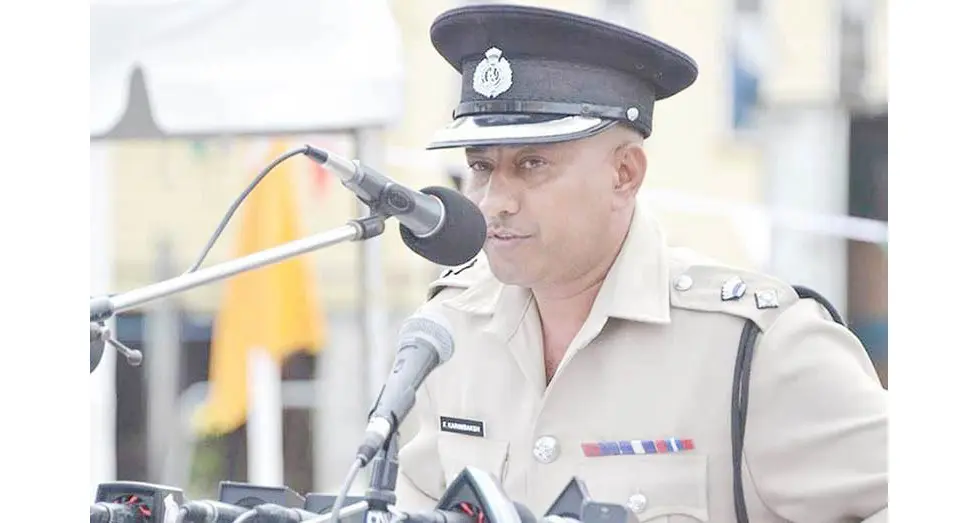
A high-stakes legal and institutional standoff has erupted in Guyana’s top law enforcement circles, after a senior police commander facing sexual assault allegations from a subordinate has refused to step aside for an ongoing probe, arguing that the body legally empowered to enforce disciplinary action against him does not currently exist.
Deputy Police Commissioner Fazil Karimbaksh, who also heads the Guyana Police Force’s (GPF) elite Special Organised Crime Unit (SOCU), was instructed by Police Commissioner Clifton Hicken in an October 7 correspondence to take either administrative or pre-retirement leave while the investigation into his alleged conduct unfolds. The GPF publicly confirmed the leave order on October 8, adding that the female police inspector who filed the rape and threatening behavior claims against Karimbaksh had already been reassigned from SOCU to the force’s Regional Police Division 4 ‘A’ as part of the process.
However, Karimbaksh has rejected the order outright through his legal counsel, Rizwaun Mohamed, who outlined his client’s position in a formal response letter dated October 10. In the letter, Mohamed directly challenged Hicken’s legal authority to impose the compulsory leave, arguing that no applicable statutory power or written delegation has ever granted the police commissioner the right to remove a deputy commissioner from active duty.
The core of Karimbaksh’s legal argument rests on Guyana’s institutional framework for police governance. Under the nation’s Constitution, formal disciplinary control over deputy police commissioners falls exclusively to the independent Police Service Commission (PSC), a body that requires a written delegation of authority to issue such directives. Currently, the PSC is not constituted, meaning it has no sitting members to exercise these disciplinary powers. Mohamed emphasized that the vacancy of the PSC does not automatically transfer its constitutional authority to the police commissioner or any other state body.
“A general reliance upon command authority does not resolve the distinct question of the legal basis for compelling my client’s absence,” Mohamed wrote in the letter. “Any such vacancy does not, of itself, transfer its powers to you or another authority.”
Beyond the core institutional dispute, Karimbaksh is also contesting the calculations for his entitled pre-retirement leave. While Hicken’s order pegged his accrued annualized vacation leave at 174 days, with a proposed start date of November 8, Karimbaksh argues he is only owed 118 days of leave. His legal team stressed that the reference to November 8 in communications does not constitute acceptance of the date or the underlying leave order.
Karimbaksh has also issued a clear legal warning: if the GPF attempts to force him out of his post before his scheduled retirement in April 2027, his legal team will immediately file formal court proceedings, seeking urgent interim injunctive relief alongside all other appropriate legal remedies and associated costs.
“For the avoidance of doubt, my client does not consent to compulsory pre-retirement leave on the basis presently advanced. He remains ready and available to discharge his duties and comply with lawful directions,” the letter stated. “His position must not be construed as acquiescence in an enforced absence, acceptance of the disputed leave calculation, or waiver of any right.”
As of Monday, efforts by independent media to obtain a full copy of Hicken’s original October 7 leave order have been unsuccessful, leaving key details of the top cop’s initial reasoning for the directive unavailable to the public. The standoff has now thrown a spotlight on the gaps in Guyana’s police disciplinary framework, created by the lack of a fully constituted oversight body, and set the stage for a high-profile court battle that could clarify the distribution of power within the nation’s law enforcement hierarchy.