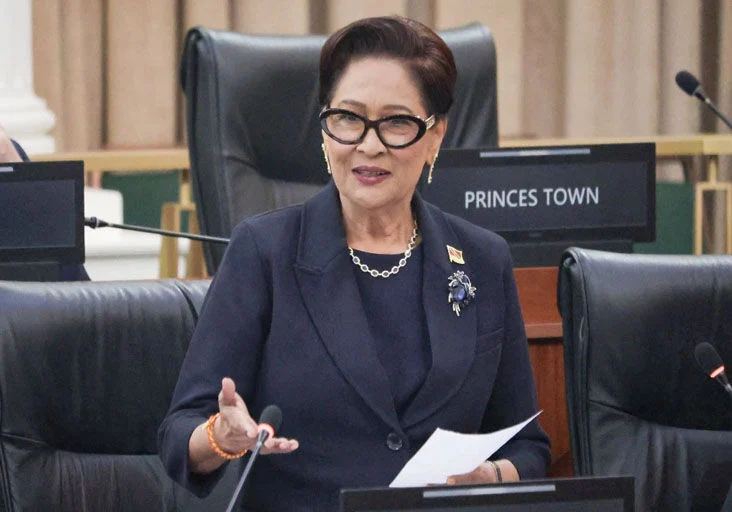
Ahead of Finance Minister Davendranath Tancoo’s presentation of the United National Congress (UNC) administration’s second national budget on the following day, Prime Minister Kamla Persad-Bissessar delivered a message of calm reassurance and measured hope to the people of Trinidad and Tobago. In an exclusive interview with the *Sunday Express*, the Prime Minister emphasized that the government remains laser-focused on advancing the public good, with core priorities centered on generating meaningful, long-term employment, expanding inclusive economic opportunity, and lifting overall quality of life for all citizens.
Persad-Bissessar acknowledged that the public is eager to see a full reversal of the country’s economic and social challenges, but stressed that national rebuilding is a gradual process that cannot be rushed. She framed the current government’s work as laying the critical groundwork for a safer, more resilient, and more prosperous future for Trinidad and Tobago, noting that the administration has spent its time in office undoing the damage left behind by the previous People’s National Movement (PNM) government while stabilizing national institutions.
“Transformation doesn’t happen overnight, but the wheels of progress are already turning, and we are fully committed to delivering lasting, meaningful results for the Trinidad and Tobago people,” she stated. “We are strengthening our systems, rebuilding our communities, and delivering on our promises. The results we have already achieved prove we are moving in the right direction.”
The budget, to be tabled less than a year after the UNC won the April 28, 2025 general election, will be rooted explicitly in the administration’s people-first governing philosophy, Persad-Bissessar confirmed. She explained that the document is designed to translate national development goals into tangible, visible improvements in the daily lives of ordinary citizens, rather than focusing on abstract economic metrics or symbolic projects.
“This budget embodies a people-centered approach to delivering the public goods and services that every community across Trinidad and Tobago depends on,” she said. The Prime Minister added that the government has already made substantial progress in fulfilling the campaign promises laid out in the UNC’s election manifesto, which forms the foundation of the administration’s governing agenda. Looking ahead, the next phase of national development will prioritize four key pillars: expanded employment opportunities, attracting targeted new investment, diversifying the national economy, and strengthening the public institutions that underpin long-term shared prosperity.
Persad-Bissessar emphasized that she maintains close, ongoing connections to the concerns of everyday citizens, making a deliberate effort to read the emails, text messages, and correspondence that members of the public send directly to her office. She understands that people want more than empty campaign promises or positive macroeconomic statistics – they want stable work, financial security, and the assurance that their children will have the opportunity to build successful lives at home in Trinidad and Tobago.
“People want to know that their hard work will pay off with a better quality of life, and that is what matters most,” she said. “At the end of the day, this budget has to mean something to the people who wake up every single morning to build this country. We know far too many families are struggling right now, and this UNC government will never turn a blind eye to that hardship.”
She added that the ultimate measure of the government’s success will not be counted in the number of new projects announced or the total value of investment secured, but in whether ordinary residents actually feel and experience meaningful improvements in their daily lives. “Our goal is a budget that delivers – one where the benefits actually reach the people who need them most,” she said.
One of the administration’s most significant achievements to date, Persad-Bissessar argued, has been the marked improvement in national security – a foundational step for broader economic recovery, she stressed. During the 2025 election campaign, the two top concerns raised consistently by voters were violent crime and widespread unemployment, and the UNC recognized from day one that no meaningful economic progress could be made without first addressing the country’s escalating crime crisis.
Persad-Bissessar pointed to the severe levels of violence that marked the final year of PNM rule, noting that 2024 saw 625 murders across the country, one of the deadliest periods in Trinidad and Tobago’s modern history. Beyond the devastating loss of innocent lives, including children, that wave of violence eroded investor confidence, deterred existing businesses from expanding, and blocked the creation of the sustainable jobs the country so desperately needs, she explained.
Under the current administration, an aggressive, targeted anti-crime strategy has already helped restore a broader sense of security and stability across the country, she said. The government has focused on dismantling transnational and local criminal networks, boosting resources and training for law enforcement, and ending the era of impunity that allowed criminal actors to operate openly. Today, Trinidad and Tobago is safer than it has been in years, creating an environment where businesses can invest with confidence, communities can grow and thrive, and citizens can pursue their goals without living in constant fear of violence.
Persad-Bissessar emphasized that economic expansion, foreign direct investment, job creation, and national security are deeply interconnected. As such, the progress made in tackling violent crime is not just a win for public safety – it is a core component of the government’s broader national economic recovery strategy, laying the groundwork for inclusive, long-term growth that benefits all sectors of Trinidad and Tobago society.