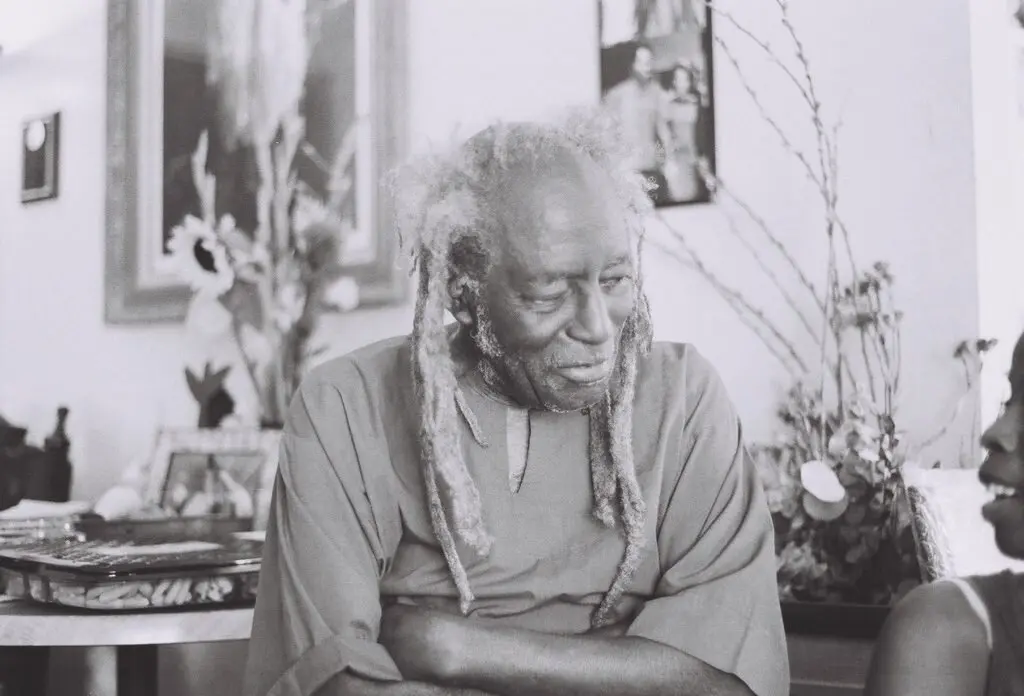
Guyana’s last surviving pioneering visionary of national independence and universal adult suffrage, Eusi Kwayana, passed away at the age of 101 on Saturday, October 10, 2026, at his residence in Atlanta, Georgia, United States. Over a life spanning more than a century, Kwayana shaped every phase of Guyana’s journey from British colonial rule to self-governance and independent statehood, leaving an indelible mark on the nation’s politics, culture, education and social fabric.
Born Sydney Evanson King in April 1925 in Lusignan, East Coast Demerara, Kwayana moved to the historically pivotal village of Buxton with his family at age seven. It was here that he first cultivated his commitment to grassroots community organizing, a value that would anchor his decades-long career. He entered public service extraordinarily early, working as a primary school teacher at just 15 years old, and by the 1940s, he had become active in local village affairs, laying the groundwork for his lifelong political activism.
In 1947, Kwayana joined a cohort of activists led by Dr Cheddi Jagan to co-found the People’s Progressive Party (PPP), the political force that would lead the charge for self-governance in British Guiana. When the PPP won the colony’s first election under universal adult suffrage in 1953, Kwayana took office as Minister of Communication and Works in the nation’s first elected government. That historic administration was cut short just months later, when British colonial authorities, alarmed by the PPP’s progressive agenda, suspended the colony’s constitution, removed the elected government from power, and reimposed direct rule. Kwayana was detained by colonial officials in 1954 during a widespread crackdown on anti-colonial organizing.
Following the 1955 split of the PPP into racially aligned factions, Kwayana’s political journey led him to the People’s National Congress (PNC), where he served as General Secretary and editor of the party’s official newspaper, *New Nation*, after earlier holding the role of Assistant General Secretary. A committed Pan-Africanist focused on advancing cultural consciousness and political empowerment for African Guyanese, Kwayana co-founded the African Society for Racial Equality (ASRE) in 1961, followed by the African Society for Cultural Relations with Independent Africa (ASCRIA) in 1964. It was during this period that he formally changed his name from Sydney King to Eusi Kwayana – a Swahili phrase meaning “Black Man of Guyana” – to reflect his political and cultural identity. He also held a series of key public roles through the 1960s and early 1970s, including head of the National Land Settlement Committee, chairman of the Guyana Marketing Corporation, and lead of the committee that established Guyana’s Cooperative Bank.
In 1974, Kwayana achieved another milestone in his political career when he co-founded the Working People’s Alliance (WPA), a multiracial progressive political movement focused on democratic participation, social justice, and working-class representation. He remained a committed member of the WPA for 52 years until his death, serving as an executive committee member, Member of Parliament, and de facto editor of the party’s publications *Open Word* and *Dayclean*. He worked closely alongside iconic Guyanese activist and scholar Dr Walter Rodney during the WPA’s formative years, and later documented Rodney’s life and assassination in the book *Walter Rodney: His Last Days and Campaigns*. In 1985, he became the WPA’s sole elected representative in Guyana’s National Assembly, serving during a pivotal era of political transition for the country.
Beyond electoral politics, Kwayana made far-reaching contributions to Guyana’s education and cultural life. In 1956, he founded County High School (later renamed Republic Cooperative High School) in Buxton and served as its principal, expanding educational access for working-class young people and strengthening community institutions. A prolific writer, playwright, and historian, he published more than a dozen major works examining core themes of Guyanese life, including colonialism, labor struggles, race relations, and political development. Notable titles include *The Bauxite Strike and the Old Politics*, *Scars of Bondage*, *Guyana: No Guilty Race*, and *Genesis of a Nation: The Indo-Guyanese Contribution to Social Change in Guyana*. He won the Best Play prize in the Youth Category at the 1965 British Guiana Drama Festival for *The Promised Land*, and in a unique contribution to Guyanese political culture, he wrote the iconic battle songs for the PPP, PNC, and WPA – the nation’s three major political parties.
In his personal life, Kwayana’s commitment to Pan-Africanism shaped his relationships. He married Tchaiko Kwayana, an American Pan-Africanist and civil rights activist, in 1971, with a wedding ceremony incorporating traditional Yoruba rites; she passed away in 2017. Kwayana retired from active public life in 2002 and relocated to the United States, where he remained until his death.
In an official statement announcing Kwayana’s passing, the WPA described him as the “Sage of Buxton,” noting that “his fingerprints and footprints are inseparable from 80 years of Guyanese history.” The party hailed him as a pioneer of Guyana’s post-colonial order, a leader who never compromised his integrity, and the modern founder of the nation’s independent radical political tradition. “Guyana has lost the last of its original independence visionaries — one of Guyana’s priceless gifts to itself,” the statement read, calling on Guyanese to celebrate Kwayana’s extraordinary life rather than mourn his passing.
WPA co-leader Professor David Hinds remembered Kwayana as one of Guyana’s most enduring political figures, whose legacy extended far beyond party politics to shape the nation’s collective identity. From grassroots community organizing to national government, from classroom teaching to published scholarship, Kwayana spent his 101 years advancing the causes of democracy, social justice, anti-corruption, and working-class welfare – leaving a legacy that will continue to shape Guyana for generations to come.