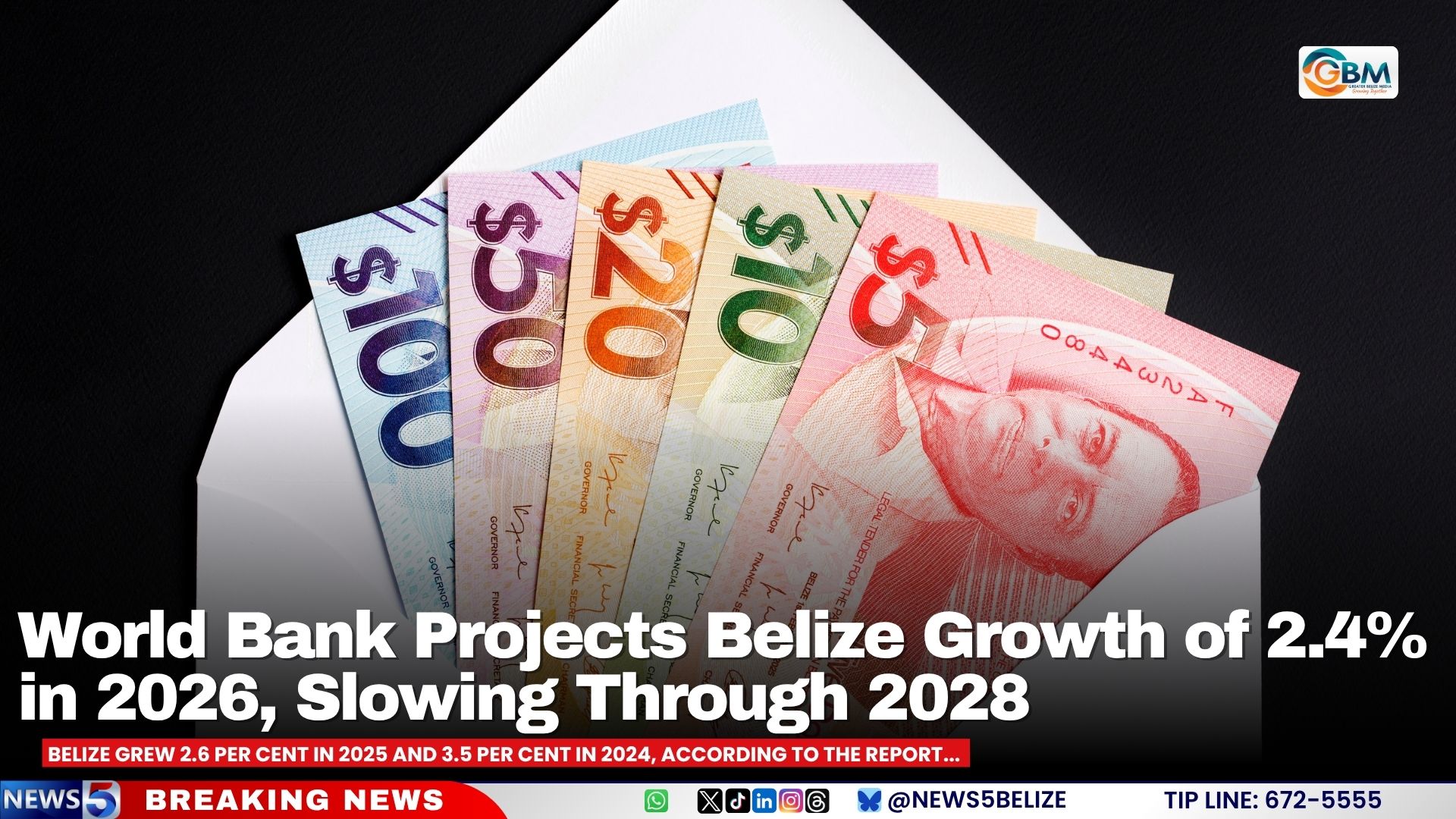
The latest Latin America and the Caribbean Economic Update released by the World Bank has laid out a clear growth trajectory for Belize’s small open economy, projecting a 2.4% expansion for 2026 followed by a gradual deceleration to 2.2% in 2027 and 2.0% by 2028. This forecast comes on the heels of solid performance in the two preceding years, with the small Central American and Caribbean nation recording 3.5% growth in 2024 and 2.6% growth in 2025, according to the report.
Beyond Belize-specific projections, the report paints a nuanced picture of the broader Latin America and Caribbean region as a whole. The World Bank forecasts regional aggregate growth will cool to 2.2% in 2026, down from 2.4% in 2025. While the bank notes that the region has shown surprising resilience in the face of repeated global external shocks, it emphasizes that current growth rates do not reflect the region’s full economic potential. Persistent structural headwinds, including stubbornly sticky inflation, constrained government fiscal space, and elevated real borrowing costs, are continuing to drag down private sector consumption and investment across much of the region.
One of the report’s key takeaways is the growing divergence in growth trajectories across different countries in the region. A handful of economies, including Argentina, El Salvador, Paraguay, Panama, and the Dominican Republic, have outperformed peers, a result the World Bank attributes to consistent, durable policy decisions. Within the Caribbean subregion, the contrast is particularly stark: Guyana and Suriname are experiencing rapid, energy-fueled expansions, while tourism-dependent island economies are navigating a slower, more mature post-pandemic recovery, weighed down by soaring energy and transportation costs. The report adds that Caribbean economies heavily reliant on food and energy imports face a dual strain of higher import bills and softer-than-expected tourism demand.
On the risk front, the World Bank warns that the balance of risks is firmly tilted to the downside. Volatility in global energy prices stemming from ongoing conflict in the Middle East could halt progress on reducing inflation, forcing central banks to maintain tight monetary policy for longer than markets currently expect. Additionally, the El Niño weather pattern poses major threats to regional production and price stability: it can trigger severe droughts that disrupt hydropower generation and agricultural output, as well as extreme rainfall events that damage infrastructure and disrupt supply chains, both of which push up food and energy prices. In response, several regional governments have already activated early warning systems, pre-positioned emergency supplies, and secured contingent disaster financing to prepare for potential shocks.
The report’s second chapter devotes special attention to the opportunities and challenges of artificial intelligence (AI) adoption across the region. The World Bank argues that AI holds significant potential to lift regional productivity, but only if countries proactively build the necessary infrastructure and capacity to leverage it. Contrary to common assumptions, the report notes that Latin America and the Caribbean does not need to invest billions of dollars to develop cutting-edge frontier AI models. Instead, governments should prioritize expanding access to “small AI”: low-cost, customized tools designed to solve specific local challenges that can be accessed by most populations through basic mobile devices.
The report estimates that 78.1% of the region’s workforce holds jobs centered on physical, on-site work, and it warns that informal workers only avoid automation displacement because of their currently low wages, a precarious protection that is not sustainable long term. To help the region capture AI’s benefits while mitigating disruption, the World Bank is calling on regional governments to upgrade national data governance systems, procure AI-powered digital tools to improve public service delivery, fund outreach and support services to help small and medium enterprises adopt AI tools, and invest in targeted worker reskilling programs to prepare workforces for the changing labor market.