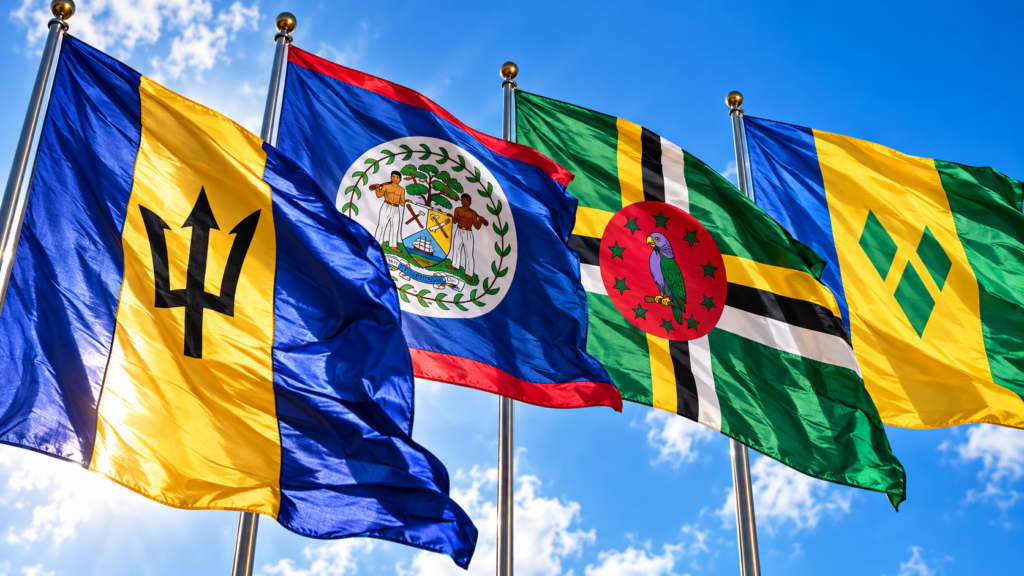
One year after a landmark regional integration initiative launched by the Caribbean Community (CARICOM), preliminary outcomes show that more than 900 CARICOM nationals have secured indefinite residency rights in four participating countries advancing free movement under an enhanced cooperation framework.
The groundbreaking free movement regime, which took effect on 1 October 2025, counts Barbados, Belize, Dominica, and Saint Vincent and the Grenadines as its founding participating members. Under the terms of the arrangement, eligible nationals from any participating member state may enter another participating nation, reside there indefinitely, seek and hold employment without needing a mandatory work permit, and access a pre-defined set of public services aligned with each country’s national regulations.
As the bloc celebrates the initiative’s first anniversary, official implementation reports submitted by all four member states confirm that the program is fully operational, and is already delivering tangible gains by expanding cross-border labor mobility, increasing employment opportunities for regional workers, and streamlining access to critical designated services for qualifying CARICOM citizens. All four participating states have either enacted new legislation or updated existing regulatory frameworks, adjusted administrative processes, and established dedicated institutional structures to support smooth implementation of entry, residency, employment, and contingent rights access under the regime.
Breaking down national-level implementation data, Barbados — the largest processing hub for applications over the 10-month reporting period from 1 October 2025 to 31 July 2026 — reviewed 918 requests. Officials noted that rollout across the country has been largely seamless, backed by consistent inter-agency coordination and targeted public outreach to inform eligible citizens of the program’s benefits and requirements. Belize, meanwhile, has granted approved free movement status to 146 beneficiaries, nine of whom have since completed registration with the country’s Social Security Board to access relevant social protections. Dominica has processed five approved applications, while Saint Vincent and the Grenadines has facilitated seven successful requests to date.
In total, the four participating states have processed 939 applications for indefinite stay. A portion of these beneficiaries already resided in their host member state prior to the program’s launch on 1 October 2025.
While the first year of implementation has delivered significant, measurable progress toward deeper regional integration, official reports also highlight key gaps that require targeted attention across all participating members. Priority areas for improvement include standardized application registration processes, more robust cross-border data collection and management systems, strengthened monitoring and mandatory reporting frameworks, expanded public awareness campaigns, and increased capacity building for key stakeholders interacting with program applicants.
Speaking on the anniversary milestone, Ambassador Wayne McCook, Assistant Secretary-General for CARICOM Single Market and Trade at the CARICOM Secretariat, emphasized that the early experience of the four founding participants proves that a regional free movement regime is viable for the bloc. “Their progress, lessons learned, and emerging best practices provide a clear roadmap for other CARICOM member states that are currently preparing to join the free movement framework approved by CARICOM Heads of Government under the Enhanced Cooperation mechanism,” McCook explained.
Looking ahead to the regime’s second year of implementation, McCook reaffirmed the CARICOM Secretariat’s unwavering commitment to ensuring that the free movement system remains accessible, transparent, predictable, and responsive to the evolving needs of all CARICOM nationals across the region.