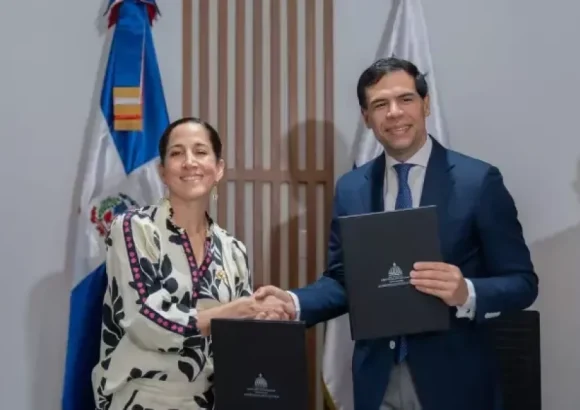
On the sidelines of the XXVIII Santo Domingo International Book Fair (FILSD 2026), where Panama holds the position of guest of honor, the two Latin American nations took a major step forward in cultural collaboration this Saturday by formalizing a landmark bilateral agreement to advance joint film and audiovisual projects.
The official signing ceremony was completed by Panama’s Minister of Culture María Eugenia Herrera and Dominican Minister of Culture Roberto Ángel Salcedo. According to Panama’s Ministry of Culture, the new agreement is designed to reinforce cross-border cooperation, unify shared resources, production capabilities, and creative talent from both countries, and drive overall growth of the regional film and audiovisual industry.
In an interview with EFE, Herrera outlined the core goals of the new framework. The agreement’s central mission, she explained, is to empower creative artists by acting as a connecting bridge between creators and film production companies, while catalyzing growth of the private creative sector. “The industry needs to be strengthened, and our role as a ministry is just that organizational bridge that lets artists take the lead in development, while incentivizing private investment to support filmmakers and broader cultural progress,” she added.
Both nations are already signatories to the broader Latin American Film Co-production Agreement, and officials note that this new bilateral deal creates a targeted, streamlined framework to deepen that existing partnership, removing administrative and logistical barriers to launching collaborative projects. For Panama, the agreement also opens new doors to expand international engagement and create more opportunities for Panamanian producers and industry professionals to join large-scale regional initiatives.
Herra also emphasized that creative industries are a major contributor to national gross domestic product and broader economic development, and praised the Dominican Republic’s well-documented, successful track record of growing its domestic film sector in recent years.
Beyond the new film agreement, Panama’s guest of honor status at FILSD 2026, which concludes its run this Sunday, has featured a packed schedule of cultural exchanges showcasing Panamanian art and creativity to Dominican audiences. Herrera highlighted standout events including a September 28 performance of the iconic Russian ballet *Swan Lake* by the Panamanian National Ballet. She also drew attention to the Panama Symphony Orchestra, which is celebrating its 85th anniversary this year and scheduled a major performance at Santo Domingo’s National Theater for the same Saturday the film agreement was signed.
More than 35 Panamanian writers have taken part in fair activities, holding collaborative sessions and exchanges with Dominican literary creators, while over 250 Panamanian artists across disciplines have participated in the event. Herrera extended thanks to the Dominican people for what she called their warm, brotherly hospitality throughout the fair.
“This collaboration proves that art is meant to be shared, that exchanging culture deepens the bonds between our peoples, and that we are united by common ground even as we celebrate our beautiful diversity. We are both multicultural and multiethnic nations,” Herrera said. “Panama seeks to connect with the entire world, and the best way to let people get to know us is through our culture and our artists – they are the living voice of our nation.”
For his part, Salcedo praised the commitment and enthusiasm Panama brought to its guest of honor role, noting that the participation of the Panamanian National Symphony Orchestra, National Folkloric Ballet, and delegation of more than 30 Panamanian writers demonstrated the country’s deep dedication to cultural exchange.
Speaking about the new film co-production agreement, Salcedo explained that the deal will enable joint projects that leverage the existing supportive structure of Dominican film law, as well as the stunning, diverse natural landscapes both Panama and the Dominican Republic offer.
These collaborative productions, he noted, will advance regional integration and strengthen the Latin American film ecosystem as a whole – a priority that Central America and the entire Latin American region must continue advancing. Salcedo called the agreement a high-impact first step that lays the groundwork for a far broader, more diverse regional audiovisual sector.
“It is a first step of extremely high value, of great significance in creating a much broader and more diverse base in the audiovisual world,” he said.