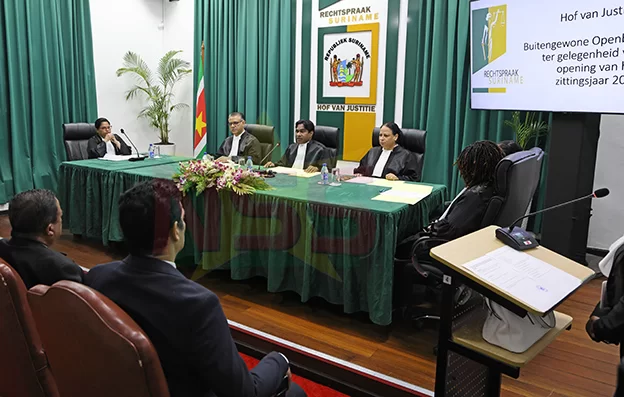
On the opening day of its new judicial term this Friday, the Suriname Court of Justice marked a key milestone: the addition of 15 new judges to strengthen its roster. However, court president Iwan Rasoelbaks made clear that the Surinamese judiciary still grapples with a crippling understaffing crisis that threatens its ability to deliver timely, fair justice to citizens.
Rasoelbaks credited productive dialogue between the executive and judicial branches for making the recent expansion possible, extending public praise to Suriname’s president and sitting government for their collaboration. “This is what true strengthening of the judiciary looks like,” he said in his opening address. “Chapeau to the president and the cabinet; congratulations to Suriname’s rule of law.”
In his remarks, Rasoelbaks pushed back against the idea that constructive friction between branches of state is a sign of systemic weakness. Instead, he argued that controlled tension and reciprocal checks and balances keep all state bodies and the broader legal community accountable and focused on upholding constitutional governance. “These exchanges keep all parties sharp on the principles of the rule of law and the balance of power between branches,” he explained, noting that this open dynamic fosters a shared understanding of how democratic institutions should function.
With the addition of the 15 new judges, the court now has a total of 45 sitting justices. This expansion, Rasoelbaks noted, allows the institution to make meaningful progress toward its goal of delivering timely, accessible justice across first-instance, appellate, and disciplinary cases. The court is also advancing efforts to decentralize judicial services across the country, a milestone that will be marked next Monday when the first court session in Albina is held after a multi-year hiatus.
Despite these gains, Rasoelbaks emphasized that operational pressure on the court remains far from alleviated. To meet international standards that set a benchmark of one judge per 10,000 residents for efficient, sustainable justice delivery, the court requires an additional 15 judges even under current circumstances.
The staffing gap is set to widen dramatically in coming years as a wave of retirements looms. If a proposed legislative change to lower the mandatory retirement age for judges to 65 moves forward, 10 justices will retire immediately. Even if the current retirement age of 70 remains in place, 12 sitting judges will step down within the next five years.
To shore up long-term capacity, the court is planning to launch a new four-year judicial training program in 2027, with the goal of selecting at least 10 qualified lawyers to train for the bench. The court has also submitted several draft pieces of legislation to parliament: if approved, these bills would introduce multi-judge panels for complex civil and criminal cases in first-instance hearings, and formalize specialized tax judicial processes.
Beyond staffing shortages, Rasoelbaks outlined another major source of uncertainty: proposed legal and constitutional changes that could reshape the judiciary and its institutional structure. The court has already sent formal correspondence to the government and parliament raising concerns, and Rasoelbaks said these worries remain “very large” as long as constructive tripartite dialogue between the three branches of state is not held. This uncertainty, he added, is already complicating long-term policy planning for 2027.
Rasoelbaks called for urgent, constructive negotiations between all three state branches to clarify the ground rules, institutional safeguards, and structure for the ongoing modernization and strengthening of the judiciary. “We all share the same goal: a stronger judiciary for Suriname,” he noted rhetorically. “The only question that remains is how we will get there, and what shape that work will take.”
In recent years, the court has built expertise on judicial modernization through partnerships with the Supreme Court of the Netherlands, the Dutch Council for the Judiciary, and the Caribbean Court of Justice. These collaborations have focused on developing a framework to structurally, responsibly govern, modernize, and strengthen judicial services. The insights from these partnerships have already been integrated into draft legislative proposals, which outline a new court organizational structure and a third-tier judicial body, all designed to benefit Suriname’s rule of law and its citizens. If advanced, these reforms are expected to lay the groundwork for a more robust judiciary and more equitable access to justice across the country.