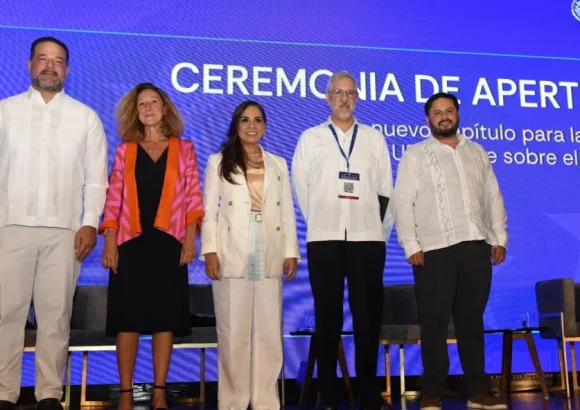
Cancún, Mexico — When 350 stakeholders from 45 countries and territories gathered in the Mexican coastal state of Quintana Roo for the Fourth EU-Caribbean Global Gateway Conference on Sargassum, a cross-border consensus took center stage: the growing tide of invasive Sargassum can only be contained through coordinated, cross-sector regional action. Leading calls for this unified approach, Dominican Republic’s Minister of Environment and Natural Resources Paíno Henríquez outlined that any effective response must be built on three core pillars: proactive anticipation, multi-stakeholder coordination, and open cross-border knowledge exchange.
Unlike localized environmental issues, Sargassum’s rapid spread does not recognize national boundaries. As Henríquez emphasized in his keynote address, shifts in open-ocean Sargassum growth eventually impact coastlines, marine ecosystems, and coastal livelihoods across the entire Greater Caribbean region. Fishing operations, tourism economies, and the daily lives of thousands of coastal residents hang in the balance, making isolated national efforts inherently insufficient.
“What happens offshore affects our coasts, ecosystems, fishing, tourism, and the lives of thousands of people. And precisely because it knows no borders, we cannot pretend to face it individually. This is a shared challenge, and we must face it as a team,” Henríquez told conference attendees.
The Dominican Republic is already shifting its own national strategy from reactive cleanup to proactive, integrated management, the minister shared. Where past efforts centered solely on stockpiling harvested Sargassum from shorelines, the country is now building out layered monitoring systems that combine satellite and geospatial data with on-the-ground field teams to track blooms before they make landfall.
For this new framework to work, Henríquez stressed, coordination across every segment of society is non-negotiable. National governments, local municipal bodies, private industry, academic institutions, the global scientific community, and local coastal populations must all align under clear shared protocols. Even routine cleanup work, he noted, requires strict adherence to science-backed guidelines to avoid unintended harm: sand removal operations must follow technical standards to prevent irreversible beach erosion, damage to coral reefs and mangrove habitats, and disruption to critical sea turtle nesting areas.
“It’s not simply a matter of showing up with a machine and removing what we find. We have to intervene with the awareness that we are acting upon an ecosystem,” Henríquez said. “We need to understand the beach, use the right equipment, measure what we’re doing, and evaluate the results.”
On the national level, the Dominican Republic has laid out concrete targets to back this strategic shift: by 2027, the country aims to sustainably manage 150,000 metric tons of Sargassum biomass. With financial and programmatic support from the European Union, the government launched an international call for innovative solutions across the entire Sargassum value chain, drawing 45 submitted proposals from 10 countries. The United Nations Food and Agriculture Organization (FAO) provided technical support to evaluate these submissions.
Beyond monitoring and cleanup, the country is actively exploring viable pathways to repurpose Sargassum biomass into marketable, useful products, creating new economic opportunities from the environmental challenge. All potential uses are held to strict standards, requiring environmental safety validation and alignment with peer-reviewed scientific evidence. The end goal is a model that balances ecological protection, scientific rigor, and long-term economic viability by connecting global research, technical innovation, and local operational capabilities.
Henríquez argued that cross-border knowledge sharing is one of the most impactful forms of regional cooperation, eliminating redundant work and accelerating the rollout of proven solutions. “We don’t have to solve the same problem twenty times in twenty different countries. If a solution works, we have to share it. We have to share information, experiences, research, technology, and knowledge. That is true regional cooperation,” he said.
He called for continued investment in strengthening collaboration across all Greater Caribbean nations, turning existing collective knowledge and capabilities into tangible on-the-ground action to address a phenomenon that impacts every coastal community in the region.
Co-hosted by the European Union and Mexico’s Ministry of Environment and Natural Resources (Semarnat), in partnership with the Quintana Roo state government, the two-day conference brought together representatives from national governments, private enterprises, academic institutions, global financial bodies, and international intergovernmental organizations.
In closing, Henríquez reaffirmed that successfully tackling the Sargassum crisis depends on sustained collaboration across borders, sectors, and stakeholder groups. “We have to do it with science, with awareness, and together. Because united we can do so much more for our environment,” he said.