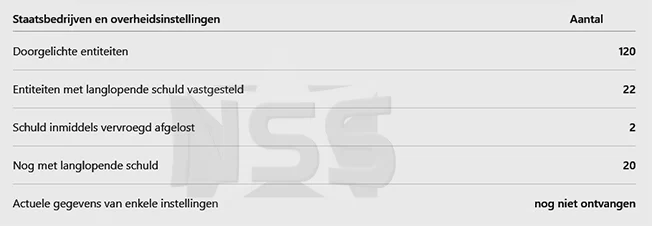
The government of Suriname is rolling out enhanced oversight of long-term debt held by state-owned enterprises, parastatal entities and public agencies, a proactive policy reform designed to stop unanticipated financial distress at these organizations from creating unplanned burdens on the national public budget. A recent comprehensive screening of 120 state-linked entities identified 20 that currently hold outstanding long-term debt obligations, a figure down from an initial count of 22 after two entities completed early repayment of their liabilities, the government confirmed in official planning documents released earlier this month.
Under the new framework, the country’s Debt Management Office has been assigned a formal mandate to centralize collection of debt data and issue regular public reports on outstanding liabilities across all state-linked entities. The core goal of this institutional change is to detect hidden budget risks at an earlier stage and implement targeted control measures before small-scale problems escalate into larger fiscal crises.
The entities with outstanding long-term debt include both financial and non-financial public institutions. Prominent financial institutions on the list are the Central Bank of Suriname, the Suriname Post Office Savings Bank, the Volkskredietbank Foundation, and the National Development Bank of Suriname. Among non-financial state-owned enterprises and agencies with outstanding long-term debt are major public service providers including Staatsolie Maatschappij Suriname, the national electricity utility EBS, the water utility SWM, the land management agency SLM, national telecommunications provider Telesur, the Airport Management Authority, mining firm Grassalco, the Paramaribo Academic Hospital, the National Health Insurance Fund, and two additional public agencies MAS and BGVS.
A key unresolved issue highlighted in the government’s 2027 Annual Financial Plan is the lack of updated debt data from several high-profile state entities, including CEVIHAS, FAI, the Port Authority of Suriname, and Canawaima Management Company. Authorities noted that closing these data gaps will be a priority in the first phase of the expanded monitoring program.
The 2027 National Debt Plan explicitly lays out the rationale behind the government’s push for greater transparency and oversight. The expansion of monitoring will be rolled out in a phased sequence to build a complete, accurate picture of all potential financial obligations and contingent risks that the public sector could face. The policy focuses specifically on obligations that could transfer to the national government if state-owned enterprises are unable to meet their own payment commitments.
To implement the new framework effectively, the government plans to secure targeted technical support to develop formal standardized guidelines for ongoing debt monitoring. The end goal is to detect financial risks and unplanned funding needs at an early stage, allowing policymakers to implement corrective interventions before these liabilities create downward pressure on the country’s overall public finances.