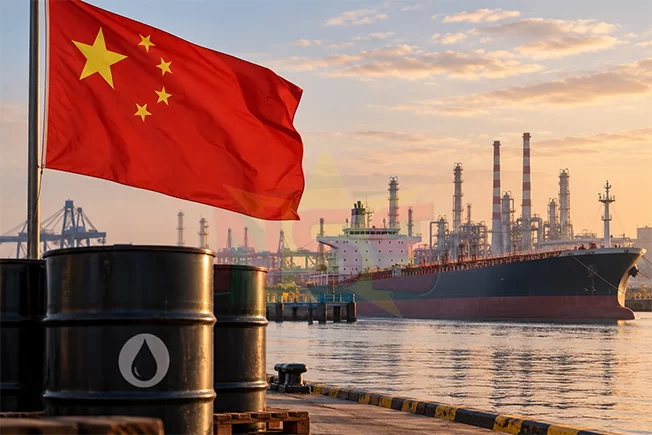
As of October 1, China’s major oil refining facilities have suspended exports of refined oil products to nearly all international markets, a policy shift that is expected to add further strain to an already strained global fuel market and drive up energy prices worldwide. Only exports to Hong Kong and Macau are exempt from the new restrictions, which stem from Beijing’s refusal to grant export quotas for October to the country’s leading refiners. The core goal of the move is to safeguard domestic fuel inventories amid ongoing domestic demand uncertainty.
State energy giant PetroChina has already scrapped multiple planned October shipments of gasoline and jet fuel, while Zhejiang Petrochemical, one of China’s largest private refining operators, has scheduled no export deliveries during the country’s Golden Week national holiday period that runs from October 1 to 7. It remains unclear how long the export restrictions will remain in place. Industry sources note that Beijing’s decision on whether to resume export approvals after the holiday will hinge on two key factors: the size of domestic fuel stockpiles and domestic refinery production levels.
The Chinese policy change comes at an extremely sensitive juncture for global energy markets, which are already grappling with widespread supply disruptions. Existing supply chain shocks from major producers in the Middle East and Russia, including recent attacks on Russian refining infrastructure, have already cut into global supplies of refined petroleum products. Compounding this uncertainty, the U.S. administration is also considering implementing restrictions on diesel exports in a bid to rein in skyrocketing domestic fuel prices. Former U.S. President Donald Trump confirmed Wednesday that an export ban remains under active review.
The global diesel market is particularly exposed to the latest disruption. Following news of China’s export suspension, Asian diesel production margins jumped to roughly $75 per barrel, hitting a one-week high. Market analysts warn that if Chinese supply remains off the market for an extended period, both diesel and jet fuel will face significant additional upward price pressure. China boasts the world’s largest crude oil refining capacity, and in times of global deficit, it has long served as a critical supplementary supplier to international markets – a role that is now temporarily sidelined. As recently as August, China exported 6.01 million tons of oil products, marking a 12.7% year-on-year increase in outbound shipments.
Global crude oil prices also moved sharply in response to the new development. Benchmark Brent crude climbed around 2% to trade near $100 per barrel, while U.S. West Texas Intermediate crude settled at approximately $92.50 per barrel. Market volatility stems from widespread expectations that the reduction in Chinese fuel exports will widen existing global supply gaps.
For economies that rely heavily on fuel imports, a prolonged export restriction could have far-reaching impacts beyond just higher prices at the pump. Diesel is a foundational energy source for global freight transport, agriculture, construction, and industrial production, while higher jet fuel costs will directly raise operating expenses for the global aviation sector. In regions like the Caribbean, higher fuel and transport costs are expected to trickle down to push up prices for all imported consumer goods. If Beijing chooses to extend the export curb after October 7, what was expected to be a temporary adjustment could become the latest major disruption to an already fragile global fuel market.