On September 30, the Surinamese government officially delivered the 2027 draft national budget to the National Assembly, marking a key step in locking in the country’s fiscal framework for the coming fiscal year. The submission was held in conjunction with the annual address from President Jennifer Simons, and was accompanied by two complementary policy documents: the 2027 Financial Year Plan and the 2027 National Debt Plan.
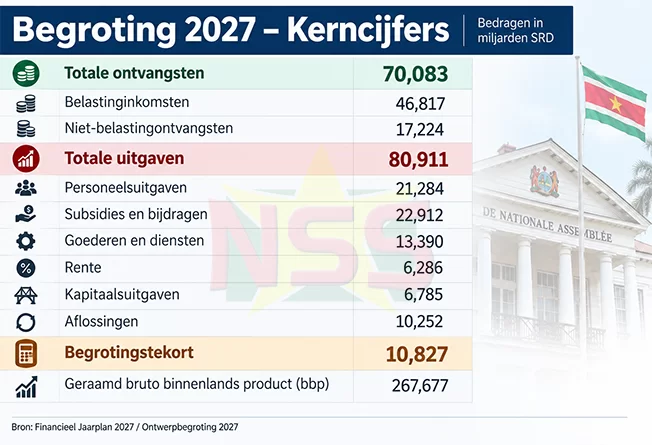
According to the official projections outlined in the budget documents, total government outlays for 2027 are forecast to hit SRD 80.9 billion, while total public revenues are estimated to reach approximately SRD 70.1 billion. This gap translates to a nominal overall budget deficit of roughly SRD 10.8 billion for the 12-month period.
Breaking down revenue projections, the Financial Year Plan shows that current revenues are expected to total SRD 64 billion. Of this sum, SRD 46.8 billion will come from various tax streams, with the remaining SRD 17.2 billion generated through non-tax revenue sources.
On the expenditure side, current spending is penciled in at around SRD 63.9 billion. Personnel costs, which have risen to SRD 21.3 billion, reflect the 15% wage adjustment implemented in September 2026 for public sector workers including civil servants, teachers, and security personnel, the plan explains. Subsidies and transfer contributions are allocated SRD 22.9 billion, while spending on goods and services is set at SRD 13.4 billion, and interest payments on existing public debt are projected at SRD 6.3 billion. Capital expenditure for infrastructure and long-term public projects carries a budget allocation of SRD 16.8 billion.
Fiscal analysts highlight that the planned primary deficit for 2027 sits at just SRD 78 million, which rounds out to effectively 0% of the country’s projected gross domestic product. The overall financing deficit is forecast at SRD 6.4 billion, equal to 2.4% of nominal GDP. The government’s baseline projections assume a total 2027 nominal GDP of SRD 267.7 billion.
The Financial Year Plan notes that three core factors are shaping overall public expenditure levels for 2027: available revenue streams, the implementation capacity of existing government programs, and the prioritization of high-priority policy initiatives. Beyond addressing near-term spending needs, Suriname’s 2027 fiscal policy is centered on four key long-term goals: reducing the country’s overall public debt burden, strengthening tax collection systems and compliance, improving overall public financial management, and positioning the domestic economy to capitalize on expected growth in the offshore oil and gas sector, a key emerging industry for the nation.