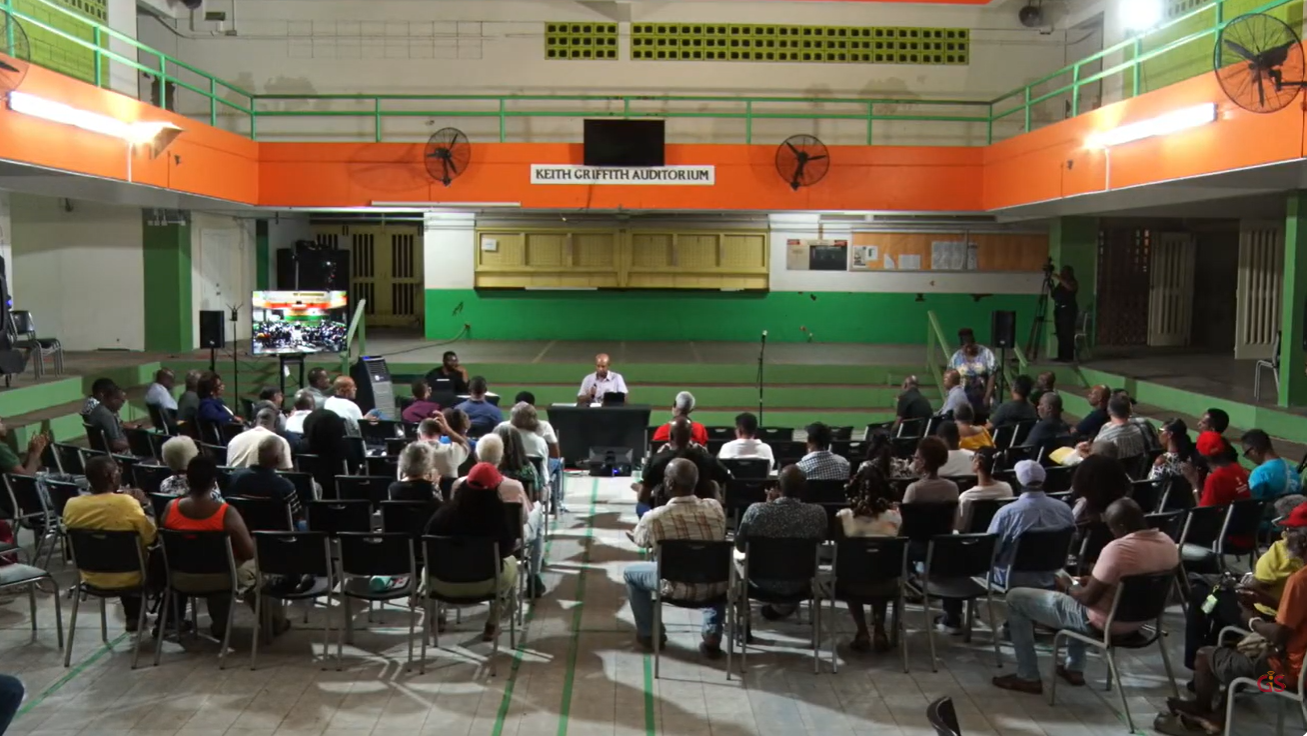
Local residents in Holetown are demanding that the current beachfront location of the town’s civic centre remain permanently zoned as public space, a push that comes as top government ministers have repeatedly clarified that no formal development application for a private hotel has yet been submitted for review. Professor Robin Mahon, speaking on behalf of the Sunset Crest Property Owners’ Association, told a public Ideas Forum held at Frederick Smith Secondary School on Monday that the community views this prime coastal real estate as far too valuable to be handed over to private commercial development.
The controversy traces back to early last year, when Prime Minister Mia Mottley announced a government plan: once the new Holetown Civic Centre is completed, the existing facility will be relocated inland to make way for a multi-story private hotel on the beachfront plot. Parliament approved the acquisition of land for the new civic centre in February 2025, and construction work at the Trents development site has been underway for three months. According to Mahon, the association’s alternative proposal is to retain the existing beachfront site for public use and upgrade it into a expanded multi-purpose coastal public space that serves the entire community.
Mahon explained, “We understand that once the new civic centre opens across the way, the old site is slated to become a multi-story hotel, but we have a far better vision for this space. If we retain its current status as a public coastal space, this site will deliver far greater benefits to Holetown and to Barbados as a whole.”
He went on to note that the 100-acre Sunset Crest community, which counts 314 lots, already has a robust existing tourism sector, including hotels, condominiums, rental villas, and apartments, totaling approximately 500 tourism units. The vast majority of these are locally owned, and collectively they support a large share of the area’s employment. Mahon emphasized that the community’s entire tourism offering depends on broad public access to expansive beach space, not just a narrow public corridor along the shoreline.
The current civic centre site is already heavily used by both residents and tourists for a wide range of activities, including beach recreation, water sports, and community events. Local small businesses, from street vendors and beach chair rental operators to water sports instructors, rely on public access to this space to earn their livelihoods. Mahon also highlighted the presence of Surfside Restaurant, local commercial fishers who operate nearby, and the site’s long-standing role as a venue for the annual Holetown Festival and other major community gatherings.
“Even if the developer sets aside a small portion of the site for public use, it would be nearly impossible to preserve all of the current functions that this space serves,” Mahon argued. “If we lose this current public access and functionality, Holetown will change beyond recognition from the town we know today.”
Mahon added that the association’s proposal would keep the site fully publicly accessible while upgrading it into a dynamic multi-use space that supports local livelihoods and fosters connection between residents and visitors.
In response to community concerns, Kerrie Symmonds, the Member of Parliament for the area, stressed that no final decision on the site’s future has been made. “The reality is that no proposal has been brought before Cabinet for a decision,” Symmonds stated. The MP said he could not confirm whether any formal application for a hotel development has been submitted, but added that all potential uses for the site should remain on the table for consideration. “If this were a straightforward decision, it would have been made long ago,” he said, noting that “we genuinely need to make the most of every inch of coastal space we have, because open coastal land is extremely limited here.”
Deputy Prime Minister and Minister of the Environment Santia Bradshaw also confirmed that her ministry has completed checks and received no development application for a hotel at the site. Bradshaw explained that any proposal for a hotel with more than 50 rooms would trigger a mandatory environmental impact assessment, require consultation with relevant community stakeholders and government agencies, and require full public disclosure of the developer’s plans before any approval can be considered.
Bradshaw urged residents to avoid assuming that a hotel development has already been approved. “I understand and appreciate the passion behind this issue, but we need to approach this carefully. I don’t want anyone to jump ahead and assume this is a done deal,” she said. “Any development that moves forward will require full, comprehensive consultation with all relevant parties before a decision is made.”