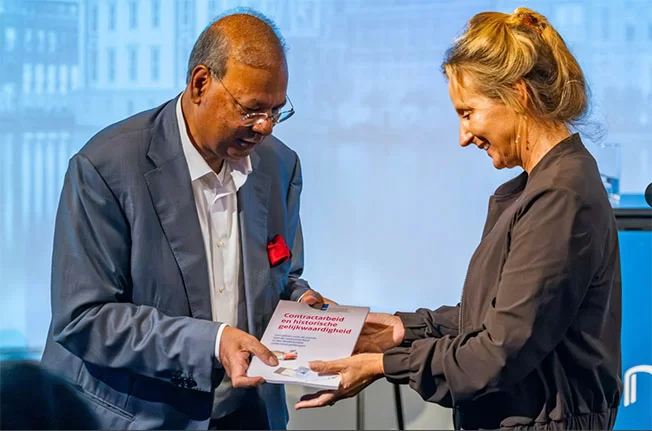
On Monday in The Hague, Rabin Baldewsingh, the head of the Dutch National Coordinator against Discrimination and Racism (NCDR), formally presented a landmark advisory report titled *Contract Labor and Historical Equivalence* to the Dutch government. The report focuses on the underaddressed history of indentured contract labor carried out by Chinese, Hindustani, and Javanese people during the Netherlands’ colonial era.
This development comes as the Netherlands has made incremental but significant progress in confronting its colonial past in recent years. The most high-profile steps include the Dutch government’s official apology for the country’s history of chattel slavery in December 2022, followed by a similar apology from King Willem-Alexander during the national slavery commemoration held in Amsterdam in July 2023. To back this reckoning, the government has allocated more than €200 million to fund initiatives centered on public awareness, formal recognition, and ongoing reckoning with the slavery legacy, with a portion of the funding earmarked for projects in Suriname, the former Dutch colony at the heart of this history.
This growing national reckoning with slavery has opened wider space for public dialogue about other understudied chapters of Dutch colonial history. As a sign of this expanding conversation, King Willem-Alexander is set to receive a five-volume set of research findings on the role of the House of Orange-Nassau in Dutch colonial history spanning from 1600 to 2025 this Friday in Leiden. The comprehensive research was conducted by a team of 60 academics led by Professor Gert Oostindie, with former Member of the House of Representatives Kathleen Ferrier serving on the project’s oversight committee.
Against this backdrop, the history of contract labor in Suriname has emerged as a critical next chapter demanding formal public attention. This history shaped the development of both Suriname and the Kingdom of the Netherlands, and the descendants of Chinese, Hindustani, and Javanese contract workers have integrated this legacy into modern Dutch society. Even so, the history of colonial contract labor has long been overshadowed by the national focus on chattel slavery in Suriname.
Over the past several months, the NCDR collaborated with academic researchers, subject-matter experts, heritage professionals, and community representatives from the Chinese, Hindustani, and Javanese communities to examine how this history is positioned in the Netherlands’ collective national memory. The final product is the new advisory report, which centers on the core principle of “historical equivalence.” The report outlines six interconnected recommendations structured around three core pillars: recognition, institutional embedding, and public connection. As one key example of the proposals, the NCDR recommends establishing a national Knowledge Institute for Contract Labor to embed this history in public research and education.
In remarks following the presentation, Baldewsingh emphasized the core message of the report: “The principle of historical equivalence is the most important idea I deliver to the government. It means that all major chapters of the Netherlands’ colonial past must be carefully and sustainably recognized, researched, preserved, taught, and passed to future generations. This does not mean every history must be commemorated in exactly the same way or carry the same character. But a society that claims to be willing to confront its past cannot remain selective about which chapters it chooses to make visible.”
Barbera Wolfensberger, Director-General for Kingdom Relations at the Dutch Ministry of the Interior and Kingdom Relations, accepted the report on behalf of the Dutch government. In her response, she committed to working to ensure the government will integrate the history of contract labor into all future discussions of the Dutch colonial past, noting that indentured contract labor is inextricably linked to the history of Dutch chattel slavery in Suriname.