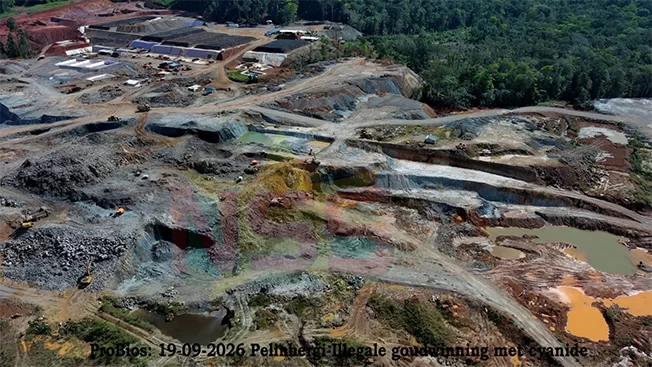
Suriname sits on vast untapped gold reserves, but what the nation lacks is any meaningful oversight of its gold mining industry. What unfolds across large swathes of the country’s interior can no longer be dismissed as a handful of small-scale artisanal prospectors testing their luck with basic tools. Today, illegal mining operates as a full-fledged professional industry, utilizing heavy machinery, clearing permanent access roads, moving massive volumes of earth, and deploying toxic chemical processing agents. This level of operation requires significant capital, coordinated logistics, and structured organization — leading to one unavoidable core question: who is backing these illegal activities, and where do the billions in proceeds end up?
Recent developments involving Rosebel Gold Mines (RGM), a project majority-owned by China’s Zijin Mining, have pushed this question to the top of the national agenda. RGM confirms it has been alerting the Surinamese government to unauthorised mining activity on two of its concession areas since January 2020. The company now estimates the illicit operation has grown into one of the largest gold mining projects in the entire country, with total damages to RGM, state oil firm Staatsolie, and the Surinamese government adding up to roughly US$138.3 million. The scale of the operation makes clear that fundamental, years-long failures in regulatory oversight and enforcement have allowed the crisis to escalate.
This reality raises a cascade of urgent unanswered questions: How could an illegal enterprise grow to such massive size while authorities were aware of its existence? Who are the principal operators behind the mines? How many tons of gold have already been extracted from Surinamese soil? Where has that gold been smuggled or sold, and how much revenue has the national treasury lost in unpaid taxes and royalties? RGM itself has an obligation to provide full transparency to the public. If the firm can calculate a damage figure as specific as US$138.3 million, it must also explain what estimates of illicit gold production that total is based on, and how it arrived at those production numbers, given that it never granted permission for the activity to occur.
It is long past time to abandon the fiction that political interests and the Surinamese gold sector operate in separate spheres. Vice President Ronnie Brunswijk holds verifiable large-scale financial interests in the gold industry, while simultaneously carrying political responsibility for regulating the sector as part of the sitting government tasked with bringing order to gold mining. Under that same government, the Ministry of Natural Resources has been led by ABOP party minister David Abiamofo, who has retained his position through successive administrations.
Back in September 2020, the government established a new Commission for the Ordering of the Small-Scale Gold Sector, tasked with cracking down on illegality, addressing widespread environmental damage, and ensuring the state captured a fair share of gold revenue. Six years later, the government is once again announcing plans for sector reform — a repetition that alone demands a full, independent audit of what has actually been achieved from all the prior commissions, development projects, international donor support, training programs, and public funds poured into past reform efforts. As recently as 2022, the government confirmed it held a full master planning document for gold sector reform, complete with a concrete action plan. The public still has no clear update on what progress has been made on that framework today.
President Jennifer Simons has publicly acknowledged that all prior sector regulation systems have failed. In response, her administration has temporarily suspended the issuance, renewal, and transfer of new mining concessions and announced it will adopt a completely new regulatory approach. This is a necessary first step, but the government now must follow through on its promises with tangible action, without exception for powerful or well-connected figures. That means launching full investigations into the overlapping political and business interests that shape the sector, targeting not just the low-level workers operating excavators, but also permit holders, concession owners, financial backers, gold buyers, and export actors. It also means uncovering who knew about the illegal operations and which public officials had a duty to intervene but failed to act.
The environmental harm caused by unregulated mining can no longer be treated as an afterthought, either. RGM has confirmed that testing found traces of cyanide at the illegal mining sites, and for years public health and environmental advocates have raised unanswered questions about the use of Jin Chan mercury-based gold processing products. A 2018 research report by Glenn Geerlings and Tirzah Karsowidjojo focused specifically on Jin Chan use in Suriname, and that full document must be made public and subjected to independent review. The public deserves to know exactly what the research found, what its formal conclusions were, and how those findings were used (or ignored) by regulators.
Veteran environmental activist Erlan Sleur has been sounding the alarm on these issues for years. His recent visit to the Pelin Bergi mining area, alongside DNA party parliamentarians Rabin Parmessar and Michael Marengo and independent journalists, has reignited public scrutiny of large-scale unregulated mining and the suspected illegal use of toxic chemicals. The parliamentary delegation has already called for an immediate halt to activity at the site and an independent public investigation, and this momentum for accountability must not be lost.
The path forward is clear: authorities must launch full investigations into all mining concessions, audit all active permits, identify the true beneficial owners of all mining operations, map the full volume of gold production and cross-border financial flows, and test for illegal toxic chemical use. Where it is confirmed that gold has been extracted illegally and revenue has been withheld from the state, the government must move quickly to recover all lost funds.
At its core, this crisis is about control of a national resource: the gold extracted from Suriname’s soil belongs to the Surinamese people. Its wealth should be used to advance inclusive national development, not disappear into a system that enriches a small connected elite while leaving the general public to cope with toxic environmental pollution and billions in lost public revenue. True sector reform is not just about creating another new bureaucratic commission. It means finally answering the critical questions: who is mining Suriname’s gold, who is profiting from it, who looked the other way for years, and who will be held accountable for the harm done. Where the state has been robbed of revenue, that money must be returned. Where the environment has been damaged, those responsible must pay for full remediation. Where laws have been broken, law enforcement must act without favor.
Suriname cannot afford to accept yet another half-hearted attempt at “reform” while tons of national gold disappear and the public is left holding the bill for the damage. The gold is in our ground, the harm stays in our country, so the profits cannot be allowed to vanish into the pockets of a tiny few. The era of looking the other way must end now.