A bitter wage standoff between state-owned Telecommunications Services of Trinidad and Tobago (TSTT) and the Communication Workers’ Union (CWU) has escalated in recent days, with union leaders openly questioning the company’s good faith in reaching a resolution and warning that frontline workers may be caught in the crossfire of the impasse.
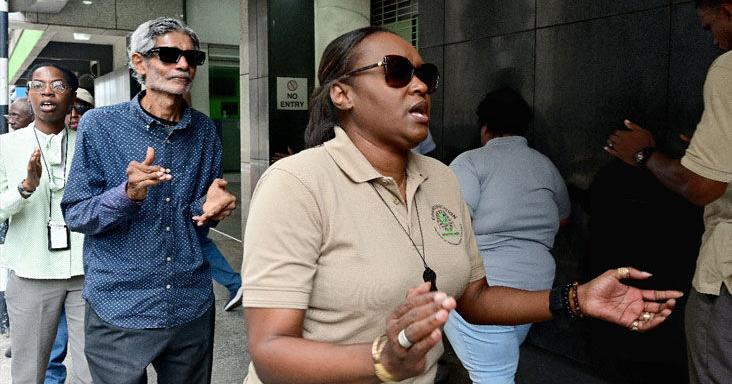
Following a lunchtime demonstration held by TSTT employees to demand answers over the rejected wage deal, CWU Secretary General Joanne Ogeer reiterated the union’s call for Prime Minister Kamla Persad-Bissessar to step in and break the deadlock that has frozen negotiations. The protest also centered on a demand for TSTT Chairman Kern Dass to publicly explain why a tentative 10% wage increase agreement, reached after months of back-and-forth between negotiating teams, was ultimately struck down by the company’s board of directors.
Ogeer clarified that the demonstration was not organized in direct response to pre-action protocol letters issued by TSTT leadership and Public Utilities Minister Barry Padarath. Instead, the core grievance centers on the unexplained rejection of a deal that was finalized by executive representatives from both sides. The 10% proposal, which would phase in the pay raise over a two to three-year period, was the only one of five initial offers the union found acceptable, after four other packages were rejected out of hand, Ogeer explained. Once both negotiating teams signed off on the terms, the plan was forwarded to TSTT’s board for final approval — only for the union to be notified weeks later that the deal had been turned down.
The CWU leader’s questioning of the board’s decision carries extra weight given TSTT’s recent blockbuster financial results: the company reported a $214 million after-tax profit for the financial year ending March 31, 2026, a performance TSTT itself called the strongest it has posted in 17 years, dating back to 2009. Ogeer pushed back on the company’s long-standing claims of cash flow constraints that were previously used to justify wage freezes and low offers.
“When the company repeatedly claimed before that it had cash flow problems, that it was not turning a profit, so it could not afford to pay workers more — but now you have announced a $214 million profit… what justification can you possibly give for saying no now?” Ogeer said in a press briefing after the protest. She also called for transparency around the sources of the windfall profit, asking whether the gains came from the government’s national laptop programme, a surplus in the company’s pension fund, or other operational gains. “It makes no sense for a company that has not received government subventions in recent years, and is now posting its highest profit ever, to claim it cannot or will not pay workers what they have agreed to,” she added.
To back up the union’s claim that the 10% deal was properly negotiated and agreed, Ogeer said the union has already provided TSTT with two specific dates of the executive negotiating sessions and called on the company to review internal security footage to confirm that the meetings took place, who attended, and how long the negotiations lasted. “We are not making this claim out of thin air. The 10% agreement did not happen in a vacuum,” she said.
Most strikingly, Ogeer admitted that the union has little confidence that TSTT will return to the negotiating table with a genuine commitment to reaching a fair deal. “What I can say clearly is that we are not optimistic that the company will come back to the table in good faith, and I want to stress that. We have no hope that the company will honor the agreement it made with the union,” she said. “As a matter of fact, we believe that TSTT workers will be weaponized even more as this dispute drags on.”
Ogeer also raised questions about the independence of an ongoing internal investigation into TSTT’s former chief executive, noting that while the union does not oppose a proper probe into potential misconduct, it is demanding clarity over who is overseeing the process. “Who is guarding the guards at TSTT?” she asked. “Stakeholders are watching, investors are watching, citizens are watching, employees are watching… right now, TSTT does not look good.”
In response to the pre-action protocol letters received from TSTT and the public utilities minister, Ogeer confirmed that the union has assembled a team of experienced legal representatives to handle the impending litigation, though she declined to share further details on the legal strategy. She made clear the union is confident in its position. “I am comfortable, and I am very confident with the representation that we have retained on the matter at hand,” she said.
The protest drew support from other national labor groups, with Trinidad and Tobago Unified Teachers’ Association (TTUTA) President Crystal Ashe and prominent activist Dr. Wayne Kublalsingh in attendance. Ogeer noted that the demonstration marked a key moment for the labor movement, as it was the first major protest the union has been able to hold since the national state of emergency was lifted, giving workers the chance to publicly advocate for their rights once again.