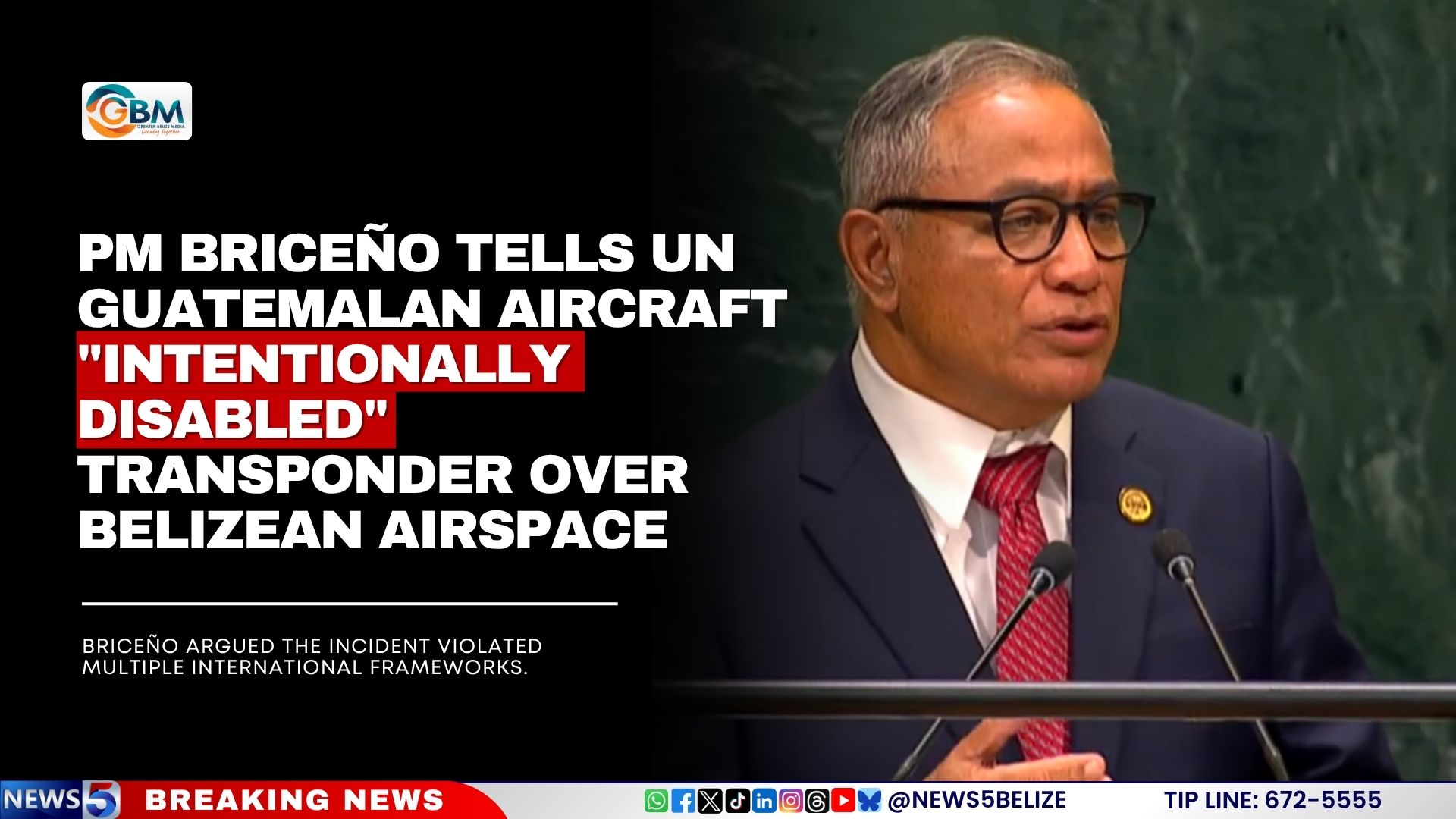
On September 26, 2026, during his formal address to the 81st Session of the United Nations General Assembly, Belizean Prime Minister John Briceño brought a pressing cross-border incident to the attention of the global community, accusing Guatemala of a deliberate violation of international law. Three days prior, on September 23, a military aircraft operated by the Guatemalan government entered the sovereign airspace of Belize, with its transponder intentionally disabled, according to Briceño’s official statement to the assembly.
Briceño emphasized that this single incursion violates multiple binding international agreements and long-standing legal norms. The act, he noted, runs counter to the standards set out in the Chicago Convention on International Civil Aviation, established customary rules governing the operation of state-owned aircraft, and the core principle of territorial sovereignty enshrined in Article 2(4) of the United Nations Charter.
Further, the Belizean Prime Minister framed the airspace incident as not an isolated mistake, but the latest development in a sustained pattern of unlawful activity along the shared border between the two nations. The Sarstoon River, which forms a section of the contested border between Belize and Guatemala, has seen repeated illegal entry by Guatemalan state vessels and personnel into Belizean territorial waters, Briceño claimed. These actions, he added, directly contradict existing mutual obligations that require both parties to avoid any actions that would escalate or expand the territorial dispute, which is already pending before the International Court of Justice (ICJ).
With formal public hearings in the ICJ’s territorial dispute case scheduled to begin in February 2027, Briceño warned that Guatemala’s repeated incursions carry significant risks for the international dispute settlement process. He stated that these provocative actions threaten to compromise the authority of the ICJ and erode the foundational principle of peaceful dispute resolution outlined in Article 33 of the UN Charter.
In his address, Briceño laid out clear demands for Guatemala. Belize calls on the neighboring state to immediately end all incursions across air, land, and maritime borders, to fully comply with its legal obligations under the UN Charter, the Chicago Convention, and existing confidence-building measures overseen by the Organization of American States (OAS), and to uphold the integrity of the ongoing ICJ judicial process. Additionally, Briceño requested strengthened international monitoring of the border region: he called on both the United Nations and the OAS to increase oversight to ensure no UN member state uses military pressure or intimidation to sway the outcome of ongoing judicial proceedings. Closing his address, Briceño expressed confidence in the upcoming ICJ ruling and reaffirmed Belize’s commitment to seeing its territorial borders fully respected by all neighboring states.