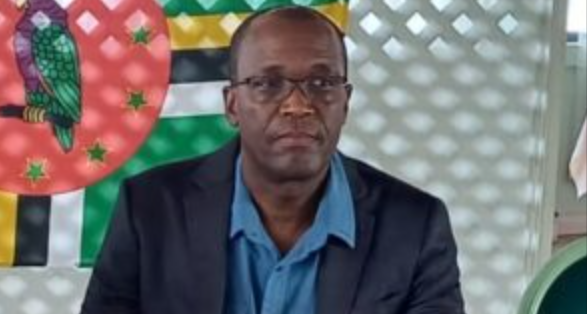
After more than eight years of legal wrangling, a high-profile criminal case stemming from a 2017 opposition rally in Dominica’s capital Roseau has officially drawn to a close, with the country’s top public prosecutor discontinuing an obstruction charge against United Workers’ Party (UWP) leader Dr. Thomson Fontaine.
The case traces back to a February 7, 2017 opposition-organized “Day of the People” gathering held on Upper Kennedy Avenue. Following the conclusion of the meeting, authorities brought charges against Fontaine connected to a truck registered as TB 859 parked near the Roseau Financial Centre. Prosecutors alleged that Fontaine repeatedly ignored police orders to allow the vehicle to move west, claiming he intentionally blocked law enforcement officers from carrying out their official duties.
In a public statement released this week, Fontaine confirmed that Director of Public Prosecutions (DPP) Sherma Dalrymple has moved to end all proceedings against him, exercising authority granted under Section 72(c) of the Commonwealth of Dominica Constitution. Fontaine has never wavered in his assertion of innocence throughout the entire legal process, and he has long argued that the charges against him were nothing more than a politically motivated effort to target the opposition, rather than a legitimate pursuit of justice. Had he been convicted on the obstruction charge, he faced the possibility of a prison sentence.
In recounting his years-long legal ordeal, Fontaine detailed repeated disruptions to his life and career. For much of the duration of the case, he held a senior leadership role as head of strategy at the Joint Monitoring and Evaluation Commission in Juba, South Sudan, a body tasked with overseeing the implementation of the country’s fragile peace agreement. Despite living and working thousands of miles from Dominica, Fontaine was required to make 22 separate trips back to the island for mandatory court appearances. He noted that many of these appearances were scheduled on extremely short notice, forcing him to purchase last-minute plane tickets that cost between $5,000 and $7,000 per one-way trip — the equivalent of 13,500 to 18,900 Eastern Caribbean dollars. On many occasions, after traveling thousands of miles, his hearing would simply be adjourned for a later date, he added. Fontaine also claimed he was arrested three times by authorities, spent a total of three days in police custody, and was pursued by officers in military-style gear “like a common criminal.”
Beyond the personal financial toll, Fontaine has raised questions about the unnecessary public cost of the prosecution. He claims officials brought three senior legal lawyers from Trinidad and Tobago to handle the low-level obstruction case, despite the matter being fully capable of being managed by local legal professionals. No official total of the public funds spent on the prosecution has been released to date.
To date, the DPP’s discontinuance notice does not provide any official explanation for the decision to drop the charges, nor does it address Fontaine’s allegations of political motivation or excessive public spending. The conclusion of the case brings an end to one of the longest-running legal disputes between Dominica’s opposition and ruling administration in recent years, though the claims of political targeting remain unaddressed by official bodies.