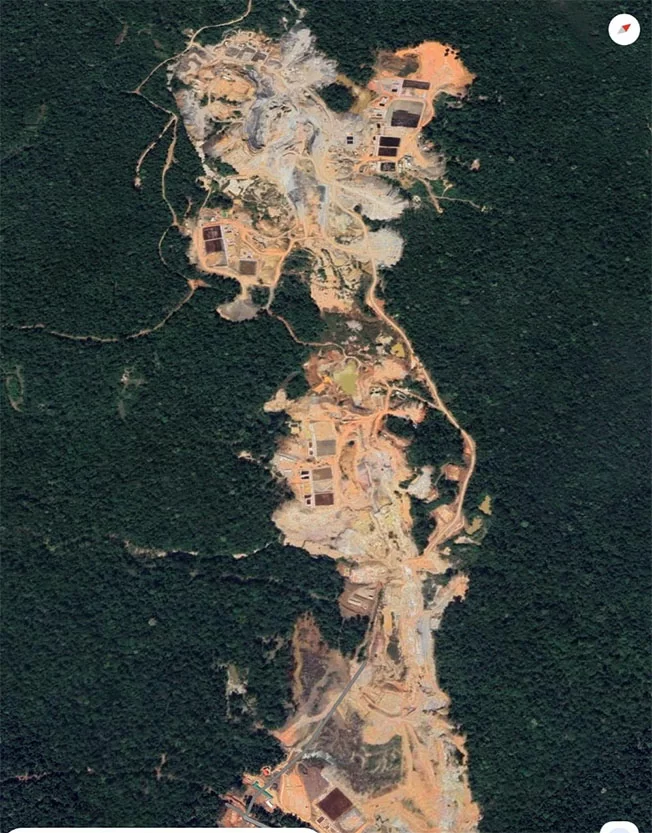
Two members of Suriname’s National Assembly (DNA), Rabin Parmessar of the DNA and Michael Marengo of the NDP, have formally submitted a request to President Jennifer Simons calling for an immediate temporary suspension of all exploration, extraction and processing activities at the Pelin Bergi mining site near Kwakoegron. The request, submitted on September 25 via the Speaker of the National Assembly, follows an on-site inspection conducted by the lawmakers on September 19 alongside journalists and environmental activist Erlan Sleur from the non-profit organization Pro Bios.
During their visit to the site, the parliamentary delegation observed clear signs of large-scale unregulated gold extraction operations, including significant portions of the mountain slope that had been excavated, with massive volumes of excavated material regularly transported to off-site processing locations. Based on their on-ground observations, the lawmakers note evidence pointing to the use of the controversial heap-leaching gold extraction method, which relies on cyanide to separate gold from ore. While the pair have not presented independent lab results confirming cyanide contamination in soil or surface water, they have raised urgent concerns about the unregulated handling, storage and disposal of toxic mining waste and potentially contaminated runoff water.
Critically, the lawmakers warn that any unmanaged leakage of toxic substances could spread through local waterways that connect directly to two of Suriname’s most important river systems: the Saramacca River and the Suriname River. These water sources support drinking water supplies, livelihoods and ecosystem health for surrounding communities, so the pair argue that precautionary action is necessary before irreversible damage occurs. They are calling for on-site inspections by official agencies, secure collection of environmental samples, and independent testing of both soil and water quality to confirm the presence and extent of contamination.
A core focus of the lawmakers’ request is clarifying the legal status of operations at Pelin Bergi. They are demanding the government disclose all details of which individuals or companies are conducting mining activities, what permits, concessions or legal agreements authorize the work, which government body granted those rights, and when the authorization was issued. Additional questions include how much gold and other minerals have been extracted and transported from the site in recent years, how production has been recorded, regulated and taxed, and what environmental regulations apply to the site.
The letter also notes visible use of explosives at the site, prompting questions about whether legal permits for explosive use are in place and who supplied the materials. Of particular note, Pelin Bergi falls within the Area of Interest designated for an unincorporated joint venture between Rosebel Gold Mines (RGM), majority-owned by China’s Zijin Mining, and Suriname’s state-owned oil company Staatsolie. During the on-site visit, the delegation observed vehicles that local sources linked to Zijin/RGM, though the letter draws no definitive conclusions about company involvement and instead calls for a full independent investigation into any potential connection.
The lawmakers also highlight potential financial risks to the Surinamese state. Under the terms of the joint venture, RGM holds a 70% stake and Staatsolie holds a 30% stake, meaning unregistered extraction would result in lost royalty and tax revenues for the state. The letter raises the possibility that mining has been ongoing for an extended period without complete production reporting, tax settlement or required royalty payments to the state – a claim presented as an unproven allegation requiring formal investigation, not a confirmed fact.
To address all these overlapping concerns, Parmessar and Marengo are calling for a full independent multidisciplinary investigation that brings together environmental agencies, law enforcement, mining and hazardous materials experts, tax and financial regulators, and the Public Prosecutor’s Office. Their broadest demand is the immediate temporary halt to all mining activities at Pelin Bergi, which would remain in place until investigators confirm the legal identity of operators, the legitimacy of their operating authority, and full compliance with environmental and safety regulations.
Framing the suspension as a necessary precautionary measure, the lawmakers argue that it is unreasonable to allow high-risk operations to continue for months while an investigation is ongoing. If competent authorities confirm immediate environmental or public health risks, or confirm that operations are proceeding without required legal authorization, the pair say appropriate enforcement action must follow. They have called on the government to deliver concrete, verifiable investigation results in the near term, and if violations are confirmed, demand that responsible parties are held legally accountable, and all damage to public health, the environment and state revenues is fully quantified.