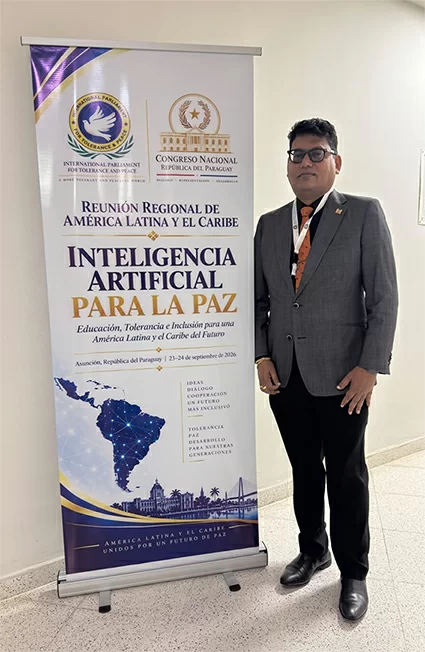
On September 24, 2026, the International Parliament for Tolerance and Peace (IPTP) concluded its regional gathering in Asunción, Paraguay, centered on one of the most pressing topics in 21st-century learning: unlocking artificial intelligence’s potential for education while ensuring equitable, widespread access to this transformative technology. Hosted in partnership with the Global Council for Tolerance and Peace (GCTP) and welcomed by Paraguay’s Honorable Chamber of Deputies, the three-day conference brought together parliamentary representatives and technology experts from across the globe to share cross-regional insights on integrating AI into learning ecosystems.
Conference attendees heard targeted presentations and case studies from a range of contributors, including leading South Korean technology and education specialists. Delegates exchanged on-the-ground experiences from diverse national and subnational contexts, with deep dives into AI-education advancements in both South Korea and the Brazilian state of Paraná. Representing Suriname at the discussions was Asiskumar Gajadien, a sitting IPTP member and faction leader of the Progressive People’s Party (VHP), who attended the gathering at his own expense. Gajadien emphasized that AI carries unprecedented opportunity to strengthen global education systems— but only if paired with intentional investment in core enabling infrastructure.
“Investing in AI for education means, first and foremost, investing in our children and our teachers,” Gajadien told delegates. He argued that beyond teaching students to interact with AI tools, education systems must prioritize building core critical thinking competencies, information evaluation skills, and frameworks for responsible technology use. Even as AI becomes more integrated into classrooms, Gajadien noted, teachers will remain central to guiding student learning and digital literacy development.
The conference’s landmark outcome was the unanimous adoption of the *Asunción Declaration – Artificial Intelligence for Tolerance and Peace*, a framework guiding collaborative global action on responsible AI development. The declaration commits all signatories to advancing AI innovation and deployment that upholds human dignity, fundamental human rights, accountability, and transparency. It also reiterates the urgent need for inclusive access to AI’s benefits across all regions and socioeconomic groups, ensuring no community is left behind by the digital transition.
Beyond core AI ethics principles, the declaration highlights AI’s role in advancing public service delivery and social development, with a specific focus on education. The document frames education that fosters critical thinking, social tolerance, and responsible citizenship as an essential tool to prepare populations for rapid change in an increasingly digital society. For Gajadien, the declaration creates a shared foundation for cross-parliamentary collaboration on navigating AI’s rise. He noted that cross-border knowledge and experience sharing allows nations to more effectively adapt to both the opportunities and challenges brought by fast-paced technological evolution.
“Not all of our countries have access to the same resources,” Gajadien said. “That is why collaboration and mutual learning are so important. Technology will continue to change, but our starting point must always be that technology serves people, and contributes to better education, greater inclusion, tolerance, and peace.”
Gajadien extended formal gratitude to Paraguay and the Honorable Chamber of Deputies for their hospitality as hosts, as well as to all participating experts who shared their AI and education insights with delegates. Founded to connect parliamentary leaders across borders to advance shared goals of tolerance, peace, and equitable social development, the IPTP now counts representatives from more than 100 countries among its membership.