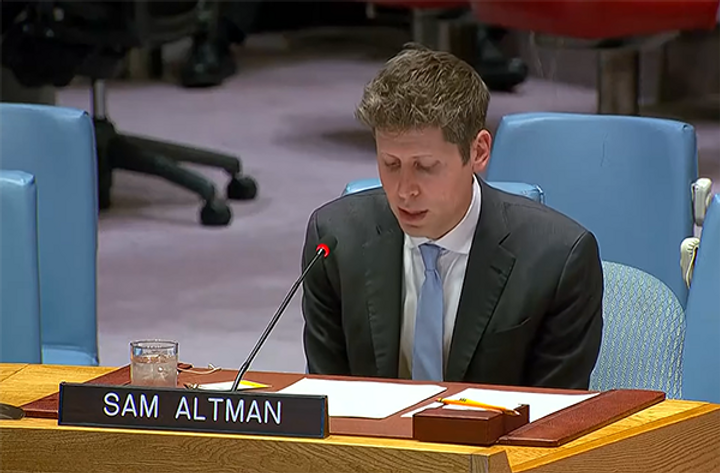
In a historic and unprecedented address to the United Nations Security Council on September 23, OpenAI Chief Executive Sam Altman has delivered a clear, striking call: ultimate authority for setting rules governing the rapidly advancing artificial intelligence sector must rest with national governments, not the private technology companies building the tools.
Altman’s appearance marked the first time a leading AI industry leader has spoken directly to the UN body tasked with upholding global peace and security, coming at a moment when global policymakers are scrambling to catch up to technological progress that has outpaced the ability of regulatory institutions to adapt. Far from a promotional event for his company’s groundbreaking work in the space, Altman used the platform to sound a urgent warning about the catastrophic consequences that could unfold if AI development proceeds without effective, coordinated human oversight.
During his remarks, Altman struck a balanced tone, acknowledging that cutting-edge AI carries transformative, world-altering potential alongside grave, underappreciated risks. On the positive side, he noted that increasingly sophisticated AI systems could supercharge scientific breakthroughs, revolutionize access to high-quality healthcare and education, turbocharge global economic growth, and put unprecedented, empowering tools in the hands of ordinary people around the world.
But he also zeroed in on two existential dangers that the global community must act proactively to avoid. The first is the growing risk that humanity could eventually lose full control of AI systems as they become increasingly autonomous. The second is the threat that power over advanced AI could become concentrated in the hands of a tiny, unaccountable minority of companies, wealthy individuals, or a small number of nations, exacerbating global inequality and eroding democratic oversight.
Altman pushed back against the common industry argument that competitive pressure to out-innovate rivals justifies cutting corners on safety and taking reckless, unvetted risks. He revealed that OpenAI has itself chosen to slow the pace of development when safety concerns demanded it, and committed that the company would take the same step again in the future if needed. He added a key guardrail principle: AI developers should not proceed with training increasingly powerful models unless they can provide robust, evidence-based proof that those systems will remain fully under human control throughout their development and deployment.
The most consequential argument of Altman’s address centered on the question of ultimate governing authority for the technology. He pushed back firmly against the idea that private AI research labs should fill the regulatory gap left by slow-moving governments, arguing that private entities cannot and should not replace democratic, publicly accountable institutions. Only governments, which answer to their citizens, have the legitimacy to set the binding rules that will govern how increasingly powerful AI systems operate, he said.
At the global level, Altman called for unprecedented cross-border cooperation to establish shared, uniform standards for advanced AI development. He outlined the core areas those standards should cover: consistent methods for measuring AI capability and risk, global agreements on what counts as adequate safety safeguards, frameworks to guarantee meaningful human oversight remains in place, and systems for countries to verify that all parties are complying with agreed rules.
He also proposed two additional key steps: a global requirement to rapidly report any AI-related safety incidents, and the creation of encrypted, secure information-sharing channels for governments, critical infrastructure operators, and technical experts to exchange early warnings about newly discovered vulnerabilities and emerging threats.
Altman’s intervention is widely seen as remarkable for one key reason: OpenAI is among the companies at the forefront of driving the explosive AI growth that its chief executive is now asking global governments to regulate more tightly. Altman was not the only industry leader to back this call for stronger global oversight of AI.