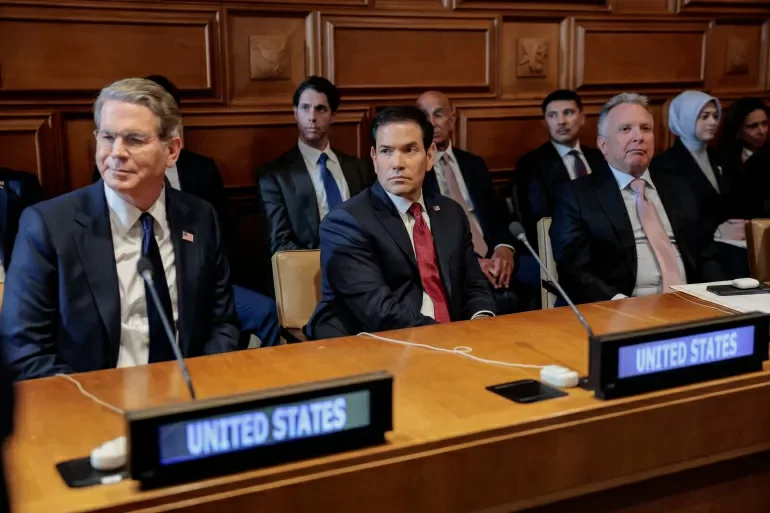
Against the backdrop of the 81st United Nations General Assembly in New York, the United States and Iran launched indirect, multi-hour negotiations mediated by regional third parties on Tuesday, with discussions centered on ending regional hostilities and reopening the strategically critical Strait of Hormuz to commercial shipping. While both sides have described the initial round of talks as promising, no breakthrough has yet been announced, and core differences on priorities and sequencing of concessions remain unresolved.
U.S. President Donald Trump initially stated that his special envoy Steve Witkoff and senior advisor Jared Kushner held three hours of direct discussions with Iranian officials, calling the session “very good” and “very productive”, noting significant momentum toward a final agreement. He later confirmed that talks would continue and expressed confidence that a final arrangement would be reached. The White House later clarified that Trump himself did not participate in the negotiations, and that mediators shuttled between the U.S. and Iranian delegations led by Witkoff and Iranian Foreign Minister Abbas Araghchi respectively. Witkoff characterized the completed first negotiating round as potentially “constructive and promising”, adding that mediators would continue their shuttle work in the coming days.
At the heart of Iran’s negotiating position are its demands for the United States to roll back economic and military pressure in exchange for reopening the Strait of Hormuz. Iranian state media report that Tehran conveyed its formal terms to Washington via mediators: these include lifting the U.S. blockade on Iranian ports, unfreezing billions of dollars in Iranian assets held abroad, and ending U.S.-led military campaigns against Iran and its regional allied armed factions. A senior Iranian official told state media that Tehran would be willing to fully restore open shipping through the strait within seven days if Washington agrees to reduce military pressure and scale back economic sanctions.
The Strait of Hormuz is one of the world’s most critical energy chokepoints, carrying roughly a fifth of global oil supplies and a large share of liquefied natural gas exports from Gulf producing states to global markets. Disruptions and uncertainty around shipping through the waterway have already roiled global energy markets, with Reuters market data showing Brent crude prices climbed above $100 per barrel on Tuesday following news of the negotiations.
Washington’s priorities differ sharply from Tehran’s. Trump has repeatedly emphasized two non-negotiable U.S. red lines: Iran will not be permitted to develop a nuclear weapon, and unimpeded commercial shipping through the Strait of Hormuz must be restored immediately. This leaves the two sides’ core negotiating objectives directly opposed: Iran demands that relief from pressure come first, while the U.S. insists on tangible Iranian commitments on shipping security and nuclear limits before making any concessions.
A notable dynamic of the current process is the gap between harsh public rhetoric and quiet diplomatic outreach. Just hours before the negotiations opened, Trump used his address to the UN General Assembly to deliver sharp criticism of Iran, saying he faced a “major decision” between a deal that would allow Iran’s economy to recover and further military escalation. He reaffirmed that the U.S. would never allow Iran to acquire a nuclear weapon, with the White House identifying Iran’s nuclear program as one of the administration’s top global security priorities.
Iran responded in kind: the Iranian General Staff issued a warning that the country would deliver a stronger and more unpredictable response to any new U.S. attacks. Still, Iranian officials have left the door open to a diplomatic resolution, stating that talks can progress if Tehran’s core conditions are met. Analysts quoted by Al Jazeera note that the combative public language from both sides is a deliberate negotiating tactic: both governments face domestic political pressure, and neither wants to be seen as making concessions under duress to the other side.
Qatar and Pakistan have taken on the lead role as mediators between the two governments, working to narrow gaps and bring the parties closer to an agreement. Qatari Prime Minister and Foreign Minister Sheikh Mohammed bin Abdulrahman Al Thani met with Araghchi in New York on Tuesday to discuss regional developments, de-escalation, and laying the groundwork for sustained dialogue. Qatar has also previously held exploratory talks on establishing a temporary shipping corridor through the Strait of Hormuz and practical cooperation to clear the waterway for commercial traffic, highlighting that diplomacy is not just focused on a high-level political agreement, but also on putting in place practical arrangements to resume global shipping.
According to Reuters, negotiators are also exploring a broader regional security framework that would include Iran and the Cooperation Council for the Arab Gulf States. This proposal would tie negotiations on the Strait of Hormuz to wider agreements on long-term security across the Gulf region, though the text of the proposal has not yet been made public.
Outside of the mediated bilateral talks, France has put forward a separate international initiative to protect shipping through the strait. Reuters reports that Paris is drafting a UN Security Council resolution to authorize an international maritime mission to guarantee free navigation through Hormuz, a proposal that is being coordinated with Washington. Previous attempts to launch such a mission stalled due to objections from China and Russia, which argued that the initiative would be disproportionately targeted at Iran. Paris is now working to revise the text to explicitly frame the mission as focused solely on protecting commercial shipping and global energy security, rather than confronting Tehran.
Despite the opening of talks and signs of goodwill on both sides, key obstacles remain unaddressed. Beyond conflicting core priorities, the two sides cannot agree on the sequencing of concessions. Tehran refuses to give up its leverage over Hormuz shipping before it receives the economic and military relief it has demanded, while Washington insists on seeing concrete Iranian action on its core demands first. This impasse means any final agreement will likely require a carefully structured package of simultaneous or phased reciprocal steps from both sides.
The ongoing UN General Assembly, which runs from September 22 to 28 in New York, provides a critical immediate diplomatic window for further talks, with senior officials from both sides already on location for the global summit.