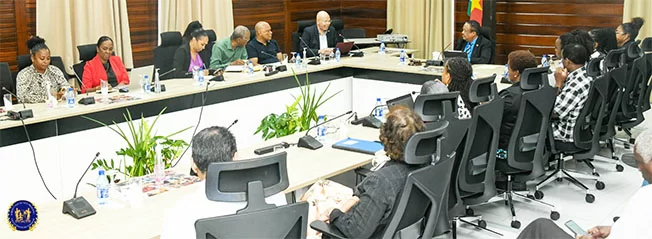
As the 2026-2027 academic year approaches, Suriname is racing against the clock to address a series of unmet challenges in the education sector that threaten the smooth start of the new term. Acting President Gregory Rusland has held urgent consultations with Minister of Education, Science and Culture Dirk Currie and senior ministry leadership, ordering that all outstanding preparation issues be finalized as quickly as possible to minimize disruption for students across the country.
During the meeting, Minister Currie presented a full update on the current state of pre-term preparations, noting that ministry teams are working around the clock to deliver an orderly start to the academic year. Currie outlined that core priorities guiding the preparations include guaranteeing equal access to education for all students, expanding sufficient learning opportunities for every learner, fostering positive character development, and prioritizing the mental well-being of young people.
To date, placement has been secured for hundreds of students who were waiting for school assignments. However, officials confirmed that some students will still need to travel longer distances than usual to attend classes on a temporary basis. The government has reaffirmed its non-negotiable commitment that all students must be able to access in-person schooling five days per week.
For a remaining group of primary school students, authorities are currently sourcing temporary classroom facilities. The evaluation process for these temporary spaces takes into account not only upfront costs and delivery timelines, but also the potential for the facilities to be repurposed sustainably at other locations after the first quarter of the academic year. Parallel to this search, the government is also accelerating the handover and inspection processes for 12 newly constructed permanent classrooms that are already completed.
Teacher shortages remain another pressing challenge that requires urgent attention. The ministry is currently pursuing aggressive recruitment and deployment strategies for qualified educators, including reaching out to retired teachers to return to the classroom temporarily to fill gaps. For subjects where qualified in-person instructors remain unavailable, digital learning formats and supplementary after-school lessons are being assessed as viable interim solutions.
In addition to these core challenges, the ministry is also prioritizing the timely delivery of required learning materials and classroom furniture. Close attention is also being paid to arranging domestic transportation for commuting teachers and securing appropriate housing for educators assigned to schools in remote areas.
Acting President Rusland has directed all relevant stakeholders to use the remaining time before the term starts in a focused, goal-oriented manner, requiring that progress updates on unresolved issues be submitted in the very near term. The overarching goal of these urgent efforts is to eliminate as many risks to a smooth school opening as possible.
“It is our shared collective responsibility to ensure that the new school year begins as orderly and smoothly as possible,” Rusland stated. “Where bottlenecks exist, we must make quick decisions and provide necessary support, always keeping the best interests of our students at the forefront of all our actions.”