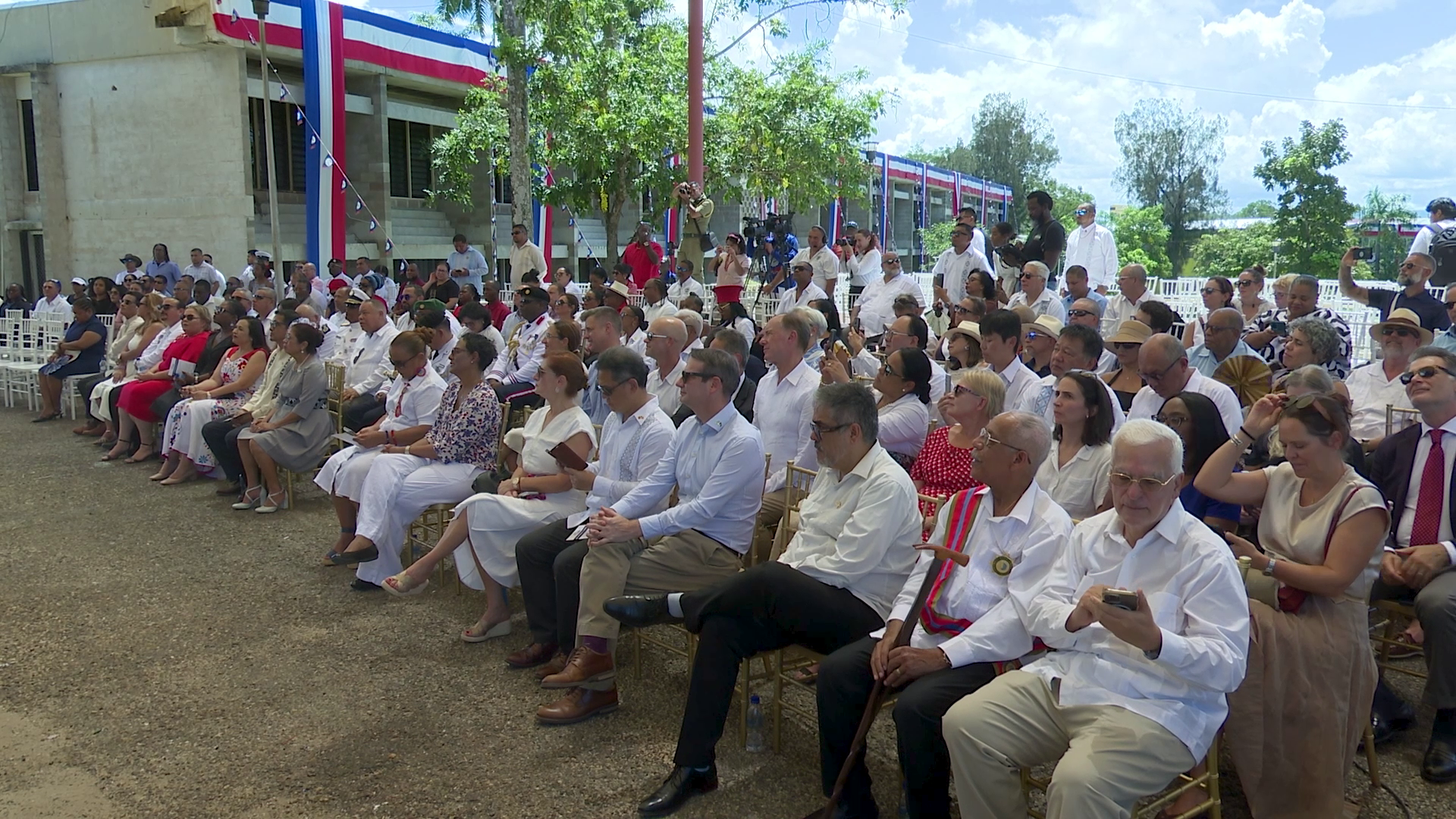
As Belize marked its 45th year of sovereignty on September 21, 2026, the national Independence Day celebrations unfolded as a study in contrasts: a unifying, pride-focused address from the nation’s prime minister in the capital, while a local commemoration in the southern district of Punta Gorda devolved into a heated public political confrontation.
In his keynote national address, Prime Minister John Briceño centered his remarks on deeply personal ideas of national identity, shifting away from the economic policy and development metrics that dominated his public remarks the previous week. Aligning with the 2026 celebration theme, “Look at me. I am Belize at 45,” Briceño paid tribute to the quiet strength, ingenuity and relentless determination that define ordinary Belizeans across every sector of society.
Briceño highlighted that Belizean identity lives in every member of the community: from farmers tending fertile lands and fishers venturing into Caribbean waters, to educators molding the next generation, entrepreneurs building new businesses, honest public servants, and union advocates fighting for workers’ rights. He emphasized that beyond the nation’s globally renowned natural attractions — including the UNESCO-listed Belize Barrier Reef and the iconic Blue Hole — and its vibrant multicultural heritage, the world should recognize the core character of the Belizean people as the nation’s greatest asset.
A key focal point of Briceño’s forward-looking address was the long-running territorial dispute with neighboring Guatemala. He announced that the International Court of Justice had scheduled oral arguments in the Belize-Guatemala case for February 2027, to be followed immediately by oral presentations in a separate border dispute between Belize and Honduras. After decades of unresolved border tensions, Briceño expressed confidence that the ICJ process would vindicate Belize’s territorial sovereignty, clearing the way for improved, constructive relations with both the Guatemalan government and people.
In a moment of tribute to foundational Belizean leaders, Briceño honored the late Gwendolyn Lizarraga as a paragon of public service, holding her up as a model for young Belizeans to follow, citing her lifelong commitment to using her talents to strengthen the nation.
While the national event maintained a focus on unity, the mood shifted sharply during Independence Day activities in Punta Gorda, the capital of Belize’s southern Toledo District. For years, Belizean political leaders have intentionally separated partisan political messaging from Independence Day commemorations to preserve a spirit of cross-party unity around national pride. But that consensus broke down during a local ceremonial address, when a verbal exchange between opposing party politicians escalated into a public confrontation.
The clash began when Frank “Kranka” Polonio, the United Democratic Party (UDP) mayoral candidate, used his speaking time to deliver a blistering critique of the current administration’s failures. Polonio questioned the meaning of national independence for ordinary Belizeans, pointing to widespread unaffordability of land, lack of economic opportunity for young people, household financial strain, underfunded public schools where teachers must beg for basic classroom supplies, and a system he claimed awards opportunities based on political connections rather than merit. He also demanded public answers regarding unaddressed corruption allegations tied to the Toledo Teachers Credit Union and claims of millions of dollars in misappropriation linked to a local political family, arguing that silence cannot be accepted as a response to public concerns.
Polonio’s remarks drew an immediate fiery response from Dr. Osmond Martinez, the incumbent People’s United Party Area Representative for Toledo East. Martinez pushed back against Polonio’s claims, revealing that he had personally assisted Polonio in processing his own land title documents. He also attacked Polonio’s record in public office, noting that during Polonio’s six years as deputy mayor of Punta Gorda, Polonio was forced to sue the UDP-led town council to receive his earned monthly stipend, as the council could not even afford to pay its own deputy mayor. Martinez challenged Polonio to compare that six-year record to the progress delivered by the current administration over just two years in office, and accused Polonio and the UDP of discriminating against Mayan communities, highlighting that Polonio is currently campaigning against a PUP candidate of Mayan descent — a move Martinez called unacceptable for any self-described leader.
After the public exchange, Martinez declined to comment further, noting that he had attended the event committed to the spirit of unity, and only responded after Polonio delivered a deliberately negative, partisan address.
This report is a transcript of an evening television newscast, with all Kriol-language statements transcribed using a standardized spelling system.