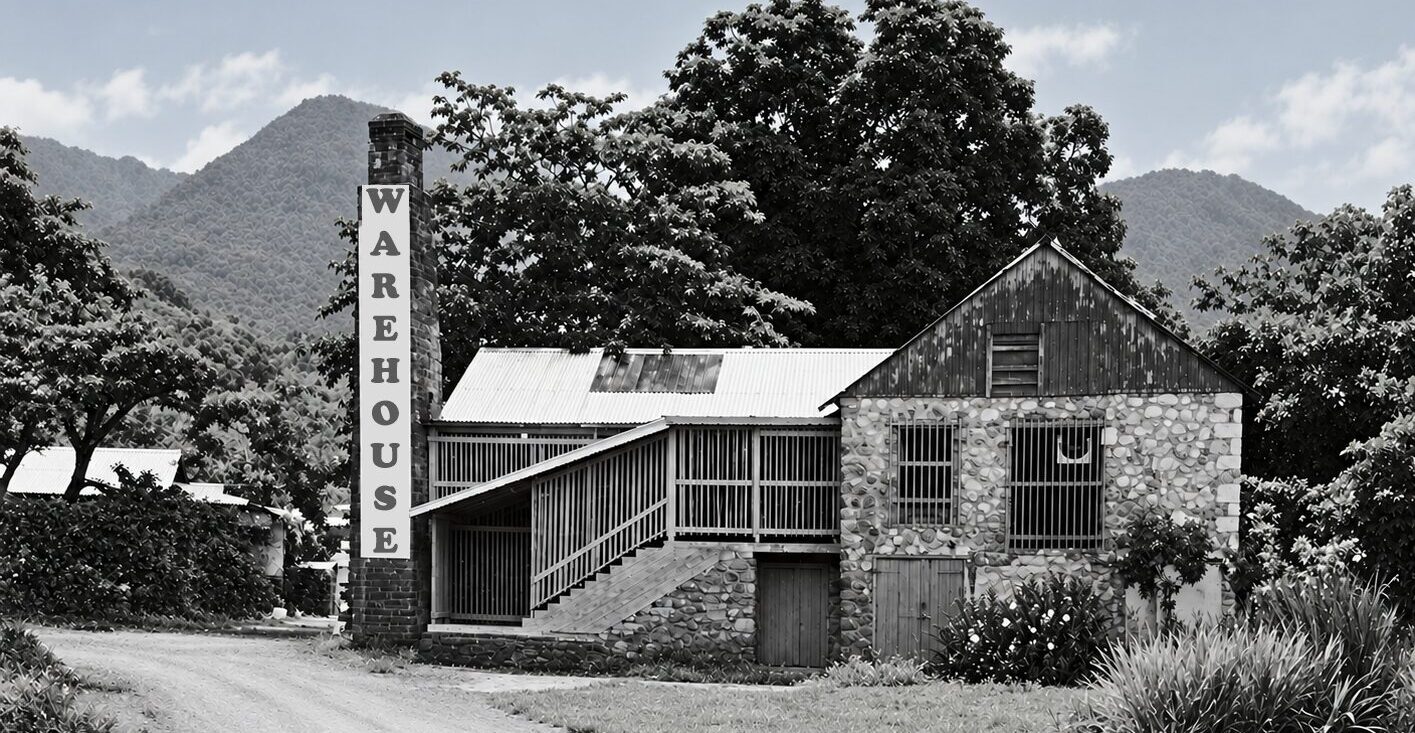
Nestled in the eastern Caribbean, the small island nation of Dominica carries a musical legacy unmatched by many larger places across the globe. For centuries, its people have woven rhythm into daily life, from traditional instrumentation like the goat-skin lapeau cabrit, accordion, flute and shack-shack to the homegrown genre of Cadence-Lypso, popularized by legendary local acts including Exile One, Grammacks, Black Affairs and Midnight Groovers. But one specific moment in the island’s cultural history stands out as a defining coming-of-age for a generation: the summer of 1981, when a repurposed old sugar mill along the coastal road to Massacre village, just a short drive from Canefield Airport, became the beating heart of Dominican disco culture: Warehouse Disco.
To understand the phenomenon of Warehouse Disco, one must start far earlier, in the middle-class living rooms of mid-century Dominica, where families gathered around gramophones and turntables like they once gathered around hearths. The cultural foundation was laid by Cee Bee’s Bookstore and Record Shop, a beloved Roseau institution located on the capital’s Cork Street, owned and operated by Hesketh Casimir. Casimir was far more than a shopkeeper: he was a lifelong musician, having led the iconic 1930s ensemble the Casimir Brothers Orchestra, and later served as musical director of the Music Lovers Government Band. His decades-long connection to Dominican music shaped every corner of his shop, which became far more than a retail outlet—it was a gateway to the world.
Casimir’s shelves held a stunningly eclectic mix that reflected his commitment to musical breadth: intricate Bach counterpoint sat next to Motown’s biggest hits, Beethoven’s thunderous symphonies alongside Johnny Cash’s country western, Tchaikovsky’s romantic overtures beside The Jackson Five’s latest chart-toppers. The shop carried the sharp, witty calypso of Trinidad’s Mighty Sparrow, the roots reggae of Jamaica, and the upbeat soca of Trinidad, giving Dominicans access to every corner of Caribbean sound. Beyond music, Cee Bee’s stocked international news magazines like *Time* and *Newsweek*, Black-focused publications like *Ebony* and *Jet*, and a wide selection of fiction, comic books and romance novels. In the deeply Catholic nation, adult publications like *Playboy* were kept discreetly in sealed plastic sleeves, a small, thoughtful compromise between cultural norms and the reality of a wider world.
For generations of Dominican young people, shopping at Cee Bee’s was a formative cultural education unlike any classroom curriculum. Families would carry home 45-RPM singles and full LP records like precious treasure, and a home with a quality turntable and curated collection carried significant social cachet. Children grew up bouncing seamlessly between Mozart and Bob Marley, Beethoven and Byron Lee, Tennessee waltzes and Sparrow’s sharp social commentary, absorbing a layered mix of local, regional and global culture without ever trying. By the time Warehouse Disco opened its doors, the music was already in the bones of the island’s young people, planted by Cee Bee’s and the community dances held at major holidays by popular local acts like Swing Stars, Belles Combo and De Boys and Dem.
Dominica’s disco scene predates Warehouse, of course. Earlier iconic venues like The Green Lantern, Manicou, Palm Grove, and Grotto— which remained popular right up to Dominican independence in 1978—paved the way, and Nite Box Disco, owned by future beloved Roseau figure Frederick “Juice Man” Joseph in Pottersville, gave the capital’s young people their first dedicated space for dancing under colored lights to amplified music. But Warehouse was different.
Its location, tucked in an old stone sugar mill steps from the moonlit Caribbean Sea, just far enough from the bustle of Roseau, combined with DJ Cleve Royer’s natural gift for curation, gave the venue an almost magical pull for young Dominicans coming of age in the early 1980s. Royer perched 12 feet above the dance floor in a wooden booth, headphones clamped to his ears, spinning tracks that would become the soundtrack of an entire generation. Visiting Warehouse was not just a night out—it was an event, a declaration of belonging to something bigger than oneself.
The crowd that gathered at Warehouse every Friday and Saturday night was the island’s golden generation: young people who had entered secondary school around 1972, children of parents who survived World War II and prioritized giving their kids a quality education. By 1981, they were young civil servants, university students returning home from schools in Miami, Halifax, Scotland and the University of the West Indies, full of new ideas and new sounds. Young men arrived in coveted Jordache jeans (a status symbol that signaled travel abroad or a thoughtful loved one overseas) paired with Italian leather zip-side boots, thin gold chains catching the disco lights. Young women wore their finest outfits, perfumed to cut through the tropical heat, ready to dance the night away. Young people from the northern port of Portsmouth would make the long, winding drive across the island’s forested, mountainous interior just to join the crowd—a testament to Warehouse’s singular magnetism.
Royer’s setlist was a musical kaleidoscope, a true meeting of global sounds filtered through Dominican identity that could only have existed in that specific moment and place. Michael Jackson’s 1979 breakthrough *Off the Wall* reigned supreme, with “Don’t Stop ’Til You Get Enough” and “Rock With You” pulling crowds to the floor with irresistible energy. Royer would seamlessly shift from disco queen Donna Summer’s hot, pulsing beats to Roberta Flack’s tender, aching slow jams, from the iconic guitar arpeggios of The Eagles’ *Hotel California* drifting out into the warm Caribbean night to the righteous rhythms of Bob Marley and the Wailers, Gregory Isaacs’ smooth lover’s rock, and the familiar wit of the Mighty Sparrow.
But the most electric moments of every night came when Royer reached for the sounds that belonged only to Dominica: homegrown Cadence-Lypso. Created by Gordon Henderson and Exile One, Cadence-Lypso fuses the rhythmic core of Caribbean cadence with the lyrical fire of calypso to create a sound that is irreducibly Dominican. When the iconic track “Moi Twavay Pour Ayen” boomed through the speakers, the entire dance floor shifted into a collective recognition, a homecoming. This was not music imported from New York or Europe—it came from the volcanic forested soil that every person in the room called home.
Jeff Joseph and Grammacks followed with “Soucouyant,” a playful, infectious track that draws on traditional Dominican folklore of the shapeshifting bloodsucking spirit, turning ancient storytelling into danceable rhythm. Chubby and the Midnight Groovers brought “Milk and Honey,” a sweet, nourishing track that feels like a benediction for the island’s abundance. Royer also celebrated the broader Francophone Creole Caribbean that Dominica belongs to, spinning compas hits from Haiti’s Tabou Combo and upbeat tracks from Guadeloupe’s Les Aiglons, tying together a shared cultural heritage across island nations.
Outside the old sugar mill, the island lay quiet under the moon: cool mountain breezes drifted down from the volcanic peaks, carrying the rich green scent of Dominica’s lush forests—so dense that Christopher Columbus reportedly told Spanish monarchs the island’s shape could be perfectly represented by crumpling a sheet of paper and dropping it on a table. The Caribbean stretched out silver and still under the moonlight, and the warm glow of bungalow lights dotted the coastline. Inside, dancers moved as one: lovers pressed close during slow songs, returning students brought new moves and fresh records to share, and travelers from across the island mixed equally with locals, no distinctions made on the dance floor. What emerged was a new, entirely unique cultural synthesis: not purely American, not purely Caribbean, but something that bore the stamp of Dominica’s unique place in the world, taking influence from everywhere and remaking it into something local and alive.
For a newly independent nation that had just survived back-to-back catastrophic hurricanes in 1979 and 1980, that joy was not frivolous—it was earned. The dance floor was a space to celebrate survival, to rebuild collective spirit after catastrophe, and to revel in the simple, profound joy of being young on a beautiful island, surrounded by peers. What had once been a sugar mill that profited from the enslavement of African people was reborn as a space of freedom, joy and collective belonging, its original purpose erased by the music and love of a new generation. For those golden hours every weekend, surrounded by the sound that had been planted in their souls by generations of Dominican musicians and cultural gatekeepers, there was nowhere else on earth any of them would rather have been.