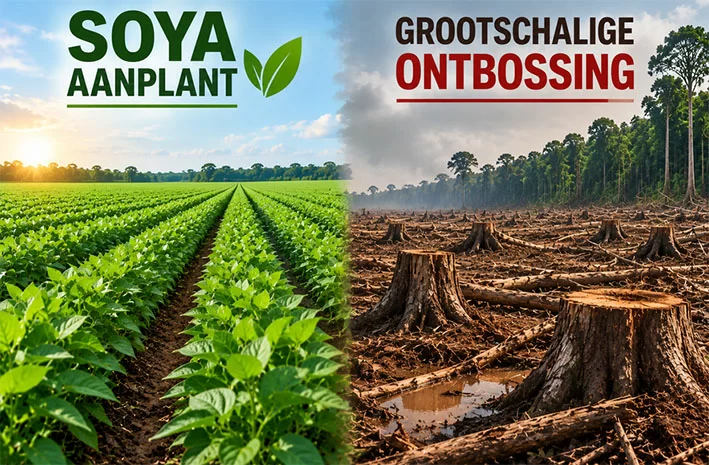
A proposed large-scale soy and corn production project led by Braganza Marketing Group in Suriname has sparked intense environmental scrutiny, after the company’s own strategic business document acknowledged the link between expanding global soy cultivation and widespread deforestation and biodiversity loss in other regions. The debate over ecological risks has gained new urgency as the agribusiness firm moves forward with plans to develop thousands of hectares of land and partners with Mennonite farmers to execute the initiative.
Braganza’s 2022-2031 business plan, finalized in May 2023, opens with an analysis of the global soy market and large-scale agricultural production hubs around the world. In the document, the company explicitly notes that rising international demand for soy – most of which is used for livestock feed – has driven the conversion of large swathes of the Brazilian Amazon rainforest into agricultural land, with devastating impacts on native forest ecosystems and global biodiversity. Despite this acknowledgment, the plan outlines major expansion of mechanized large-scale agriculture in Suriname, starting with thousands of hectares of cultivated land with plans for further incremental expansion.
In January 2026, Suriname’s Ministry of Agriculture, Livestock and Fisheries (LVV) entered into a public legal agreement with Braganza, granting the company conditional access to 9,366.72 hectares of state-owned land in the Para district for a 20-year term. The land is designated specifically for large-scale mechanized farming and related supporting activities, and the agreement requires Braganza to bring at least 10 percent of the total area into cultivation each year.
However, the deal does not give Braganza free rein to clear the entire concession. All development activities must comply with Suriname’s national environmental legislation, binding international commitments, and existing national agricultural policy frameworks. Additional specific permits are required for site preparation, land cultivation, and infrastructure construction.
Environmental concerns have become the central point of public debate around the project and the involvement of Mennonite farmers recruited by Braganza. LVV Minister Mike Noersalim has publicly stated that all mandatory environmental impact assessments must be completed and all required approvals secured before large-scale development can begin, adding that any clearing of primary forest is strictly prohibited under national regulation.
Braganza CEO Ruud Souverein told reporters the company has already submitted the scoping phase of its environmental impact report to the National Environmental Authority (NMA) and is currently awaiting regulatory feedback. Souverein claimed that preliminary surveys have found no primary forest within the project concession area, noting that most of the vegetation targeted for development is secondary forest. This claim has not yet been independently verified, leaving key questions unresolved: what is the official classification of vegetation and forest cover across the concession, how much land will ultimately be approved for clearing, and what binding environmental conditions will the NMA impose on the project?
Mennonite farmers recruited by Braganza have already established a presence in the Tibiti region. During a recent site visit by members of Suriname’s parliament, environmental activist Erlan Sleur, and journalists, observers confirmed that a portion of the concession area has already been cleared. Local reporting indicates that further clearing and development work is currently on hold pending regulatory review.
Braganza’s business plan itself acknowledges that most available agricultural land in Suriname requires major preparation before it can be brought into commercial cultivation, and it also identifies land rights issues as a key risk for the project. The public agreement between Braganza and the LVV requires the company to prioritize local community members for employment opportunities, support local services, and include local stakeholders in regional development planning. The deal also mandates the establishment of a $100,000 community development fund.
However, the official agreement document obtained by local outlet Starnieuws leaves critical details about the fund undefined: it does not specify which local community or communities are intended to benefit from the fund, who will manage its assets, or what formal rules will govern the distribution of funds for local projects. This lack of clarity has added to existing concerns from civil society groups that the project will prioritize corporate profit over environmental protection and the rights of local populations, who have lived in and relied on the region’s forest ecosystems for generations.