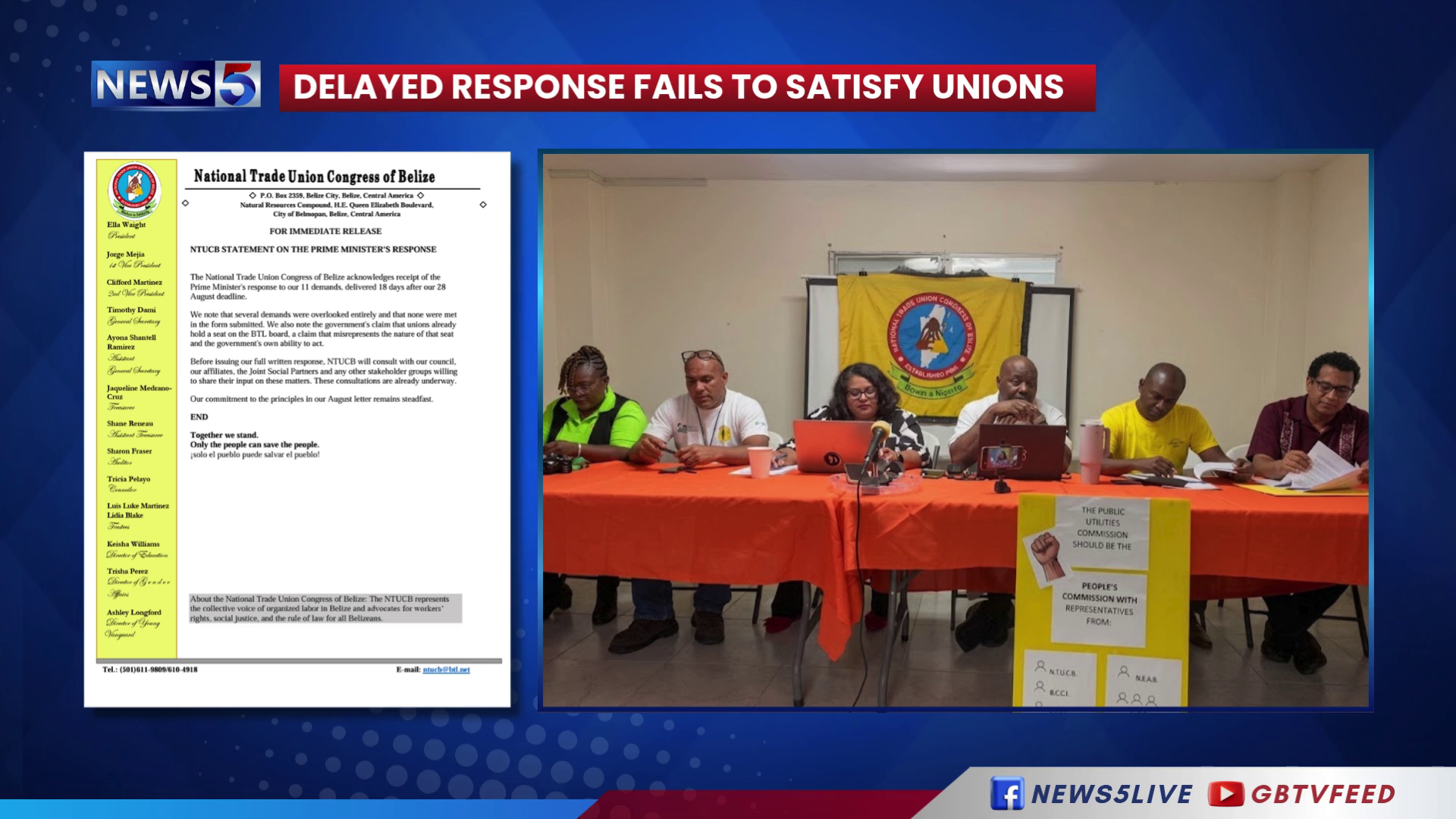
Nearly three weeks after organized labor in Belize issued a formal deadline for action on 11 core worker demands, the country’s prime minister has finally delivered a government response — and it has been flatly rejected as insufficient by the nation’s largest labor umbrella organization.
The National Trade Union Congress of Belize (NTUCB) confirmed that Prime Minister John Briceño’s official reply arrived 18 days after the union body’s August 28 deadline for addressing worker priorities. While the delay itself is a point of frustration, union leaders say the far more critical issue is the substance of the response: the government sidelined multiple of the 11 submitted demands, and failed to fully satisfy any of the proposals exactly as they were put forward.
One key point of contention is a claim from the Briceño administration that labor already holds a representative seat on the board of Belize Telecommunications Limited (BTL). The NTUCB pushed back against this assertion, arguing that the government’s statement misrepresents both the actual scope of the existing seat and the government’s own authority to resolve the union’s demand for formal, meaningful labor representation on the board.
In the coming days, the NTUCB will enter a period of consultation to build consensus on its next steps. The organization is currently holding discussions with its governing council, all affiliated local unions, the Joint Social Partners collaborative body, and other relevant stakeholder groups. Following these consultations, the NTUCB plans to release a full, detailed written response outlining its position and potential next actions.
For the moment, the union body has made its stance clear: it remains unwaveringly committed to the core principles laid out in its original August letter of demands. The outright rejection of the prime minister’s response signals that the ongoing standoff between Belize’s organized labor movement and the Briceño administration is far from reaching a resolution.
This report is adapted from a transcript of a televised evening news broadcast, with Kriol language quotes rendered using a standardized spelling system where applicable.