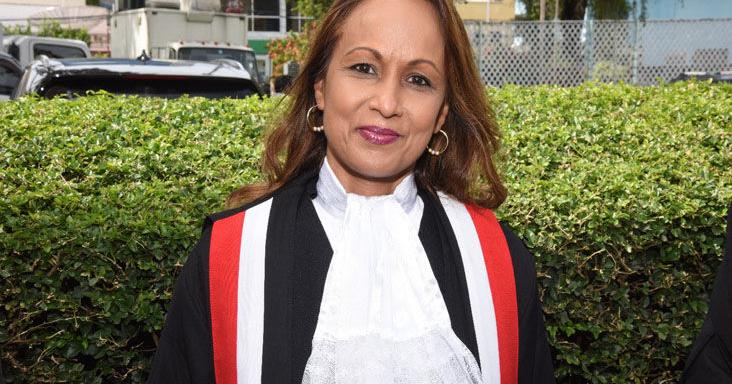
A years-long case of unlawful administrative action against a police officer has concluded with a landmark High Court ruling that vindicates the rights of public employees and reinforces constitutional safeguards against punitive action without due process. After more than four years of unpaid suspension that never resulted in criminal charges or formal disciplinary proceedings, Police Constable Miguel Jaikaran Singh has been granted more than $343,800 in compensatory damages by Justice Margaret Mohammed, who ruled that his extended suspension was illegal, unconstitutional, and had devolved into an unapproved penalty.
Singh was attached to the now-disbanded Special Operations Response Team (SORT) when he was placed on suspension effective January 13, 2022. The suspension was tied to an investigation into the 2021 in-custody deaths of Andrew Morris and Joel Balcon, two men arrested in connection with the high-profile kidnapping and murder of Andrea Bharatt. Court records show that Singh and other SORT officers were taken into custody and questioned over the deaths in April 2021, but Singh was released shortly after and never faced any criminal charges or formal disciplinary action connected to the case.
In her sweeping ruling, Justice Mohammed outlined multiple failures on the part of the Police Commissioner that rendered the suspension invalid from the start. First, the official suspension notice failed to meet the mandatory requirements of Regulation 152, as it provided Singh no clear details of the allegations against him. The judge noted that the evidence presented to the court contained no specification of the offense Singh was accused of committing, no rationale for the commissioner’s suspicion, and no justification for the suspension on grounds of public interest or protecting the reputation of the Police Service. “The claimant was suspended without being provided with any clear reasons for his suspension, which is unlawful,” Mohammed wrote in her judgment.
Beyond the flawed initial notice, the court found that the commissioner never conducted any regular review of Singh’s suspension over the entire four-year period. Legal frameworks for police suspensions outline that such a measure is only intended to be a temporary, interim step ahead of planned criminal or disciplinary proceedings, not a permanent status. The commissioner’s argument that an open investigation justified holding Singh on suspension indefinitely was rejected outright by the court.
Most critically, Justice Mohammed ruled that the extraordinary length of Singh’s suspension transformed a temporary administrative measure into a de facto punishment, which directly violates section 129(4) of the national Constitution. That constitutional provision explicitly states that no penalty may be imposed on a public servant outside of formal disciplinary proceedings. “The effect of the claimant’s suspension without the instituting of any disciplinary proceedings or the institution of any criminal charge for over four years has made the claimant’s suspension indefinite which has the effect of making it into a penalty,” the judgment explained.
While Singh continued to receive his base salary during the suspension, he was stripped of multiple work-related allowances. The court awarded him $263,802.56 to compensate for the lost allowances, which included commuted overtime, plain clothing, and meal benefits. An additional $80,000 was granted to cover non-pecuniary harm: Singh documented significant mental distress, public embarrassment, and professional humiliation stemming from the four-year limbo of his unproven suspension.
Justice Mohammed ultimately quashed the Police Commissioner’s December 29, 2021 suspension decision, declaring the entire measure illegal, null, void, and without legal effect. She also ordered the commissioner to cover all of Singh’s legal costs incurred throughout the case. Singh was represented by attorneys Gerald Ramdeen and Dayadai Harripaul, while the commissioner was represented by a legal team including Jinai Chong Sing, Janique Mitchell, Rachel Wright, and Justay Guerra.