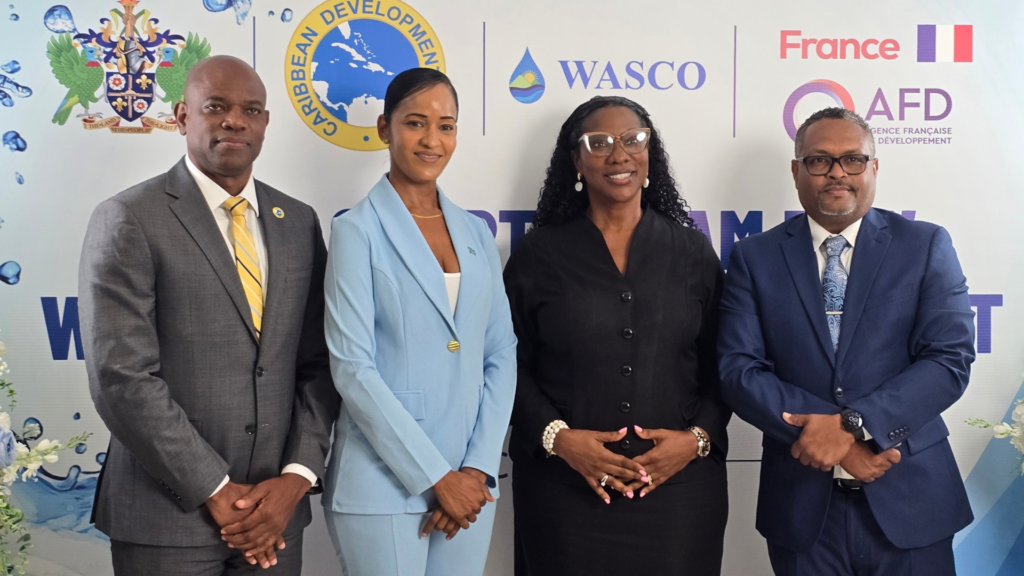
For years, persistent water supply disruptions have been a major headache for communities across Saint Lucia, but a landmark infrastructure project launched this week is set to finally address this long-running public service crisis.
Officials and development partners gathered at Rodney Bay’s Harbor Club on Thursday to mark the official launch of the John Compton Dam Raw Water Pipeline Replacement Project, a multi-million-dollar initiative that will swap out 5 kilometres of aging, leak-prone water infrastructure for modern, climate-resilient piping. The route of the new pipeline follows the same corridor as the existing line: starting at the John Compton Dam, cutting through the Millet and Vanard communities, and terminating at the Theobalds Treatment Plant, which is already undergoing separate upgrade works.
The existing infrastructure that will be replaced has been in operation for 40 years, serving thousands of customers across Castries and the northern half of the island — a region that accounts for 58 percent of all customers serviced by the Water and Sewerage Company (WASCO). For decades, the deteriorating pipes have caused widespread problems: an average of 30 emergency repairs are required every year, and leaks have led to a staggering 50 percent water loss across the route, driving chronic service interruptions for local households and businesses.
Charlin Louisy-Regis, Chief Economist at Saint Lucia’s Ministry of Economic Development and Youth Economy, explained that the project will deliver cascading benefits beyond just fixing leaks. “The replacement of the raw water pipeline is expected to reduce the high rate of leakage and reduce pipeline failures,” she said, noting that the upgrade will cut down on the need for constant, disruptive maintenance and put an end to the repeated outages that have plagued local communities for generations.
Funding for the transformative project comes from a collaborative partnership between regional and international development institutions, totaling $22.8 million in total investment. WASCO Chief Executive Officer Zilta George-Leslie confirmed that the bulk of financing comes from the Caribbean Development Bank (CDB), with additional joint contributions from the governments of France and Italy. Cavon White, Portfolio Manager in CDB’s Economic Infrastructure Division, broke down the funding structure in detail: CDB is providing a $15.7 million loan alongside ongoing technical guidance and project oversight, while France’s Agence Française de Développement is contributing a $5 million credit facility. The government of Italy is contributing 2 million euros (equivalent to approximately EC$6.2 million) through its regional program supporting sustainable development across CARICOM member states.
White emphasized that this blended financing model delivers major benefits for Saint Lucia. “This blend of resources ensures that Saint Lucia benefits from competitive rates, competitive financial terms, long maturities, and concessional support for climate-resilient infrastructure,” he said.
Construction is scheduled to get underway in the first half of 2027, with a targeted completion date of June 2030. George-Leslie noted that the new pipeline will be built with expanded capacity to meet future water demand, but acknowledged that construction activity will cause noticeable disruption for residents in Millet and Vanard. She confirmed that the project team will implement traffic management measures, and pre-scheduled temporary water outages will be communicated to affected communities well in advance, with ongoing engagement throughout the build.
Crucially, government officials have moved to reassure residents that service will be maintained as much as possible during construction. Minister Shanda Lee Harracksingh, from the Office of the Prime Minister, explained that the new pipeline will be constructed alongside the existing operating line, allowing water services to continue running for most residents throughout the build process.
The launch of this major project is part of a broader island-wide push to upgrade Saint Lucia’s water infrastructure. Multiple smaller and medium-sized upgrade initiatives are already underway, including the Northern Pipeline Rehabilitation Project connecting Bonneterre and Gros Islet. Officials are also prioritizing expanding water storage capacity and improving rainwater harvesting capabilities across the country, as part of long-term efforts to build a more reliable and climate-resilient water supply for all Saint Lucians.