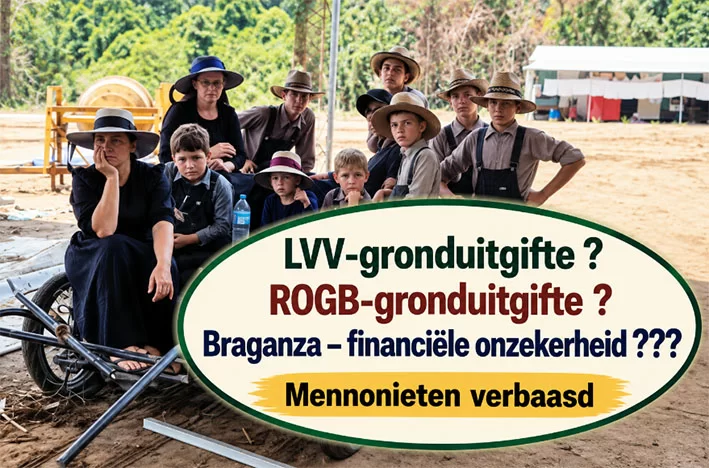
In January 2026, Suriname’s Ministry of Agriculture, Livestock and Fisheries (LVV) awarded a conditional 20-year lease for nearly 9,400 hectares of state-owned land in the Para region to Braganza Marketing Group, clearing the way for the firm to develop a large-scale commercial agricultural project on the site. A portion of the already deforested land is currently being worked on by Mennonite farmers recruited by Braganza to move to Suriname for the initiative. But newly public documents from the project’s founding raise serious questions about whether Braganza ever proved it had the financial capacity to meet the strict development requirements tied to the lease agreement. The project was approved in large part based on Braganza’s 10-year business plan covering 2022 to 2031, whose final version was published in May 2023. In that document, the company itself explicitly acknowledged that its financial standing and cash flow were major weaknesses at the time the plan was drafted, noting its overall financial position remained uncertain when the proposal was submitted for government review. It remains unclear whether Braganza has addressed these financial vulnerabilities and shored up its capital position between the publication of the business plan and the January 2026 approval of the land lease. According to Braganza’s own accounting, all early operations up to the approval date were funded by its founding partners, and the company had not yet finalized key funding streams including first-revenue generation, external bank lending, outside investor commitments, government subsidies, and additional state support. At the same time, the business plan notes that there was strong interest from international investors looking to deploy direct capital into Suriname’s agricultural sector, with planned investments covering row crop production, cattle rearing, and dairy processing. Braganza outlined its overarching funding strategy in the plan around two core pillars: equity contributions from existing shareholders and commercial bank lending. What remains unconfirmed to date is what level of financial due diligence LVV conducted on Braganza prior to the ministry’s January 13, 2026 decision to hand over such a large tract of public land for 20 years of commercial development. The terms of the lease agreement impose significant mandatory development requirements on Braganza: the firm must bring a minimum of 10% of the total 9,366.72 hectares under active cultivation every year, which equals roughly 937 hectares of new development annually. The company’s own business plan actually called for a far faster rollout of development than the lease’s minimum requirements. Braganza initially projected that it would have 5,000 hectares in active production after its first full year of operations, targeting annual output of 11,250 tons of soybeans and 25,000 tons of corn. It aimed to have 10,000 hectares in production by the end of the fifth year of the project. Achieving that aggressive timeline requires massive upfront investment in land preparation, agricultural machinery, road and utility infrastructure, on-site storage, processing facilities, and transport logistics. Beyond financial questions, Braganza itself openly acknowledges in its business plan that Suriname currently lacks the full supporting infrastructure needed to sustain large-scale commercial soy and corn production. The document notes that large volumes of required production inputs are either entirely unavailable or only available in insufficient quantities within the country, meaning many key raw materials would need to be imported to keep the project running. The lease agreement grants LVV full authority to conduct regular inspections, ongoing monitoring, and periodic evaluations of the project’s progress. It also explicitly states that the lease will automatically terminate if Braganza fails to meet its mandatory annual cultivation requirements. However, based on all publicly available documents related to the approval, there is no public record of what financial guarantees Braganza submitted to LVV when the lease was signed in January, nor any confirmation that the ministry completed a formal pre-approval verification to confirm the company held enough capital to actually meet its mandatory development obligations over the course of the lease.
Braganza kreeg duizenden hectares terwijl bedrijfsplan financiële onzekerheid vermeldt