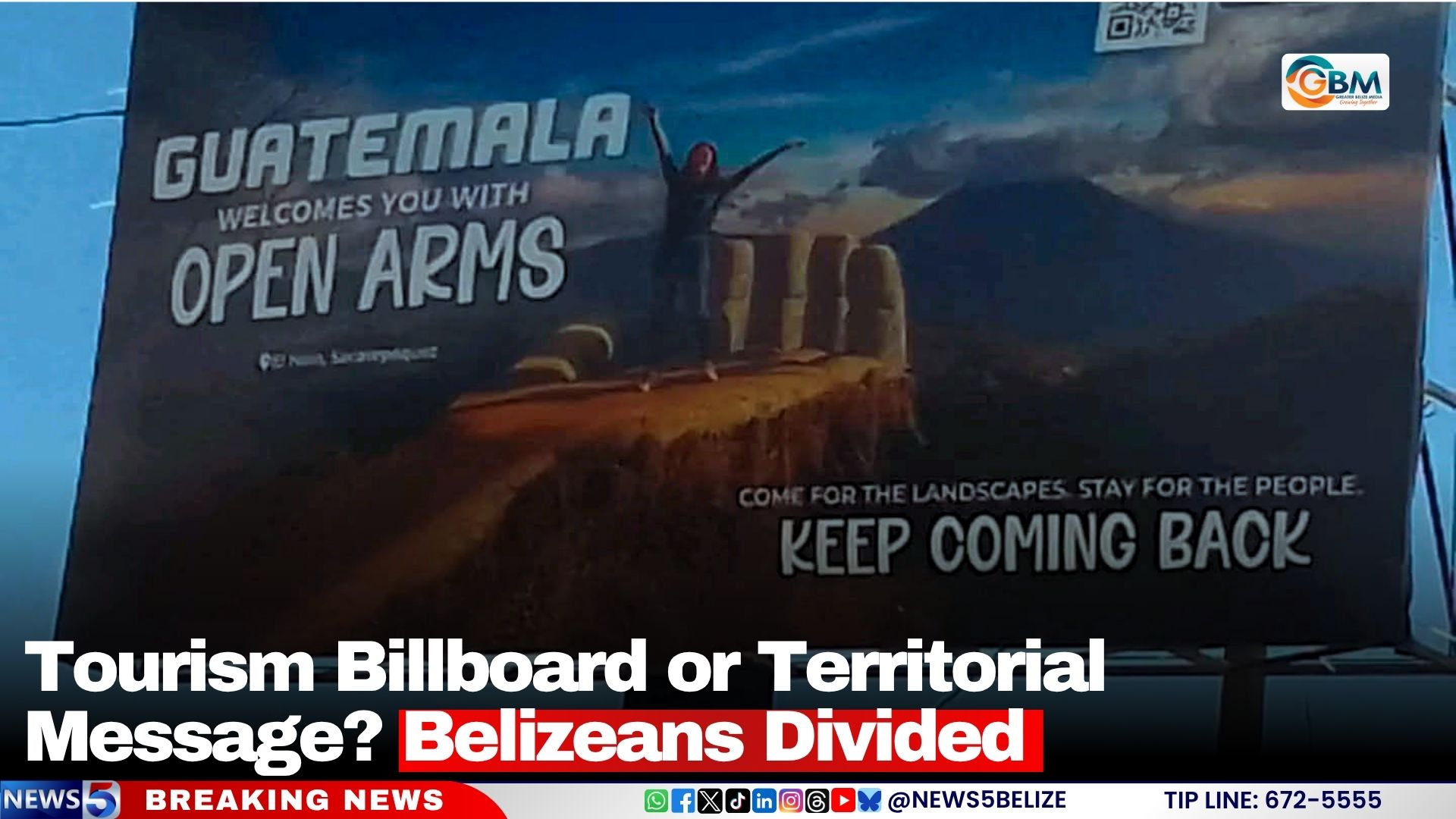
As Belize prepares to mark its 45th Independence Day, a new advertising campaign across the nation’s largest city, Belize City, has ignited fierce public division, tapping into long-simmering tensions over a decades-old territorial dispute between Belize and neighboring Guatemala.
The campaign, placed by Guatemalan tourism interests, features billboards emblazoned with a warm-sounding invitation: “Guatemala Welcomes You with Open Arms. Come for the landscapes, stay for the people, keep coming back.” Accompanying the text is imagery of rugged mountain terrain that critics are quick to note is not characteristic of Belize’s own geography, stoking immediate suspicion over the campaign’s true intent.
The timing and placement of the advertisements have landed like a bombshell in public discourse, coming as national pride reaches an annual peak ahead of the September 21 independence celebration. Online, many Belizeans have voiced fierce condemnation, framing the billboards as a deliberate incursion into Belizean sovereignty. Critics argue the presence of a Guatemalan tourism campaign on Belizean soil, paired with non-Belizean scenery, carries an unspoken territorial claim that cannot be ignored. “It’s an insult! Hattieville is in Guatemala now,” one Belizean wrote sarcastically online, while another labeled the campaign “a wrong message, a wrong gesture.”
This public anger does not reflect a universal view, however. A significant contingent of Belizeans has pushed back against the outrage, arguing the billboards are nothing more than a straightforward effort at cross-border tourism marketing. Proponents of this interpretation note that thousands of Belizeans cross the border into Guatemala annually for shopping, affordable medical care, and educational opportunities, while many international tourists who travel to Belize also extend their trips to include nearby Guatemalan destinations like Tikal or Antigua. From this perspective, the advertisements are simply targeting travelers already in the region who may be interested in adding a Guatemalan stop to their itinerary.
Top political leaders in Belize have also split along similar lines, deepening the national debate. Prime Minister John Briceño, head of the current ruling government, has aligned with the tourism marketing interpretation, though he acknowledged that the campaign’s current wording and imagery carry an unnecessary risk of misinterpretation. “I think it’s a bit misleading,” Briceño told reporters Tuesday. “I think it’s more from a touristical aspect. Maybe the billboard owners should ask them to, if they could reword it to remove that kind of fear or phobia.” The prime minister was firm in reaffirming Belizean sovereignty, adding clearly, “Belize would never be a part of Guatemala.”
For Opposition Leader Tracy Panton, however, there is no innocent explanation for the campaign. Panton has labeled the billboard initiative a deliberate “political provocation” and argued that the government must respond to it as such, rejecting any framing that reduces the issue to simple tourism marketing.
The controversy arrives at a sensitive moment for the two Central American nations, whose decades-long territorial dispute is currently ongoing before the International Court of Justice (ICJ) in The Hague. Guatemala has long claimed more than half of Belize’s current territory, a dispute that has lingered since the colonial era and only recently moved to the ICJ for a binding resolution. For many Belizeans, the billboard campaign is not just a marketing misstep, but a reminder of the ongoing threat to their nation’s territorial integrity, turning a routine advertisement into a flashpoint for national conversation just days ahead of one of the country’s most important national holidays.